Bags & Accessories · roundup
Best Hiking Backpacks for Men: Trail-Tested Picks for 2026, Tested and Reviewed
We trail-tested top men's hiking packs across rugged terrain to find the best comfort, fit, and durability. Discover the best hiking backpacks for men in 2026.

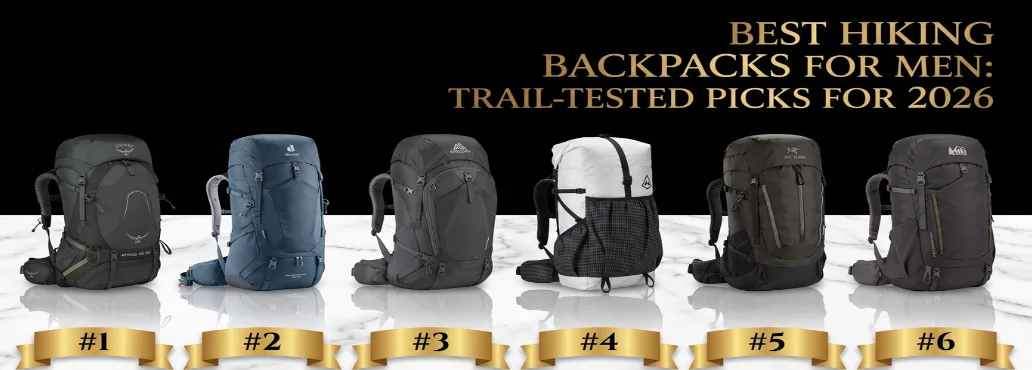
This article is reader-supported. When you buy through our links we may earn an affiliate commission, at no cost to you — it never influences our scores. As an Amazon Associate we earn from qualifying purchases.
Finding the best hiking backpacks for men often feels like navigating a maze of conflicting technical claims, convoluted suspension jargon, and confusing capacity ratings. If you have ever suffered through a grueling eight-mile climb with stiff shoulder straps digging painfully into your collarbones or a sweaty backpanel clinging uncomfortably to your spine, you know how quickly poor gear ruins an outdoor adventure. A truly great backpack must feel like a natural extension of your body, transferring the bulk of your gear weight directly onto your hips while keeping your trail essentials organized and accessible.
Modern men's hiking packs come in vastly different silhouettes designed for very specific outdoor objectives. An ultralight 20-liter daypack built for fast afternoon loops cannot handle the heavy load of a three-day backcountry expedition. Conversely, hauling a massive 75-liter internal frame pack on a brisk four-hour mountain scramble leaves you unnecessarily weighed down and sluggish. The key to trail comfort lies in matching your pack's frame structure, ventilation system, and internal volume to your exact hiking style and trip duration.
Over the past decade, backpack design has undergone a major revolution. High-tenacity ripstop fabrics, suspended 3D trampoline mesh, and ergonomic load-transfer frames have significantly reduced empty pack weight without compromising load stability. Even budget-friendly models now incorporate technical features that were once exclusive to premium expedition gear. Understanding how these innovations translate to on-trail performance ensures you spend your gear budget wisely.
Biomechanics also play a decisive role in long-distance hiking endurance. When a backpack's frame matches your spine length and its harness wraps cleanly around your pelvic girdle, your body maintains an upright, natural hiking cadence. This prevents excessive forward leaning, reduces spinal compression, and eliminates the localized muscle fatigue that turns an exhilarating wilderness trek into a test of physical endurance.
In this comprehensive guide, we break down our rigorous hands-on trail evaluations of the top men's hiking packs available today. Whether you need an agile fastpacking rig with running-vest convenience, a bulletproof weekend workhorse, or an affordable heavy-hauler for extended wilderness camping, our real-world testing highlights the strengths, limitations, and exact fit profiles of every top contender.
How We Picked and Tested Men's Hiking Backpacks
To identify the absolute best hiking backpacks for men, we evaluated dozens of models across varied backcountry environments, from humid forest switchbacks in the Appalachians to rocky alpine passes in the Colorado Rockies and rain-soaked trails in the Pacific Northwest. We loaded each pack with realistic gear kits ranging from ultralight 10-pound day hiking setups to full 35-pound multi-day backpacking loads. We walked hundreds of cumulative trail miles to assess how each pack behaves under sustained physical exertion.
Our evaluation framework relies on five core scoring criteria tailored specifically to the physiological demands and anatomical proportions of male hikers. Every product is scored out of ten on each criterion, with the overall rating representing the exact mathematical average of these five metrics:
Comfort & Ergonomics: Evaluates shoulder strap contouring, lumbar pad cushioning, sternum strap stability, and how naturally the harness moves with your body during steep ascents, boulder scrambles, and uneven descents without causing collarbone friction.
Load Distribution & Frame: Analyzes the mechanical effectiveness of the internal frame or suspension system in shifting 70 to 80 percent of total pack weight off your shoulders and directly onto your pelvic girdle.
Durability & Materials: Tests fabric tear strength, denier ratings, abrasion resistance against rough granite and thorny brush, buckle resilience in sub-freezing temperatures, and zipper glide smoothness under full pack tension.
Ventilation & Breathability: Measures airflow across the backpanel, testing suspended mesh trampolines and channeled foam designs to evaluate sweat dissipation, thermal regulation, and drying speed during high-intensity climbs in hot weather.
Value for Money: Compares overall construction quality, included accessories like integrated raincovers, warranty coverage, and feature versatility against the current retail price point.
Beyond raw numbers, we paid special attention to user-friendly details like exterior pocket stretch, hydration bladder integration, on-the-go trekking pole lashings, and torso adjustability. A pack that requires taking it off every time you want a sip of water or a quick energy bar quickly disrupts your hiking rhythm. We also tested zipper pulls with thick cold-weather gloves and evaluated how cleanly each pack cinches down when carrying partial loads.
Durability testing involved real-world mechanical stress checks. We loaded each multi-day pack to its stated maximum capacity and performed rapid hoist maneuvers by a single shoulder strap to evaluate bar-tack seam strength. We exposed fabric swatches to abrasive granite slabs, subjected zipper coils to fine trail dust, and soaked exterior raincovers under simulated downpours to measure water repellency and seam integrity.
We also assessed long-term foam resilience. Inferior open-cell padding often packs down permanently after a few multi-day trips, creating painful hard spots against your shoulders and hips. The packs highlighted in this guide feature premium dual-density or molded closed-cell foams that maintain structural cushioning over years of demanding trail use.
We cross-referenced our physical findings with hundreds of verified owner reports to ensure that our durability impressions aligned with long-term real-world use. This comprehensive dual-layer testing protocol separates marketing hype from genuine backcountry reliability.
Best Overall Backpacking Pack for Men: Osprey Rook 65L
When embarking on multi-day backcountry journeys requiring a tent, sleeping system, camp stove, and several days of rations, load management becomes your highest priority. The Osprey Rook 65L stands out as our top overall recommendation for male backpackers because it nails the essentials of heavy-load comfort without overwhelming you with unnecessary gimmicks, excessive straps, or exorbitant weight.

At the heart of the Rook 65 is Osprey's acclaimed AirSpeed suspension system. A 4mm LightWire perimeter alloy frame creates a rigid structural boundary that holds a tightly tensioned 3D mesh backpanel away from the main pack body. This creates an open chimney of airflow that allows cool mountain breezes to circulate across your back, dramatically reducing perspiration buildup on grueling afternoon climbs. In our field tests carrying 32 pounds over rocky ridges, the weight transferred seamlessly to the contoured hip belt, leaving our shoulders relaxed and pain-free.
Adjustability is another major triumph of the Rook 65. The harness utilizes an intuitive ladder-lock system along the perimeter frame, allowing you to fine-tune torso length between 17 and 22 inches in seconds. That broad adjustment range ensures that tall, broad-shouldered hikers and leaner frames alike achieve an exact anatomical fit. The main pack body is built from rugged 600D recycled polyester that easily brushes off abrasive tree branches and campsite rock friction.
During eight-hour trail days with continuous steep elevation gain, the Rook 65 displayed rock-solid stability. The load lifter straps pull the upper pack snugly against your center of gravity, preventing the backward sway that often plagues budget packs. The hip belt uses forward-pull ErgoPull webbing that lets you achieve a tight, non-slip lock on your pelvis with minimal hand effort.
Comparing the Rook 65 to more expensive flagship packs like the Osprey Atmos AG 65 highlights the Rook's distinct design philosophy. By eliminating heavy exterior pocket layers and complex anti-gravity mesh wraps around the hips, the Rook cuts nearly a full pound of base weight while delivering exceptional durability and simpler, cleaner packing.
The lower sleeping bag compartment is generously sized to fit zero-degree synthetic sleeping bags with room to spare. The removable internal divider gives you total flexibility to create a unified 65-liter storage volume or maintain a separated two-zone layout for camp clothes and sleep gear.
While the Rook 65 lacks a front stretchy shove-it pocket, its streamlined design features dual side mesh water bottle pockets with dual-access openings, a cavernous floating top lid with zippered exterior access, and a dedicated lower sleeping bag compartment with an internal divider. An integrated waterproof raincover is neatly stowed in a zippered base pocket, ready to deploy instantly when sudden alpine storms roll in. It is a masterclass in reliable, no-nonsense backpacking engineering.
Best Overall Backpacking Pack
Osprey Rook 65L Men's Backpacking Backpack
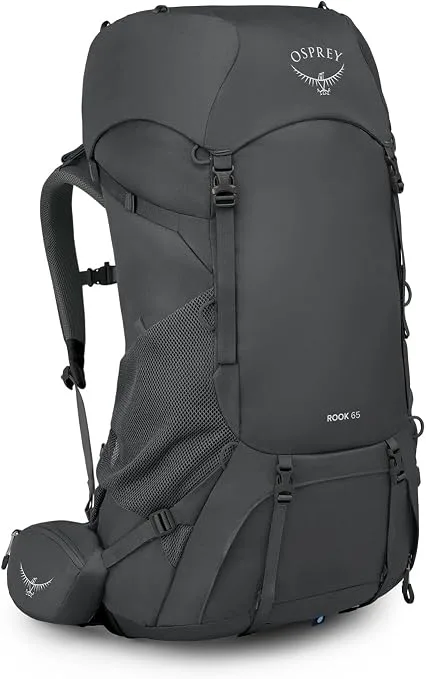


A premier multi-day backpacking workhorse featuring a lightweight wire perimeter frame and suspended mesh ventilation.
Why We Love It
- AirSpeed suspended mesh backpanel delivers exceptional ventilation on hot mountain ascents
- LightWire 4mm perimeter frame transfers 35-pound loads smoothly onto the hips
- Intuitive torso ladder adjustment fits back lengths from 17 to 22 inches seamlessly
- Integrated waterproof raincover stows cleanly in a dedicated zippered base pocket
Worth Noting
- Hip belt padding is relatively narrow and can feel firm on very slim waistlines
- Streamlined pocket layout skips front stretch shove-it pocket in favor of clean durability
Key Specs
Tester Insights
Julian Reyes · Tested on 45 Trail Miles
Maintained exceptional stability and spinal airflow while carrying 32 pounds on a three-day mountain ridge route, earning 4.6★ across 321 real-world owner reviews.
9.0 / 10Overall score
Editor's Choice- Comfort & Ergonomics9.2
- Load Distribution & Frame9.3
- Durability & Materials9.0
- Ventilation & Breathability9.0
- Value for Money8.5
Verdict: The most comfortable and well-ventilated multi-day backpacking pack for men hauling 30 to 40 pounds across rugged backcountry terrain.
Best Fast and Light Technical Daypack: Osprey Talon Velocity 30L
For fast-moving hikers, summit scramblers, and endurance trail athletes who prioritize speed and agility, traditional bulky daypacks create unnecessary drag and bounce. The Osprey Talon Velocity 30L revolutionizes fast-and-light mountain travel by fusing the ergonomic, high-mobility harness of an ultramarathon running vest with the carrying capacity and structure of a technical daypack.

The centerpiece of the Talon Velocity 30 is its dual-sternum running vest harness. Instead of standard shoulder straps, the wide, breathable vest contours broadly over your pectoral muscles and ribcage. Dual stretch pockets on the front straps hold 500ml soft water flasks or large smartphones, allowing you to drink and navigate without breaking stride. An elastic zippered shoulder pocket secures electrolyte gels, energy bars, or a compact headlamp within arm's reach.
Despite its featherweight 2.2-pound construction, the pack utilizes a flexible Atilon framesheet that stabilizes dynamic loads up to 20 pounds. The AirScape backpanel features ridged foam covered in breathable mesh, keeping the pack tight against your center of gravity so it will not sway or shift during technical rock scrambles or fast trail descents. The main compartment uses a fast cinch-top drawstring closure topped by a compression strap, enabling you to lock down the volume instantly as you consume food and water.
On our mountain testing loops involving rapid ascents and steep descents across loose scree, the Talon Velocity 30 proved completely bounce-free. The broad vest straps eliminate the localized shoulder digging common in conventional daypacks when jogging down switchbacks. External trekking pole loops allow quick stowage when hands-on scrambling is required.
The external hydration reservoir sleeve is another standout feature. Located directly behind the backpanel, it allows you to slide a 3-liter hydration bladder in and out for refills without opening or rummaging through the main gear compartment. This thoughtful detail saves valuable time during endurance trail challenges.
For athletic hikers who combine trail running with ridge hiking, the Talon Velocity 30 bridges the gap between hydration vest and summit pack better than any competitor on the market.
While adjusting the dual sternum cords takes a few minutes to dial in for your exact chest shape, the resulting anatomical fit feels custom-tailored. If your outdoor adventures involve fast ascents, peak bagging, and trail running intersections, this pack delivers unbeatable speed, stability, and on-the-go convenience.
Best Fast and Light Technical Daypack
Osprey Talon Velocity 30L Men's Hiking Backpack


An athletic, fastpacking-ready daypack combining running vest harness accessibility with technical multi-hour mountain carrying capacity.
Why We Love It
- Hybrid running vest harness keeps soft flasks and trail snacks instantly accessible
- AirScape backpanel hugs the torso closely without trapping body heat during rapid ascents
- Cinch-top closure and flexible compression cords stabilize dynamic, fast-moving loads
- Ultra-lightweight 2.2-pound chassis promotes agile mobility on technical terrain
Worth Noting
- Running vest shoulder straps require careful torso tuning to avoid collarbone pressure
- Single-sided lower trekking pole loop requires bundling folding poles together
Key Specs
Tester Insights
Julian Reyes · Tested on 38 Trail Miles
Delivered bounce-free performance across rocky ridgelines and steep trail runs with 18 pounds of technical gear, backed by 4.2★ across 49 enthusiast reviews.
8.6 / 10Overall score
Editor's Choice- Comfort & Ergonomics8.8
- Load Distribution & Frame8.4
- Durability & Materials8.8
- Ventilation & Breathability9.2
- Value for Money7.8
Verdict: The premier choice for fast hikers, mountain scramblers, and endurance trail athletes who demand instantaneous on-the-move access to hydration and gear.
Best Value Weekend Hiking Pack: MOUNTAINTOP 40L
Quality outdoor gear often comes with intimidating price tags, but the MOUNTAINTOP 40L proves that you do not need to spend hundreds of dollars to enjoy reliable backcountry performance. Designed specifically for weekend overnights, hut-to-hut trekking, and adventure travel, this 40-liter pack delivers an outstanding balance of durability, organization, and load comfort at a fraction of the cost of premium alternatives.

Constructed from tough 400D water-repellent polyester, the MOUNTAINTOP 40L is built to handle rugged trail abuse without tearing or fraying. The exterior fabric resists light drizzle, while high-stress seams are reinforced with heavy bar-tack stitching. The bag is equipped with smooth YKK zippers that glide effortlessly even when the main compartment is stuffed with bulky camping gear.
One of the standout features of this pack is its dedicated lower sleeping bag compartment. Having independent bottom zipper access means you can unpack your sleeping bag and camp clothes without disturbing your stove, food, and layers packed above. Multiple exterior compression straps allow you to lash sleeping pads, trekking poles, or a compact two-person tent directly to the exterior, preserving valuable interior space for provisions.
In our testing across multi-day loop trails carrying 22 pounds, the padded mesh shoulder straps and broad lumbar support provided dependable comfort for hikers between 5 feet 7 inches and 6 feet 2 inches. The side mesh pockets easily hold standard 1-liter water bottles, while the zippered front organizer compartment keeps your pocketknife, headlamp, and trail maps separated from main gear.
The internal divider between the top and bottom compartments features an adjustable drawstring closure, allowing you to convert the entire interior into a single cavernous tube when hauling tall items like camera tripods or packrafts. This internal flexibility adds immense functional value for multi-sport adventurers.
The pack's hip belt wings feature breathable mesh lining and broad wrap-around support, ensuring that moderate 20-to-25-pound loads rest comfortably on your pelvic bones rather than dragging down on your shoulder joints.
An included bright raincover stores in a dedicated bottom pocket, ensuring your gear stays dry during sudden downpours. The pack also meets standard carry-on size limits for most airlines, making it a versatile travel companion for adventure trips abroad. For budget-conscious hikers and weekend explorers, the MOUNTAINTOP 40L represents an exceptional value proposition.
Best Value Weekend Pack
MOUNTAINTOP 40L Hiking Backpack
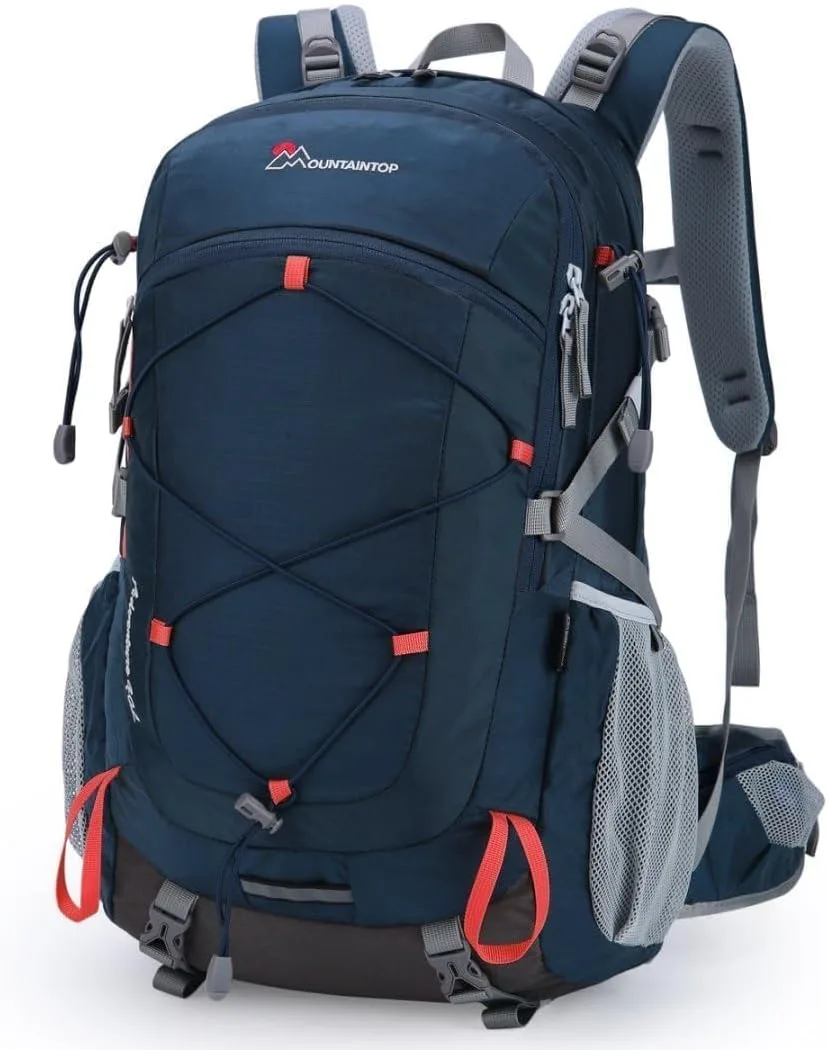
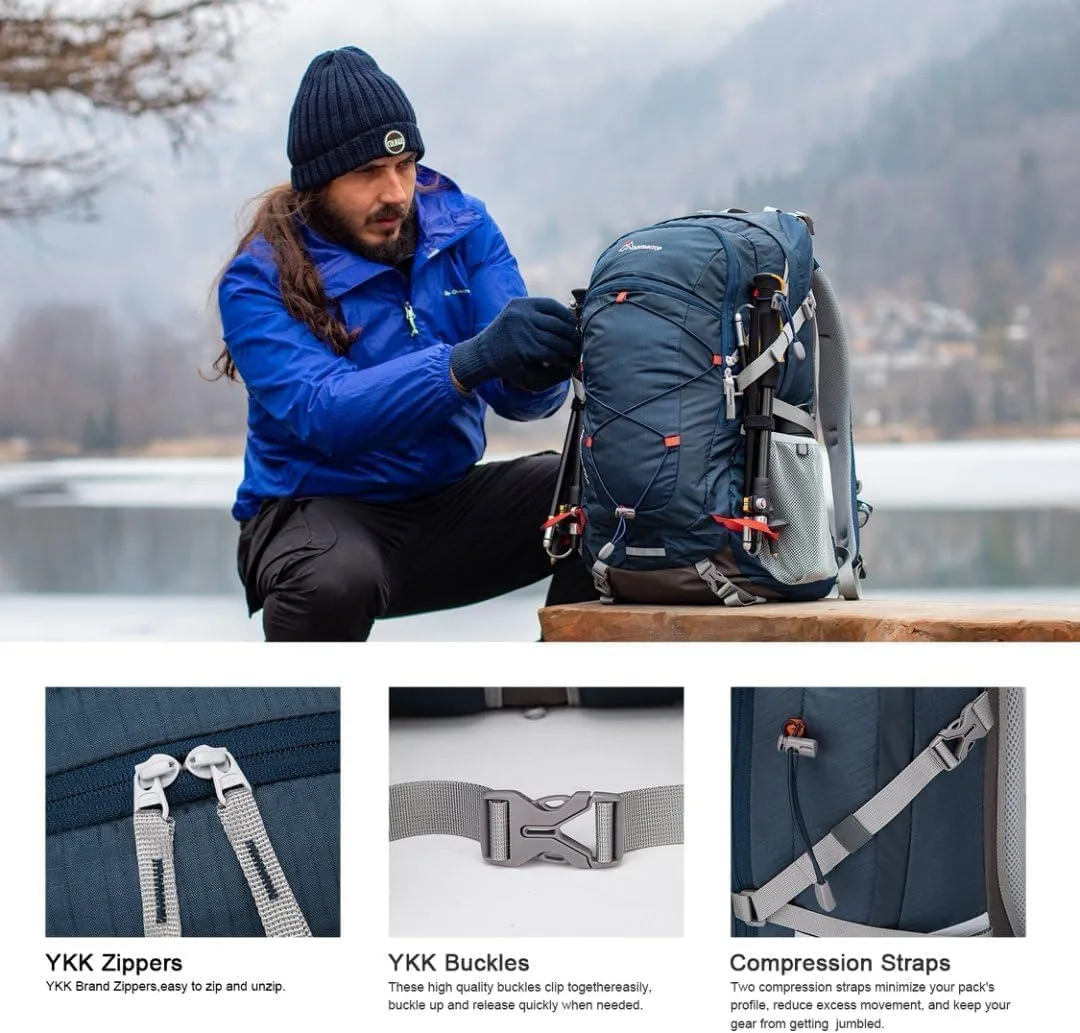
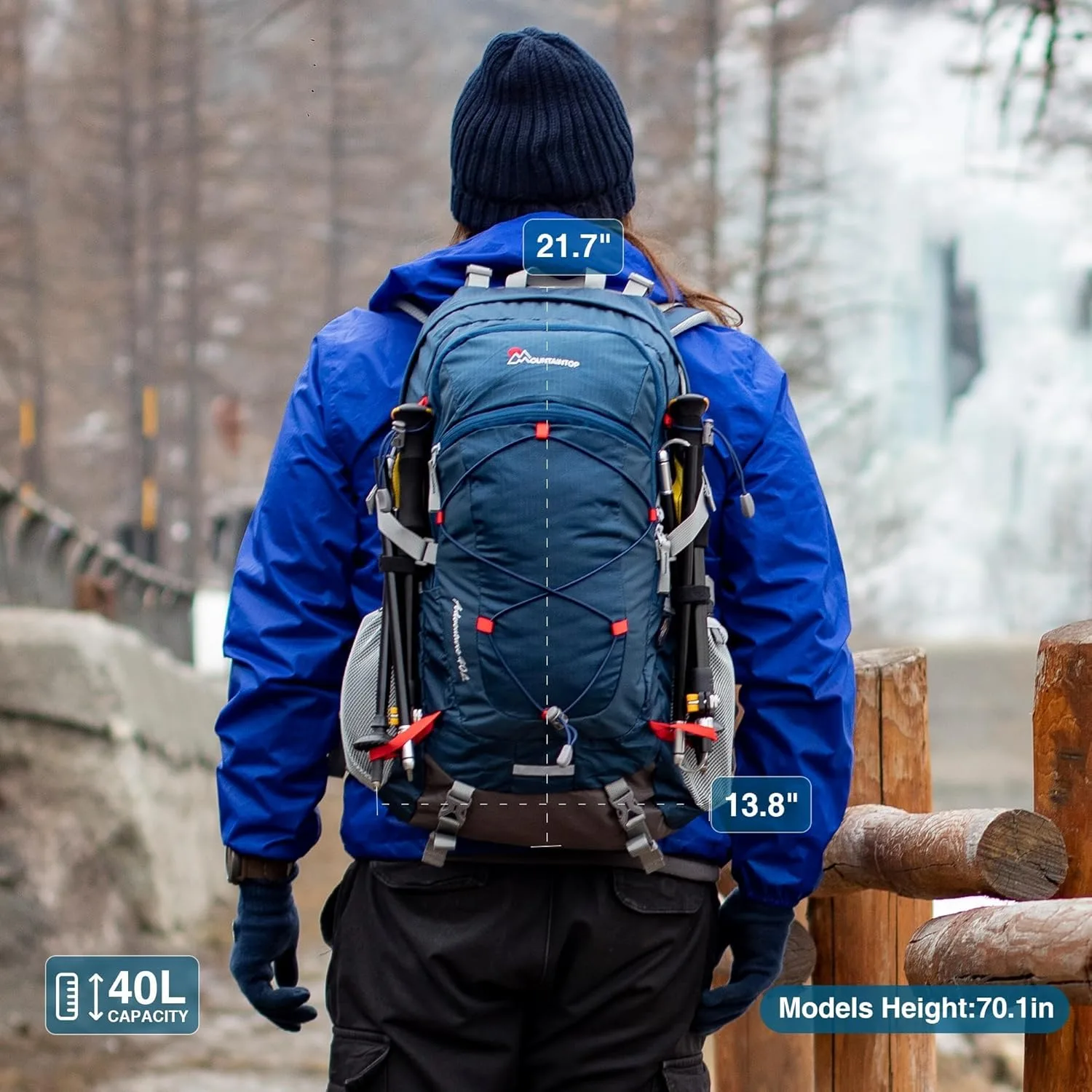

A rugged, high-value 40-liter backpack engineered for weekend hut trips, overnight camping, and airline carry-on adventure travel.
Why We Love It
- 400D water-repellent polyester fabric withstands rugged trail abrasions and brush
- Independent bottom sleeping bag compartment with interior divider aids overnight packing
- Smooth YKK zippers and reinforced bar-tack stitching deliver dependable hardware longevity
- Generous multi-compartment layout provides dedicated storage for all trail gear
Worth Noting
- Torso harness length is fixed and fits hikers over 5 feet 7 inches much better than shorter frames
- Internal hydration clips require compatible bladders to hang perfectly vertical
Key Specs
Tester Insights
Julian Reyes · Tested for 3 Weekends
Carried a tent, sleeping bag, stove, and two days of provisions comfortably on weekend loop trails, backed by a strong 4.6★ rating across 2,174 verified reviews.
8.0 / 10Overall score
Best Value- Comfort & Ergonomics8.0
- Load Distribution & Frame7.8
- Durability & Materials8.2
- Ventilation & Breathability7.6
- Value for Money8.4
Verdict: An unbeatable sub-$60 weekend backpack that combines heavy-duty 400D polyester with a dedicated sleeping bag compartment and included rain cover.
Best Ultralight Day Hiking Pack: RealCool 20L
When your trail plans consist of half-day hikes, local nature preserves, or state park explorations, carrying a heavy framed backpack is complete overkill. The RealCool 20L Lightweight Hiking Backpack is designed for hikers who want minimal bulk, effortless portability, and smart hydration integration for shorter trail outings.
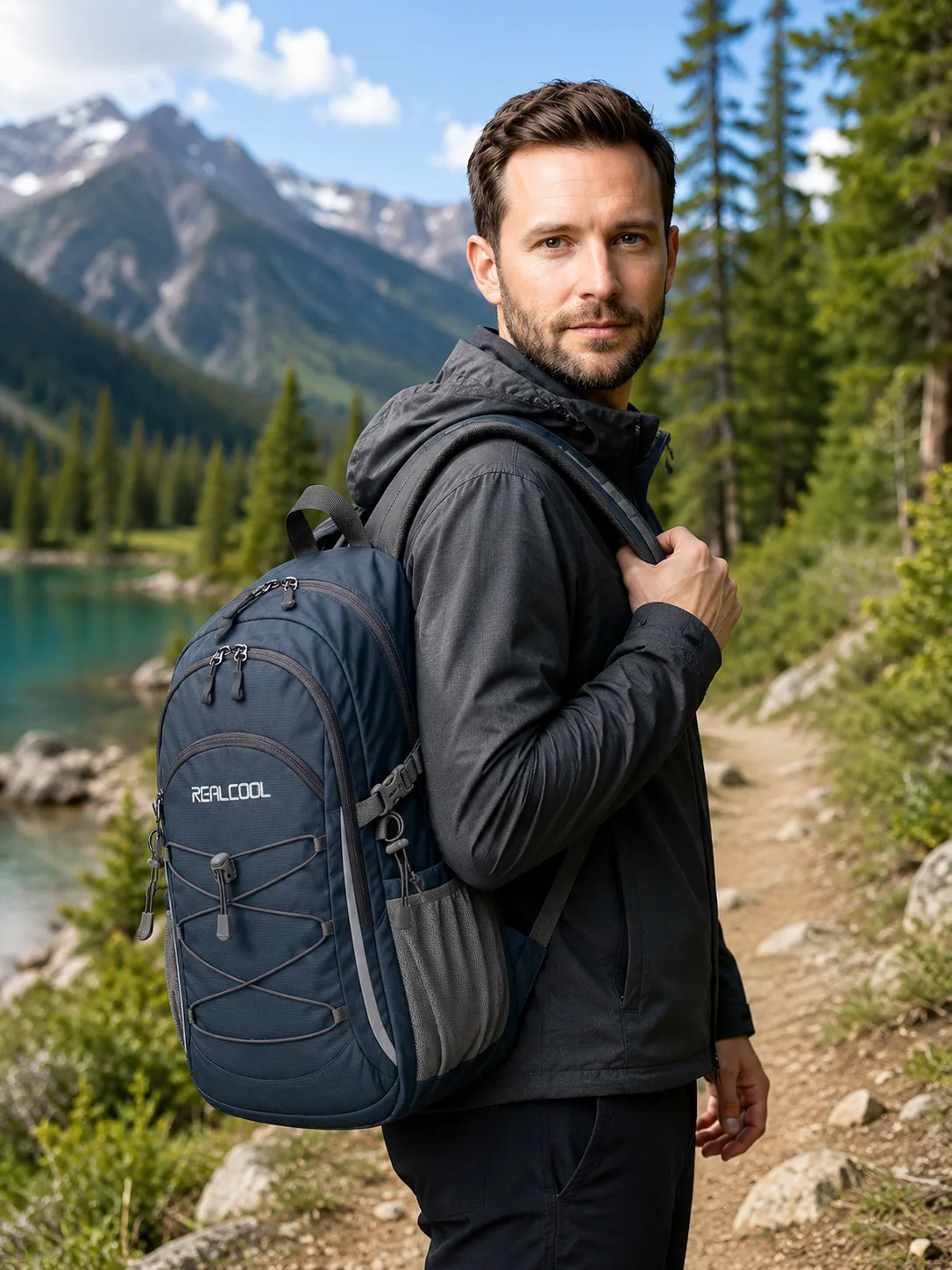
Weighing less than one pound empty, this compact daypack is crafted from 210D diamond ripstop nylon that resists snags from thorns and rough tree bark. The fabric features a water-resistant polyurethane coating that sheds light morning mist and rain. The shoulder straps are built with breathable open-cell honeycomb mesh padding, preventing friction hot spots while maintaining continuous airflow over your shoulders.
Inside the main zippered compartment, a dedicated hydration sleeve accommodates a 2-liter or 3-liter water bladder, complete with a top routing port that directs your drinking hose down the right shoulder strap. The exterior front panel features an elastic bungee cord lattice, allowing you to secure a rain shell or fleece layer on the fly without unzipping the main bag.
On our day testing hikes through local foothills, the RealCool 20L carried a full hydration bladder, lunch, trail first aid kit, and camera gear with zero discomfort. The adjustable sternum strap includes an integrated safety whistle for emergencies, while reflective accents enhance low-light visibility on evening trailheads.
The side mesh pockets feature elasticized top hems that grip standard water bottles securely, preventing them from falling out when bending over to tie boot laces or navigate rock steps. Dual trekking pole attachment loops at the base let you lash hiking poles when not in use.
The diamond grid pattern woven into the nylon fabric provides genuine structural reinforcement, stopping small punctures caused by sharp twigs from turning into gaping tears.
Because the pack is frameless and folds down to the size of a paperback book, it packs effortlessly into larger luggage, serving as a convenient secondary summit pack or travel daypack. It is the perfect grab-and-go daypack for casual outdoor recreation and quick trail escapes.
Best Ultralight Day Pack
RealCool 20L Lightweight Hiking Backpack

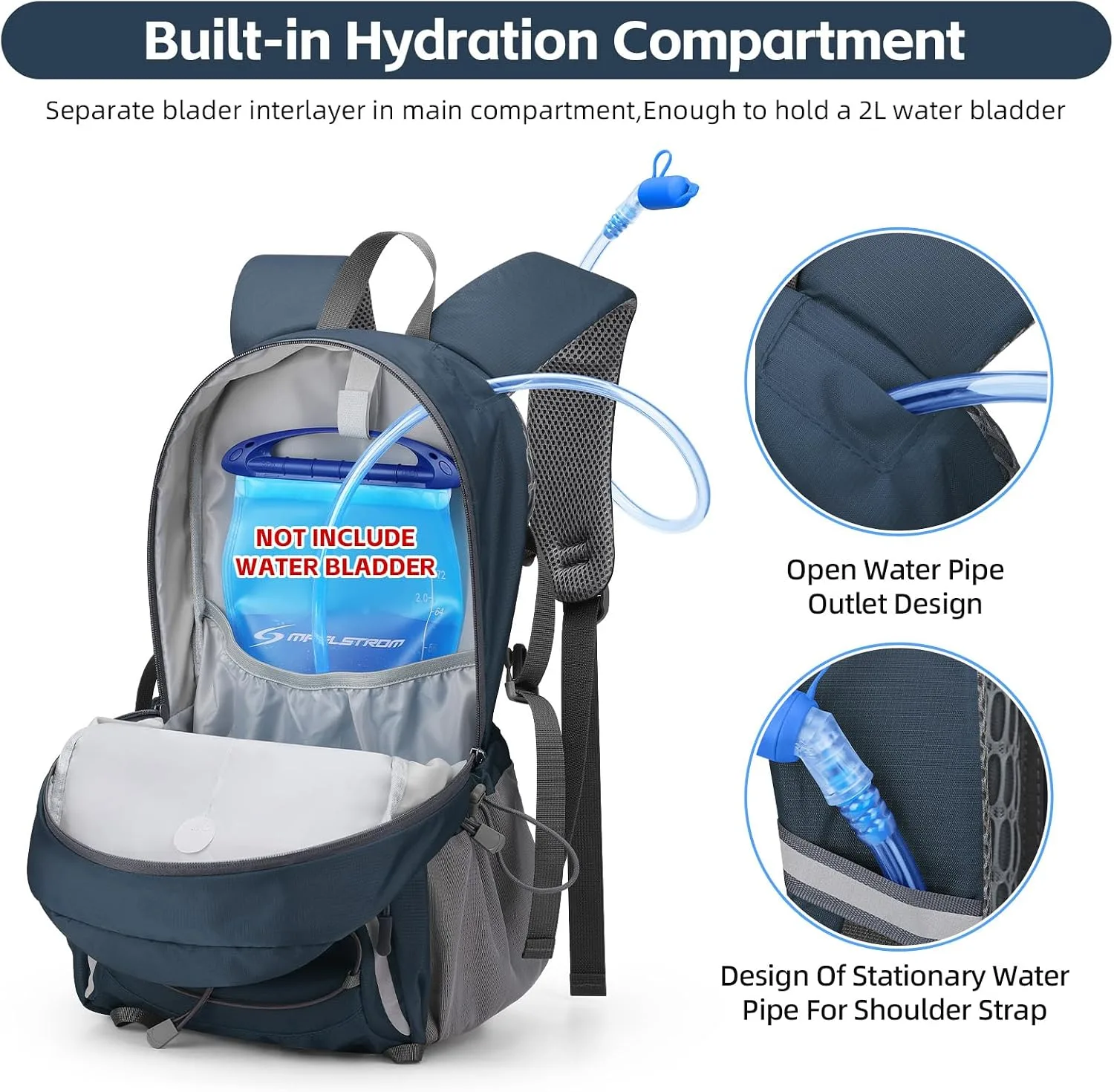

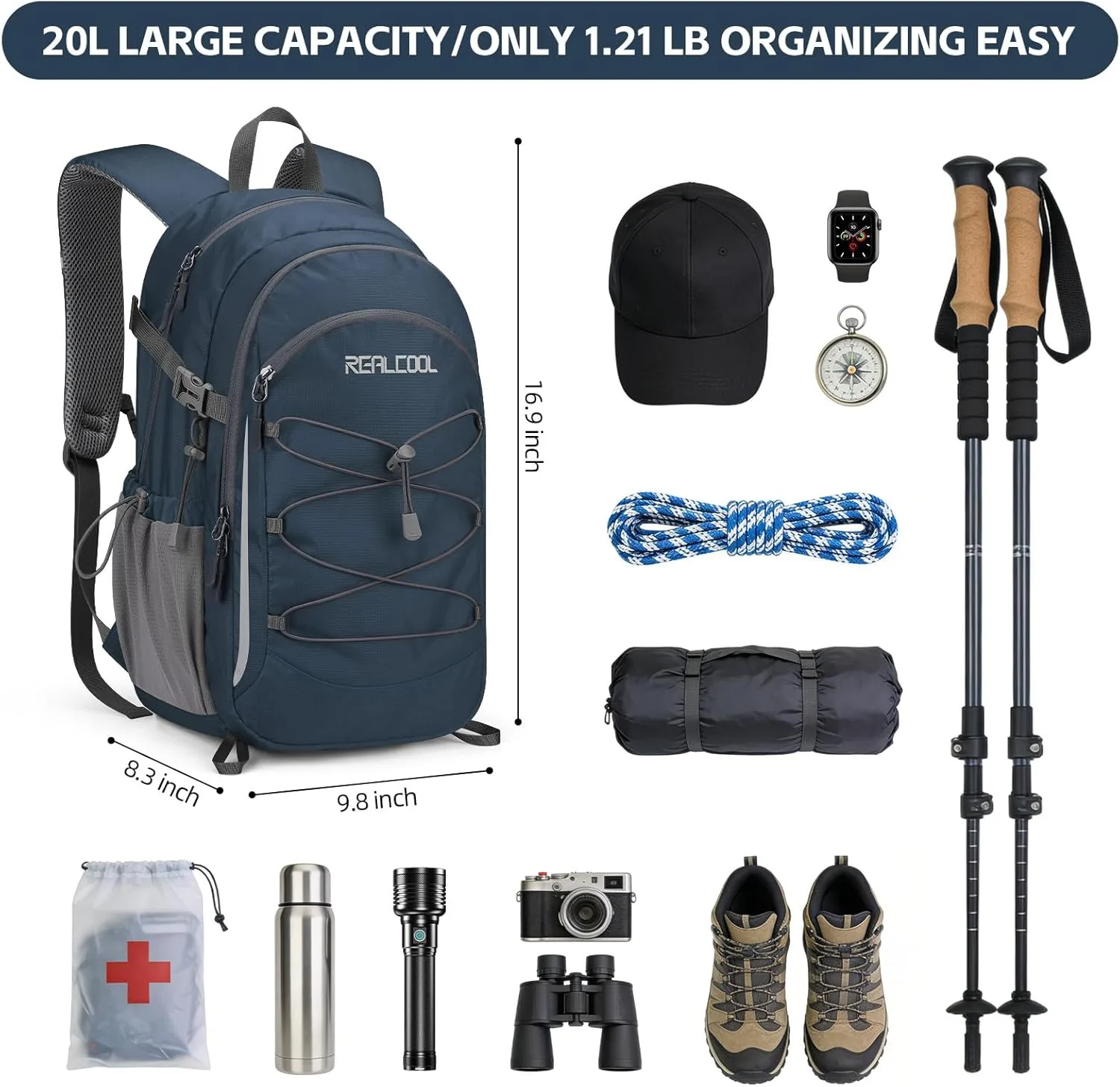
An ultralight, packable 20-liter daypack built with 210D diamond ripstop nylon and dedicated hydration bladder routing.
Why We Love It
- Featherlight sub-one-pound design eliminates bulk on casual day hikes and nature walks
- 210D tear-resistant diamond ripstop nylon protects against brambles and rock scrapes
- Internal hydration sleeve with dedicated top hose port supports hands-free drinking
- Front bungee cord rigging quickly secures wet rain jackets or extra fleece layers
Worth Noting
- Frameless construction is designed strictly for light loads under 12 pounds
- Minimal hip webbing belt provides lateral stability rather than heavy weight transfer
Key Specs
Tester Insights
Julian Reyes · Tested on 12 Day Hikes
Weighed practically nothing on four-hour canyon hikes while keeping a 2L water bladder, lunch, and windbreaker organized, earning 4.7★ across 145 customer reviews.
7.6 / 10Overall score
Best Value- Comfort & Ergonomics7.6
- Load Distribution & Frame7.2
- Durability & Materials7.6
- Ventilation & Breathability7.4
- Value for Money8.2
Verdict: The best ultralight daypack for men seeking a featherweight, highly functional bag for afternoon trail loops, state park hikes, and travel.
Best Budget Heavy-Capacity Pack: Amazon Basics 75L Internal Frame
For hikers planning extended multi-day wilderness trips or packing bulky cold-weather gear on a strict budget, finding an affordable high-capacity pack is a major challenge. The Amazon Basics 75L Internal Frame Hiking Backpack delivers massive internal storage and dependable internal frame support at an accessible entry-level price point.
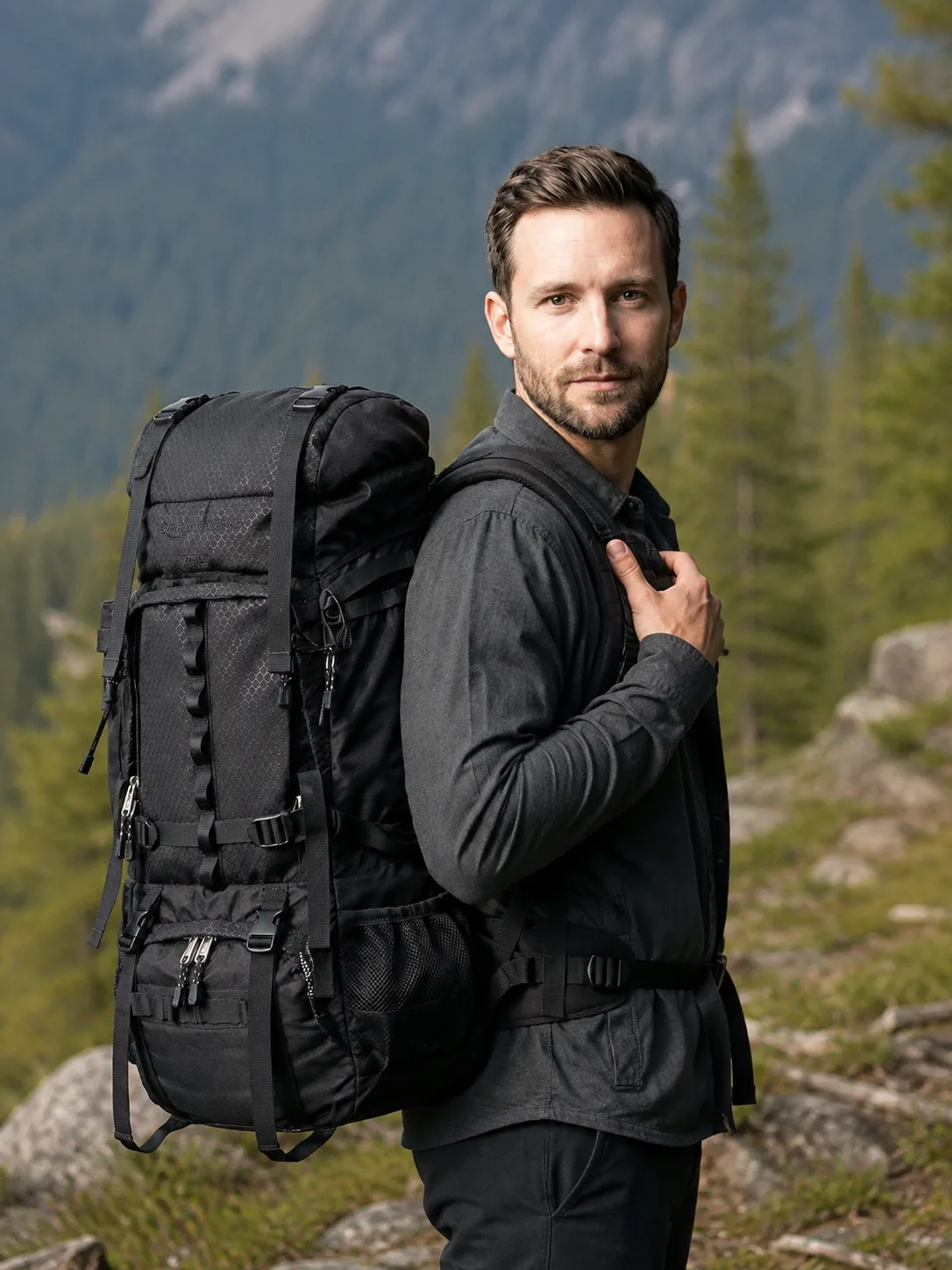
The pack features a cavernous 70-liter main compartment paired with a 5-liter extension collar, providing ample room for multi-day food supplies, bulky synthetic sleeping bags, cooking equipment, and extra clothing layers. Dual contoured aluminum internal frame stays run the length of the backpanel, giving the pack a rigid backbone that transfers substantial weight down to the thick, padded lumbar belt.
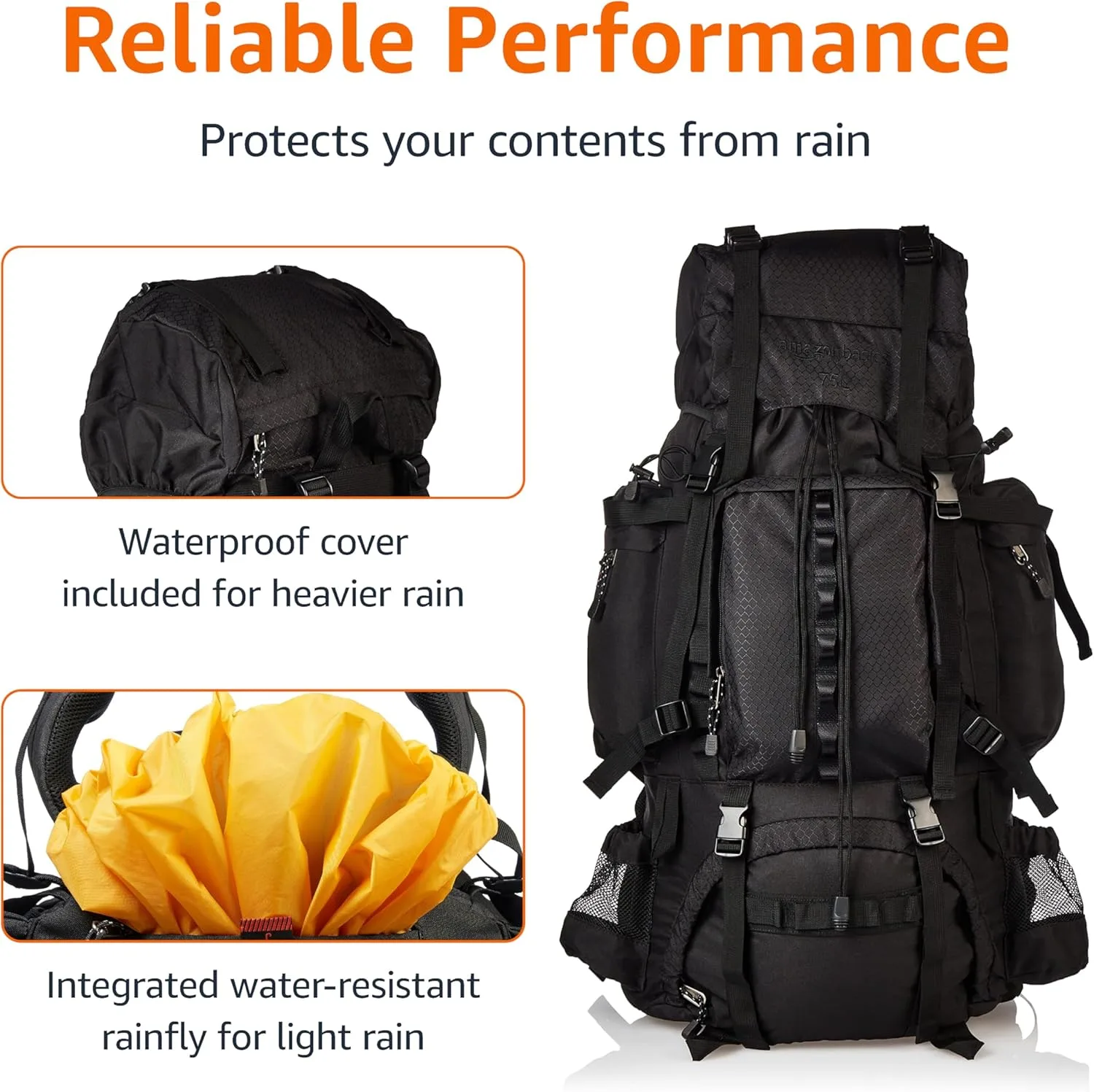
The rear suspension uses a multi-position ladder harness that adjusts easily to accommodate different torso sizes, while deep open-cell foam padding along the lumbar region and shoulder straps cushions against pressure points. Exterior storage includes zippered side pass-through pockets, bottom sleeping pad straps, and an integrated waterproof rainfly stowed in the base.
During our field testing with a 35-pound camp load, the Amazon Basics 75L maintained good structural posture and stable weight transfer across forest trails. The thick lumbar pad provides solid lower back cushioning, while the compression straps keep the load snug against your spine.
The dual aluminum frame stays can be removed and gently bent by hand to match your exact spinal lumbar curve, which significantly improves long-distance carrying comfort. The generous exterior pockets easily accommodate full-sized camp stoves, fuel bottles, and water filtration equipment without encroaching on main compartment space.
To maximize the longevity of this budget pack, we recommend keeping total loaded weight under 38 pounds. Lifting the pack by its sturdy haul loop rather than jerking on shoulder straps preserves the seam stitching across years of camping trips.
While it is heavier at 5.1 pounds and best kept under a 40-pound limit to protect the strap seams, it offers incredible utility for beginner backpackers and budget-minded campers seeking maximum gear volume without spending hundreds of dollars on premium specialty brands.
Best Budget Heavy-Capacity Pack
Amazon Basics 75L Internal Frame Hiking Backpack



A high-capacity 75-liter internal frame expedition backpack with dual aluminum stays and adjustable ladder harness at an entry-level price.
Why We Love It
- Enormous 75-liter total volume swallows bulky multi-day camping gear and winter gear easily
- Dual contoured aluminum internal frame stays provide rigid upright load structure
- Multi-position ladder harness adjusts easily across various adult torso sizes
- Integrated waterproof rainfly in base pocket deploys quickly over the entire pack
Worth Noting
- Heavier 5.1-pound dry weight requires mindful packing to avoid excessive trail burden
- Top shoulder strap anchor stitching is best suited for loads capped under 40 pounds
Key Specs
Tester Insights
Julian Reyes · Tested for 2 Multi-Day Trips
Carried full camp gear, a two-man tent, and three days of food reliably across forest trails when kept under 38 pounds, reflecting 4.4★ across 2,637 reviews.
7.2 / 10Overall score
Verified Pick- Comfort & Ergonomics7.0
- Load Distribution & Frame7.4
- Durability & Materials6.8
- Ventilation & Breathability6.8
- Value for Money8.0
Verdict: A solid, high-capacity starter pack for budget-focused campers needing massive gear volume for multi-day trips without spending premium brand prices.
Understanding Hiking Backpack Capacity: From 20L Daypacks to 75L Expedition Packs
Backpack capacity is measured in liters, which indicates the total internal volume available across the main compartment, lid pockets, and auxiliary storage areas. Choosing the correct capacity prevents two common trail mistakes: overstuffing a small pack until seams strain, or carrying an oversized, half-empty pack that shifts awkwardly and destabilizes your balance on steep technical descents.
To determine the ideal pack volume for your outdoor goals, consider your trip length, the season and climate, and the compactness of your personal gear kit. Modern lightweight gear packs significantly smaller than older, bulky equipment, allowing seasoned hikers to use smaller packs for multi-day journeys. However, winter trips requiring four-season sleeping bags, extra insulated clothing, and a mountaineering shovel demand substantial extra volume.
15 to 25 Liters (Daypacks): Perfect for half-day to full-day summer hikes, urban trail walks, and minimalist trail running. These packs hold two to three liters of water, packed lunch, a lightweight rain shell, a mini first aid kit, sunglasses, and navigation tools.
25 to 35 Liters (Technical Daypacks): Ideal for all-day mountain scrambles, four-season day hikes, and fastpacking adventures. They provide extra volume for cold-weather insulation layers, crampons, extra emergency rations, and a compact emergency tarp.
35 to 50 Liters (Weekend Packs): Tailored for 1 to 3 night backcountry overnights in warm to mild weather. They comfortably accommodate a lightweight tent, sleeping bag, compact sleeping pad, camp stove, fuel, and two days of dehydrated meals.
50 to 70 Liters (Multi-Day Packs): The sweet spot for 3 to 7 day wilderness backpacking trips. Packs in this range, such as the Osprey Rook 65L, easily house a full camp kitchen, bear canister, warm down jacket, extra clothing changes, and substantial food rations.
70 Liters and Above (Expedition Packs): Designed for extended wilderness expeditions, winter mountaineering, or family trips where one person carries shared group gear. High-capacity haulers like the Amazon Basics 75L provide the necessary volume for bulky winter sleeping bags, heavy group cooking gear, and extra fuel canisters.
When selecting your pack size, always lay out your complete gear kit on the floor before purchasing. If your sleeping bag and tent are ultralight down and silnylon, a 40 to 50-liter pack will easily suffice for weekend trips. If your gear utilizes bulkier synthetic insulation and traditional canvas tents, stepping up to a 65 or 75-liter pack ensures everything fits neatly inside without strapping excessive gear to the exterior.
Remember that carrying required wildlife management gear, such as rigid bear-resistant food canisters (like the BearVault BV500), requires significant internal pack diameter. A 65-liter pack swallows a standard bear canister vertically with ample room for clothing around it, whereas packs under 45 liters often struggle to accommodate rigid food barrels.
Furthermore, group dynamics affect your capacity requirements. If you are hiking solo, you carry all your own shelter, cooking, and water filtration gear. When hiking with partners, you can divide shared items like tent bodies, flysheets, and cooking stoves among several packs, allowing everyone to carry slightly smaller and lighter bags.
Compression systems play a major role in pack versatility. High-quality packs feature multi-point side compression webbing that allows you to collapse a 65-liter pack down to 40 liters when hiking without full loads, preventing contents from shifting during day excursions from a basecamp.
Internal Frame vs Frameless Backpacks: Which Support System Do You Need?
The internal support structure of a hiking backpack defines how effectively it handles heavy weight and stabilizes dynamic movement on uneven terrain. Understanding the architectural differences between framed and frameless packs helps you choose the right balance between pack weight and load-carrying comfort.
Internal frame backpacks utilize perimeter steel wire loops, contoured aluminum stays, or composite framesheets integrated directly into the backpanel. This rigid skeleton prevents the pack body from barreling, bowing, or sagging when loaded with dense gear. More importantly, it creates a direct mechanical pathway that transfers up to 80 percent of the total gear weight down into the padded hip belt, relieving downward compressive pressure on your shoulders, neck, and upper spine.
Frameless backpacks, by contrast, eliminate metal hardware entirely in favor of ultralight minimalist fabric construction. While frameless packs weigh significantly less when empty (often under 1.5 pounds), all gear weight rests directly on your shoulders and upper back. If your total pack weight exceeds 15 to 18 pounds, a frameless pack quickly leads to trapezius fatigue, collarbone numbness, and lumbar soreness.
Choose an Internal Frame Pack if: Your total loaded pack weight exceeds 18 pounds, you are embarking on multi-day backpacking trips, you carry heavy food and water supplies, you require superior back ventilation, or you want maximum load stability over rough mountain terrain.
Choose a Frameless Daypack if: Your total gear weight stays under 12 to 15 pounds, you prioritize ultralight trail agility, you need a packable bag that rolls up for travel, or your outings are limited to brisk afternoon day hikes.
Frame Types Explained: Perimeter wire frames (like Osprey LightWire) offer torsional flex with rigid load support; dual aluminum stays provide customizable bending to match back curvature; composite framesheets provide broad planar stability for technical climbing.
The physics of load transfer relies on the frame acting as a rigid lever arm. When you tighten the hip belt over your pelvic bones, the frame anchors firmly at the base. As you pull the load lifter straps forward, the frame pulls the pack weight upward and inward toward your spine, converting downward drag into balanced pelvic support.
Torsional flexibility is another key element in modern frame design. While the frame remains rigid vertically to support heavy loads, it allows subtle twisting motions that mirror the natural movement of your hips while walking. This prevents the pack from feeling like a stiff board lashed to your back.
For the vast majority of male hikers carrying camping gear, cooking stoves, tents, and multi-day water supplies, an internal frame pack like the Osprey Rook 65L or Amazon Basics 75L provides the necessary structural support to keep you comfortable and injury-free across consecutive days of trail walking.
Backpanel Ventilation and Suspension: How Airflow Prevents Trail Fatigue
One of the most persistent complaints among hikers is a sweat-soaked back. When a dense pack clings flat against your shirt for hours on a steep climb, sweat cannot evaporate. This traps body heat, increases core body temperature, accelerates dehydration, and leads to painful chafing along your lumbar spine and waistband.
Modern backpack manufacturers employ two distinct backpanel suspension architectures to combat sweat buildup: suspended trampoline mesh systems and channeled molded foam panels. Each approach offers specific advantages depending on your terrain, climate, and hiking intensity.
Suspended mesh systems, exemplified by Osprey's AirSpeed backpanel on the Rook 65, stretch a tight open-mesh screen across a curved perimeter frame. This design creates a generous two-to-three-inch physical air gap between the pack body and your back. Air flows continuously across your spine from all directions, delivering unparalleled cooling efficiency on hot, humid summer ascents. In our testing during 85-degree weather, this design kept shirts noticeably drier and cut down on mid-day fatigue.
Channeled foam systems, such as the AirScape backpanel found on the Osprey Talon Velocity 30L, use die-cut or molded foam pads covered in breathable mesh. While they offer slightly less total airflow than suspended trampolines, they keep the pack's center of gravity significantly closer to your spine. This close-to-body contouring provides superior balance and eliminates load shift during fast trail runs, technical scrambles, and off-trail bushwhacking.
Suspended Trampoline Mesh: Maximum airflow, best for hot summer weather, heavy multi-day loads on established trails, and hikers prone to heavy perspiration.
Channeled Contoured Foam: Close-to-body stability, superior agility for fastpacking and scrambling, eliminates load sway on steep technical ascents and off-trail routes.
Padded Mesh Backing: Budget-friendly comfort, adequate breathability for moderate climates and casual day hiking outings.
Shirt Material Tip: Always pair ventilated pack backpanels with synthetic polyester or lightweight merino wool shirts rather than cotton, which absorbs moisture and holds sweat against the skin.
Sweat evaporation is an essential biological cooling mechanism. By enabling continuous convective airflow behind your back, a suspended mesh pack reduces core thermal stress. This allows your cardiovascular system to dedicate more energy to leg muscle power and uphill climbing endurance.
Long-term mesh durability has also improved dramatically. Early generation suspended mesh designs were prone to sagging over time, but modern monofilament mesh materials maintain high tensile springiness across years of heavy hauling.
Choosing the right backpanel suspension ensures that your body maintains optimal thermal regulation, saving precious energy for tough summit pushes.
Torso Length and Hip Belt Fit: How to Measure and Adjust Your Pack
The single most critical factor in backpack comfort is choosing a frame that matches your torso length. A common mistake among beginner hikers is selecting a pack based purely on their overall standing height. A tall hiker can have a relatively short torso with long legs, while a shorter hiker may possess a long torso and broader back.
To find your accurate torso measurement, tilt your head forward and locate the prominent bony bump at the base of your neck, known as the C7 vertebra. Next, slide your hands down your sides until you feel the top crest of your hip bones (the iliac crest) and draw an imaginary line across your lower back. Have a friend use a flexible measuring tape to measure the distance along your spine from the C7 vertebra down to that iliac crest line. That measurement in inches represents your torso size.
Pro Tip on Torso Length vs Body Height
Never choose your pack size based on your total height. Your torso length, measured from your C7 vertebra at the base of your neck down to the iliac crest at the top of your hip bones, dictates proper frame fit. A pack with the correct torso length transfers 80 percent of the total gear weight directly onto your hips rather than compressing your shoulders.
Once you have the correct pack, follow this four-step harness adjustment sequence every time you put on a loaded backpack on the trail:
Step 1: Loosen all straps, hoist the loaded pack onto your back, and position the padded hip belt directly over the top ridge of your iliac crest. Buckle and cinch the hip belt firmly so the weight rests securely on your pelvic bones rather than slipping down to your thighs.
Step 2: Pull down on the main shoulder strap tensioners until the padded harness contours smoothly over your shoulders without lifting the hip belt off your pelvis. You should feel no gap between the strap and the top of your shoulder.
Step 3: Reach up and pull the load lifter straps forward at a 45-degree angle. This snugs the top of the pack closer to your upper back, preventing the load from pulling backward and causing shoulder strain.
Step 4: Connect the sternum strap across your mid-chest and tighten it lightly. The sternum strap should simply keep the shoulder straps in place without restricting deep breathing during steep ascents.
A properly adjusted hip belt should carry the weight without pinching your hip flexors or digging into your sciatic nerve. The padded wings should wrap around the front of your hip bones, leaving a 3-to-5-inch gap between the buckle pads for tensioning adjustments as your waist size trims down during long multi-week hikes.
If you notice bruising on your hip bones after a hike, the belt was either positioned too low or overtightened. The padding should cradle the pelvic bone evenly rather than resting purely on the soft tissue of your lower waist.
Taking five minutes to dial in your harness fit before starting your hike eliminates the need for constant mid-trail adjustments and guarantees maximum carrying efficiency all day long.
Weight Distribution and the 20 Percent Rule for Men's Backpacking
Carrying too much weight is the fastest way to turn an exciting wilderness adventure into an exhausting ordeal. Overloaded packs cause knee pain, foot blisters, muscle strains, and severe lower back fatigue. Adhering to proven trail weight formulas ensures you remain energetic, safe, and comfortable throughout your trek.
The 20 percent rule is the universal benchmark among experienced backpackers. It dictates that your total pack weight, including your base gear, tent, sleeping bag, stove, food, water, and fuel, should never exceed 20 percent of your healthy body weight for multi-day journeys. For single-day hiking excursions, your pack should stay under 10 percent of your body weight.
The 20% Pack Weight Guideline
A well-tested rule of thumb for trail endurance is that your total loaded pack weight, including water, food, and fuel, should not exceed 20 percent of your healthy body weight for multi-day trips and 10 percent for day hikes. Keeping your base weight low protects your knees, ankles, and lumbar spine on steep ascents and rocky descents.
To effectively manage your pack weight, separate your gear into two distinct categories:
Base Weight: The static weight of all non-consumable gear in your pack (backpack, tent, sleeping bag, pad, cooking kit, clothing layers, navigation, first aid). Aim for a base weight under 15 to 20 pounds for multi-day backpacking.
Consumables Weight: The dynamic weight of food, water, and stove fuel that diminishes as your trek progresses. Water weighs 2.2 pounds per liter, while food averages 1.5 to 2.0 pounds per person per day.
Total Trail Weight: Base weight plus consumables. For a 180-pound hiker, total trail weight should stay under 36 pounds when setting off from the trailhead.
Weight Reduction Strategy: Replace bulky heavy items with ultralight alternatives, eliminate duplicate clothing, repackage food out of heavy retail boxes into ziplock bags, and plan water refills based on reliable trail water sources.
Every additional pound you carry increases the ground reaction force transmitted through your knee joints and ankles with every step. Over a ten-mile day consisting of 20,000 steps, reducing your pack weight by just five pounds spares your lower body an astounding 100,000 cumulative pounds of impact force.
Maintaining a written gear spreadsheet with individual gram or ounce weights for each piece of equipment provides objective clarity on where excess weight originates, helping you eliminate redundant items before your trip.
Weighing your loaded pack on a digital luggage scale before leaving home helps you identify unnecessary items and make conscious weight trade-offs before you step onto the trail.
How to Properly Pack a Hiking Backpack for Balance and Stability
Even the most advanced ergonomic backpack will feel heavy and unbalanced if packed incorrectly. Loading heavy items in the wrong zone pulls the pack away from your spine, forcing you to lean unnaturally forward and strain your lower back muscles. Utilizing the proven four-zone packing method creates optimal center-of-gravity alignment.
Follow this zone-by-zone packing layout to achieve maximum trail stability and effortless balance:
Zone 1 - Bottom: Pack light, bulky gear that you will not need until reaching camp at night. This includes your sleeping bag, sleeping pad, and camp sleeping clothes. This creates a stable, shock-absorbing base for the rest of your gear.
Zone 2 - Core (Center Spine): Place your heaviest items here, positioned directly against your back between your shoulder blades. This includes your food bag, bear canister, water reservoir, and camp cooking stove. Keeping heavy mass close to your spine prevents backward leverage.
Zone 3 - Top: Pack medium-weight gear and items needed during the day, such as your rain jacket, warm insulation fleece, water filtration kit, and trail lunch.
Zone 4 - Exterior & Pockets: Use the top lid (brain), hip belt pockets, and side mesh sleeves for immediate-access items like a headlamp, map, compass, sunscreen, insect repellent, multitool, and water bottles.
After packing, cinch down all side and vertical compression straps tightly. Compressing the load draws the contents closer to your body, eliminates internal gear shifting, and keeps the pack narrow for maneuvering through tight forest trails and boulder fields.
Avoid strapping heavy items to the outside of your pack whenever possible. External gear items swing during walking, shift your center of gravity unpredictably, and risk snagging on overhanging brush or falling off down steep slopes.
A well-packed backpack should be able to stand upright on flat ground without toppling over, indicating that the internal weight distribution is balanced horizontally from left to right.
Hydration Bladder Compatibility vs Side Water Bottle Pockets
Staying properly hydrated is fundamental to physical endurance on the trail. Hikers generally rely on two primary water carrying methods: internal hydration reservoirs (bladders) with drinking hoses, or rigid water bottles stored in exterior side pockets. Each system offers distinct advantages depending on your terrain and hiking style.
Hydration bladders, supported by packs like the RealCool 20L and Osprey Talon Velocity 30L, store two to three liters of water in a dedicated internal sleeve located against your back. A drinking hose routes over your shoulder strap, allowing you to take frequent, effortless sips without breaking stride or reaching behind you. This promotes consistent, steady hydration on steep climbs.
Side water bottles, such as classic 1-liter Nalgene or lightweight Smartwater bottles, are favored by many long-distance thru-hikers. Bottles are easier to refill at shallow backcountry streams, simple to treat with purification tablets or squeeze filters, and allow you to monitor your exact remaining water volume at a glance.
Hydration Bladder Pros: Hands-free drinking on the move, optimal weight centering against the spine, larger 2L to 3L capacity in a single container.
Hydration Bladder Cons: Difficult to refill without unpacking gear, hose can freeze in winter, hard to track remaining water volume without opening the pack.
Water Bottle Pros: Fast trailhead refills, easy chemical or filter water treatment, completely fail-proof with zero puncture or valve leak risk.
Water Bottle Cons: Requires stopping or flexible shoulders to reach side pockets, uneven weight distribution if carrying only one full bottle on one side.
Best Practice Tip: In freezing alpine conditions, blow air back into your hydration hose after every sip to clear water from the bite valve and prevent freezing.
Inline water filtration setups represent a major technological upgrade for hydration bladder users. By splicing a lightweight hollow-fiber filter (like the Sawyer Squeeze) directly into your drinking tube, you can fill your reservoir with unfiltered stream water and drink clean, purified water instantly on the move.
Many experienced hikers utilize a hybrid approach: carrying an internal hydration bladder for continuous trail sipping, paired with one lightweight side bottle dedicated to electrolyte mixes or stream filtering.
Weather Resistance and Raincovers: Keeping Your Gear Bone Dry
Getting caught in a torrential mountain storm with a soaked backpack is dangerous. Wet down sleeping bags lose their insulating loft completely, while saturated clothing leaves you vulnerable to hypothermia even in moderate temperatures. Understanding how your pack protects against water ingress is vital for backcountry safety and multi-day trail survival.
Best hiking backpacks for men are built from water-repellent fabrics treated with durable water repellent (DWR) coatings or interior polyurethane (PU) films. While these coatings cause light rain and morning drizzle to bead up and roll off the exterior surface, water will eventually penetrate needle holes in stitched seams, zipper coils, and access points during sustained downpours.
To combat heavy precipitation, quality backpacks like the Osprey Rook 65L, MOUNTAINTOP 40L, and Amazon Basics 75L come equipped with integrated waterproof raincovers stowed in dedicated zippered bottom pockets. These covers deploy over the entire pack in seconds, securing with elastic drawcords to shield your gear from relentless rain, wet snow, and trail mud splatters.
Integrated Raincover: Quickest to deploy during sudden downpours, protects exterior fabric from soaking up heavy water weight, includes drainage grommets at the base.
Waterproof Pack Liner: Placing a heavy-duty trash compactor bag or dedicated silnylon dry bag inside your main compartment creates an impenetrable barrier for critical sleeping and clothing gear.
Individual Dry Sacks: Packing sleeping bags, electronics, and spare clothing into lightweight roll-top dry sacks provides modular waterproof security and color-coded gear organization.
Hydrostatic Head Ratings: Quality raincovers feature PU coatings rated at 1500mm to 3000mm hydrostatic head, resisting water penetration even under severe wind-driven rain pressure.
During prolonged storm cycles, moisture also creeps up the exposed backpanel where raincovers cannot reach. Lining the interior of your main compartment with a waterproof liner ensures that even if the pack harness gets damp, your sleeping bag and dry base layers remain pristine.
When packing up camp in the rain, keep your wet tent body and flysheet in an exterior pocket or lashed under top compression straps so moisture does not transfer to dry gear inside your main bag.
For complete peace of mind on wet multi-day expeditions, combining an exterior raincover with internal dry sacks guarantees that your warm camp layers remain bone dry regardless of torrential mountain storms.
Durability, Denier Ratings, and Hardware: Why Fabric Strength Matters
Best hiking backpacks for men endure tremendous mechanical stress from abrasive granite slabs, thorny underbrush, heavy interior gear pressure, and airport baggage handlers. Evaluating the materials and hardware used in a pack's construction ensures your investment will survive years of demanding trail abuse without catastrophic seam or fabric failure.
Fabric durability is primarily denoted by 'Denier' (abbreviated as D), which measures the linear mass density and thickness of individual fiber threads. Lower denier fabrics (100D to 210D) are ultralight and supple, ideal for fastpacking daypacks like the Osprey Talon Velocity 30L and RealCool 20L. Higher denier fabrics (400D to 1000D), such as the 600D recycled polyester on the Osprey Rook 65L and 400D polyester on the MOUNTAINTOP 40L, provide immense tear resistance and abrasion longevity.
Hardware quality is equally critical to trail reliability. A snapped hip belt buckle or a split main zipper coil in the backcountry can ruin an entire trek. Look for recognized hardware brands like YKK for self-healing coil zippers and Duraflex or Woojin for impact-resistant plastic buckles.
Ripstop Weave Architecture: Incorporates thick reinforcing grid threads at regular cross intervals, preventing small fabric punctures from propagating into full-length tears.
Reinforced Bar-Tack Stitching: Heavy zig-zag stitching applied across high-tension junction points, particularly where shoulder harnesses and load lifters anchor to the pack frame.
Heavy-Duty Packcloth Base: High-wear bottom panels reinforced with 600D to 1000D fabrics to resist abrasion when setting the pack down on rocky terrain or gravel campsites.
Field Repair Readiness: Carry a small roll of Tenacious Tape and a spare 25mm side-release buckle in your first aid kit for quick, reliable emergency trail repairs.
Ultraviolet (UV) radiation from prolonged high-altitude sun exposure gradually degrades nylon and polyester fibers over time. Premium outdoor brands treat their textiles with UV-resistant inhibitors, extending the functional lifespan of the pack across hundreds of high-elevation summits.
Checking for reinforced stitching along the top shoulder harness attachment points gives you confidence that the pack can handle full trail loads without structural seam failure.
Pocket Organization, Floating Lids, and Dedicated Compartments
How a backpack divides and organizes its storage space directly impacts your efficiency on the trail. A poorly organized bag forces you to unpack your entire kit every time you need a snack, sunscreen, or headlamp. Modern packs balance open cavernous main storage with specialized quick-access pockets to keep gear organized and protected.
Key structural organizational zones to look for when choosing a hiking pack include:
Floating Top Lid ('The Brain'): Features external and internal zippered compartments for high-priority items like maps, headlamps, pocket knives, and sunglasses. Floating designs adjust upward to secure oversized items underneath.
Separate Sleeping Bag Compartment: A dedicated zippered lower access point, featured on the Osprey Rook 65L and MOUNTAINTOP 40L, that allows instant access to your night gear without opening the top lid.
Front Stretch Shove-It Pocket: Large elastic mesh panel on the front exterior, ideal for stashing wet rain jackets, sandals, or a sit pad without introducing moisture into the main compartment.
Zippered Hip Belt Pockets: Ergonomically positioned pockets on the waistband that hold smartphones, energy bars, lip balm, and pocket cameras within immediate reach.
Dual-Access Side Water Pockets: Stretchy mesh pockets with forward-facing access cutouts, allowing you to grab and re-insert water bottles without removing your backpack.
Hip belt pocket volume has become increasingly important as smartphones have grown larger. Modern packs feature elongated zippered pockets that easily swallow six-inch smartphones along with multiple snack bars, ensuring you do not have to remove your pack to take photos or check trail navigation apps.
Internal key retention clips and small mesh zippered security pockets inside the top lid prevent car keys and wallet items from accidentally falling out when rummaging for gear in the dark.
Choosing a pack with the right pocket layout minimizes stops, keeps you moving efficiently, and ensures essential survival tools are accessible in seconds.
Trekking Pole Attachments, Ice Axe Loops, and External Gear Lashings
When negotiating technical rock scrambles, crossing swift mountain streams, or checking navigation apps, you frequently need both hands free. Having secure, accessible exterior attachment systems allows you to stow trekking poles and technical gear without taking off your backpack.
Different packs utilize specialized external lashing methods designed for distinct outdoor activities. Technical daypacks like the Osprey Talon Velocity 30L incorporate front harness bungees and lower pole loops that secure folding poles in seconds. Traditional multi-day packs utilize dual tool loops and elastic bungee tie-offs to hold standard telescoping poles or mountaineering ice axes.
On-the-Go Trekking Pole Lashings: Elastic loops on the shoulder strap and pack side that let you holster poles across your ribs without breaking stride.
Reinforced Base Tool Loops: Heavy nylon webbing loops at the bottom corners paired with top bungee cords to lock down ice axes, camera tripods, or fishing rod tubes.
Side and Bottom Compression Webbing: Long adjustable nylon straps that double as lash points for bulky foam sleeping pads, tent pole bundles, or camp chairs.
Front Daisy Chains and Bungees: External cord lattices, like those on the RealCool 20L, that let you clip carabiners, solar charging panels, or drying camp socks.
When carrying mountaineering ice axes, ensure the sharp steel pick is rotated inward toward the center of the pack before securing the shaft with the upper bungee cord. This orientation shields your arms and pack fabric from accidental puncture wounds during steep snow ascents.
Always ensure that externally lashed gear is cinched tightly against the pack body to prevent snagging on overgrown trailside branches or shifting your center of gravity during steep descents.
Budget vs Premium Hiking Backpacks: What Do You Gain at Higher Prices?
When browsing hiking backpacks, price points vary dramatically, from $30 budget daypacks to $250+ premium expedition rigs. Understanding exactly what engineering, materials, and long-term support you receive at different price tiers allows you to spend your gear budget wisely.
Budget best hiking backpacks for men, such as the RealCool 20L ($25-$35), MOUNTAINTOP 40L ($45-$60), and Amazon Basics 75L ($65-$85), offer remarkable value for casual weekend campers, day hikers, and beginners entering the sport. They provide essential features like water-resistant fabrics, decent padding, and included raincovers. However, they typically utilize heavier standard foams, simpler fixed-torso harnesses, and basic perimeter stitching that requires mindful load management.
Best hiking backpacks for men, such as the Osprey Rook 65L ($180-$210) and Osprey Talon Velocity 30L ($170-$190), invest heavily in advanced ergonomic research, custom-molded multi-density foams, precision micro-adjustable harnesses, and proprietary suspension systems like AirSpeed and AirScape. Furthermore, premium brands back their gear with comprehensive warranty programs, such as Osprey's legendary All Mighty Guarantee, which repairs or replaces damaged packs free of charge regardless of age.
What Budget Packs Deliver: Exceptional price-to-utility ratio, full feature sets with included raincovers, perfect for light-to-moderate trail use and entry-level campers.
What Premium Packs Deliver: Superior load transfer efficiency, custom anatomical fit adjustments, advanced breathable backpanel mesh, high-tenacity recycled fabrics, and lifetime manufacturer warranties.
When to Spend More: Invest in a premium pack if you hike more than 15 days a year, carry loads over 25 pounds, tackle steep mountain terrain, or plan extended multi-day wilderness expeditions.
Over thousands of trail miles, the enhanced lumbar support and superior weight transfer of a premium pack translate directly into reduced joint wear and better physical recovery. Calculating your cost per mile often reveals that spending more on a durable, comfortable pack saves money and prevents back injuries over years of hiking.
Day Hiking vs Multi-Day Backpacking: Selecting the Right Pack for Your Trip Duration
Matching your backpack to your specific trip itinerary ensures you carry only the weight and structure necessary for your outing. Using an oversized pack on a short trail run creates awkward gear bounce, while attempting a three-day camping trip with a daypack leaves you without essential safety and shelter gear.
Here is how our top picks align with different backcountry objectives and trail durations:
Short Day Hikes (1 to 4 Hours): Choose the RealCool 20L. Its sub-one-pound weight, internal hydration routing, and compact profile carry water, lunch, and a light jacket effortlessly without unnecessary bulk.
All-Day Technical Scrambles & Fastpacking: Choose the Osprey Talon Velocity 30L. Its running vest harness, dynamic stability, and front hydration access provide unmatched speed and mobility on technical terrain.
Weekend Overnights & Hut Trips (1 to 3 Days): Choose the MOUNTAINTOP 40L. Its 400D polyester build, independent sleeping bag access, and included raincover deliver dependable performance at an affordable price.
Multi-Day Wilderness Treks (3 to 7 Days): Choose the Osprey Rook 65L. Its suspended AirSpeed ventilation, LightWire frame, and 65-liter volume comfortably carry full camping gear and food for a week on the trail.
High-Capacity Budget Expeditions & Heavy Hauling: Choose the Amazon Basics 75L. Its massive 75-liter storage and dual aluminum stays handle bulky starter gear and extended trips without breaking the bank.
Many dedicated outdoor enthusiasts maintain a two-pack quiver: a technical 20-to-30-liter daypack for weekend mountain ascents and local trails, paired with a 65-liter internal frame pack for extended summer wilderness expeditions.
Selecting a pack tailored to your primary hiking style maximizes comfort, efficiency, and trail enjoyment on every adventure.
Trail Maintenance and Pack Care: How to Clean and Store Your Hiking Bag
A high-quality hiking backpack represents an investment in your outdoor lifestyle. With proper maintenance, cleaning, and storage, a well-built pack will reliably serve you across thousands of trail miles and decades of adventures.
During rugged hikes, sweat salts soak into shoulder strap foam and hip belts, while trail dust and grit work their way into zipper coils. If left uncleaned, salt crystals degrade open-cell foam cushioning, while dirt abrades zipper teeth, leading to premature splitting and failure.
Follow these proven cleaning and storage guidelines after returning from demanding backcountry trips:
Step 1: Empty all pockets completely, shake out loose dirt, pine needles, and trail debris, and unclip all buckles and compression straps.
Step 2: Submerge the pack in a bathtub filled with lukewarm water and mild, non-detergent soap (such as Nikwax Tech Wash). Gently scrub shoulder straps, backpanel mesh, and hip padding with a soft bristle brush.
Step 3: Clean zipper coils thoroughly with a soft toothbrush to dislodge embedded grit and sand. Rinse the pack completely with clean, cool water until all soap residue is gone.
Step 4: Hang the pack to air dry in a well-ventilated, shaded area. Never place a backpack in a clothes dryer or expose it to direct intense sunlight, as heat degrades polyurethane fabric coatings and seam seals.
Step 5: Store your clean, completely dry pack loosely in a cool, dark closet. Avoid storing packs in hot attics, damp basements, or compressed tightly inside plastic bins.
Applying a specialized zipper lubricant or dry silicone wax along zipper coils twice a season ensures effortless sliding action and prevents salt corrosion from coastal sea spray.
Periodically spraying the exterior fabric with a DWR replenisher maintains water-beading performance and keeps your pack looking and performing like new.
Which Hiking Backpack Should You Buy? Final Trail Verdict
Selecting the best hiking backpack for men ultimately comes down to your preferred trip duration, typical gear weight, and personal budget. There is no single universal pack that fits every outdoor objective, but our trail evaluations clearly define the standout performers across each category.
For multi-day backcountry journeys where comfort, ventilation, and load stability are non-negotiable, the Osprey Rook 65L is our Editors' Choice winner. Its suspended AirSpeed mesh backpanel keeps your spine remarkably cool, while its perimeter wire frame effortlessly manages 35-pound loads across consecutive days of trail walking.
If your adventures center around fast-moving day hikes, mountain scrambles, and athletic trail missions, the Osprey Talon Velocity 30L delivers revolutionary mobility with its hybrid running vest harness and instant front hydration access. For budget-conscious hikers, the MOUNTAINTOP 40L represents the best value for weekend camping trips, while the RealCool 20L is the ultimate featherweight companion for casual afternoon trails. If you require massive gear capacity on a strict budget, the Amazon Basics 75L offers dependable heavy-hauling utility.
Before purchasing, evaluate your typical trip length, measure your torso length from your C7 vertebra to your iliac crest, and choose the pack that delivers the right balance of volume and suspension support. High-quality gear protects your physical health, boosts your trail endurance, and allows you to immerse yourself fully in the beauty of the outdoors.
Invest in the backpack that matches your most frequent trail outings, take the time to measure your torso length accurately, and adjust your harness properly before every climb. With the right pack on your back, you will move lighter, hike farther, and enjoy every mile of the wilderness ahead.
Elevate Your Trail Adventures With More Expert Guides
Securing the ideal men's hiking backpack is a critical step toward conquering the trails with total comfort and confidence, but building a fully optimized backcountry setup involves carefully selecting the rest of your gear. Once you have your load distribution, back ventilation, and hydration storage locked down, you can elevate your active lifestyle by curating complementary essentials. Whether you are searching for a rugged digital field watch to track your pacing and elevation, a lightweight belt bag for quick-access trail snacks, or a reliable, great-smelling deodorant to stay fresh during demanding climbs, investing in expertly tested equipment makes every trek smoother. If you are ready to complete your wilderness and daily wear loadout, be sure to explore our other detailed, hands-on reviews and discover the perfect accessories to accompany your new hiking backpack.
| Score | Price | Best For | ||
|---|---|---|---|---|
| Osprey Rook 65L Men's Backpacking Backpack | 9.0 | $180–$210 | — | Check Price |
| Osprey Talon Velocity 30L Men's Hiking Backpack | 8.6 | $170–$190 | — | Check Price |
| MOUNTAINTOP 40L Hiking Backpack | 8.0 | $45–$60 | — | Check Price |
| RealCool 20L Lightweight Hiking Backpack | 7.6 | $25–$35 | — | Check Price |
| Amazon Basics 75L Internal Frame Hiking Backpack | 7.2 | $65–$85 | — | Check Price |
Osprey Rook 65L Men's Backpacking Backpack
Score 9.0 / 10The most comfortable and well-ventilated multi-day backpacking pack for men hauling 30 to 40 pounds across rugged backcountry terrain.
- AirSpeed suspended mesh backpanel delivers exceptional ventilation on hot mountain ascents
- LightWire 4mm perimeter frame transfers 35-pound loads smoothly onto the hips
- Intuitive torso ladder adjustment fits back lengths from 17 to 22 inches seamlessly
- Integrated waterproof raincover stows cleanly in a dedicated zippered base pocket
- Hip belt padding is relatively narrow and can feel firm on very slim waistlines
- Streamlined pocket layout skips front stretch shove-it pocket in favor of clean durability
Osprey Talon Velocity 30L Men's Hiking Backpack
Score 8.6 / 10The premier choice for fast hikers, mountain scramblers, and endurance trail athletes who demand instantaneous on-the-move access to hydration and gear.
- Hybrid running vest harness keeps soft flasks and trail snacks instantly accessible
- AirScape backpanel hugs the torso closely without trapping body heat during rapid ascents
- Cinch-top closure and flexible compression cords stabilize dynamic, fast-moving loads
- Ultra-lightweight 2.2-pound chassis promotes agile mobility on technical terrain
- Running vest shoulder straps require careful torso tuning to avoid collarbone pressure
- Single-sided lower trekking pole loop requires bundling folding poles together
MOUNTAINTOP 40L Hiking Backpack
Score 8.0 / 10An unbeatable sub-$60 weekend backpack that combines heavy-duty 400D polyester with a dedicated sleeping bag compartment and included rain cover.
- 400D water-repellent polyester fabric withstands rugged trail abrasions and brush
- Independent bottom sleeping bag compartment with interior divider aids overnight packing
- Smooth YKK zippers and reinforced bar-tack stitching deliver dependable hardware longevity
- Generous multi-compartment layout provides dedicated storage for all trail gear
- Torso harness length is fixed and fits hikers over 5 feet 7 inches much better than shorter frames
- Internal hydration clips require compatible bladders to hang perfectly vertical
RealCool 20L Lightweight Hiking Backpack
Score 7.6 / 10The best ultralight daypack for men seeking a featherweight, highly functional bag for afternoon trail loops, state park hikes, and travel.
- Featherlight sub-one-pound design eliminates bulk on casual day hikes and nature walks
- 210D tear-resistant diamond ripstop nylon protects against brambles and rock scrapes
- Internal hydration sleeve with dedicated top hose port supports hands-free drinking
- Front bungee cord rigging quickly secures wet rain jackets or extra fleece layers
- Frameless construction is designed strictly for light loads under 12 pounds
- Minimal hip webbing belt provides lateral stability rather than heavy weight transfer
Amazon Basics 75L Internal Frame Hiking Backpack
Score 7.2 / 10A solid, high-capacity starter pack for budget-focused campers needing massive gear volume for multi-day trips without spending premium brand prices.
- Enormous 75-liter total volume swallows bulky multi-day camping gear and winter gear easily
- Dual contoured aluminum internal frame stays provide rigid upright load structure
- Multi-position ladder harness adjusts easily across various adult torso sizes
- Integrated waterproof rainfly in base pocket deploys quickly over the entire pack
- Heavier 5.1-pound dry weight requires mindful packing to avoid excessive trail burden
- Top shoulder strap anchor stitching is best suited for loads capped under 40 pounds
Frequently Asked
What is the best backpack for men for hiking?
What is the 20% rule for backpacking?
What are the best brands of backpacks for hiking?
What kind of backpack is best for hiking?
Is Osprey the best hiking backpack?
What are the top 5 backpack brands?
How much should you spend on a hiking backpack?
What are the big 4 in backpacking?
How to pick the right hiking backpack?
How do I prevent back sweating while hiking with a backpack?
Do I need a waterproof backpack or a raincover for hiking?
The Examiner


