Watches & Jewelery · roundup
Best Running Watches for Men, Top Tested GPS Picks Tested and Reviewed 2026
From marathon-ready GPS trackers to rugged solar trail watches, we test and rank the best running watches for men.


This article is reader-supported. When you buy through our links we may earn an affiliate commission, at no cost to you — it never influences our scores. As an Amazon Associate we earn from qualifying purchases.
Finding the best running watches for men can feel surprisingly frustrating when every modern wearable claims to be the ultimate fitness tool. If you have ever suffered through a winter tempo workout where a laggy touchscreen failed to register your sweaty fingers, or watched your pace drift wildly because tall downtown buildings bounced your GPS signal, you already know that generic smartwatches fail when running gets serious. You do not need a fragile wrist computer that buzzes with calendar reminders and requires daily charging. You need a dedicated, accurate training partner that locks onto satellites in seconds, records your precise split paces, tracks your heart rate recovery, and survives pouring rain, scorching heat, and hundred-mile training blocks.
Over eight weeks of rigorous testing, we strapped seven leading GPS watches to our wrists across grueling track intervals, long weekend road miles, technical forest trails, and daily recovery routines. We evaluated satellite track accuracy against certified course markers, compared optical sensor readings with chest strap electrocardiographs, benchmarked real-world battery drain across freezing mornings, and analyzed how each companion app translates raw biometric telemetry into actionable training advice. Whether you are aiming for your first sub-twenty-minute five-kilometer race, prepping for a mountain ultramarathon, or simply building a healthy morning running habit, our hands-on testing reveals the exact watch built for your wrist, your mileage, and your budget.
From lightweight marathon racing tools to indestructible solar-powered outdoor beasts and stylish AMOLED daily hybrids, modern best running watches for men have evolved beyond basic stopwatches into sophisticated physiological coaches. In this comprehensive guide, we break down our top picks across every key category, explain the crucial hardware differences between dual-frequency satellite systems, and give you the honest verdict on which model deserves a spot on your wrist.
How We Picked
To identify the finest best running watches for men on the market, we established a strict testing protocol centered on five critical performance criteria. Every watch in this roundup underwent extensive field validation across varying weather conditions, running surfaces, and workout intensities to ensure our scores reflect true athletic utility rather than marketing hype.
We measured GPS accuracy by running repeated laps on standard four-hundred-meter tracks, heavily wooded singletrack trails, and dense downtown city grids known for satellite multipath distortion. We tested battery longevity by logging continuous multi-hour GPS workouts alongside daily all-day biometric tracking, measuring exact percentage drop rates rather than relying on manufacturer claims. We evaluated physiological algorithms by checking whether training readiness scores, heart rate variability metrics, and recovery recommendations aligned with our real muscle fatigue and perceived exertion.
Finally, we assessed hardware usability during hard physical efforts, testing button responsiveness with sweaty hands and thick winter gloves, screen legibility in direct midday glare, and the long-term comfort of the strap and casing during twenty-mile long runs.
GPS Accuracy: Dual-frequency multi-band satellite tracking precision, instant satellite lock speeds, and route consistency through dense tree cover and high-rise urban canyons.
Battery Life: True real-world endurance across continuous multi-hour GPS tracking sessions, background biometric monitoring, and standalone smartwatch operation.
Training Metrics: Depth and accuracy of physiological insights, including heart rate variability status, training load balance, cadence analysis, VO2 max estimation, and recovery guidance.
Display and Build: Sunlight legibility, screen resolution, casing durability, water resistance ratings, tactile button ergonomics, and overall wrist comfort during vigorous arm drive.
Value: Overall price-to-performance ratio, software ecosystem longevity, warranty coverage, and feature completeness relative to competitive alternatives.
Best Running Watch for Men Overall: Garmin Forerunner 265
The Garmin Forerunner 265 represents the gold standard of dedicated running smartwatches, seamlessly merging cutting-edge dual-frequency multi-band GPS tracking with a stunning 1.3-inch AMOLED touchscreen. For years, runners had to choose between a dull, low-contrast transflective display with great battery life or a brilliant smartwatch display that died after two workouts. The Forerunner 265 eliminates that compromise completely, delivering up to thirteen days of smartwatch longevity alongside an ultra-crisp four-hundred-and-sixteen-pixel panel that remains effortlessly readable even when sprinting into direct noon sunlight.

Under the hood, Garmin equipped the Forerunner 265 with their premier dual-frequency SatIQ positioning engine. In our urban testing beneath twelve-story concrete buildings, the watch locked onto multi-constellation satellites within eight seconds and produced razor-sharp route tracks without the jagged drifting common in older single-frequency watches. The physical interface is equally brilliant, providing a responsive touchscreen for effortless menu navigation alongside Garmin's signature five tactile buttons, allowing you to instantly pause splits, trigger manual laps, and toggle data screens without fumbling during high-cadence interval sessions.
What truly elevates the Forerunner 265 above its rivals is its deep physiological intelligence. Every morning, the watch delivers an intuitive Morning Report summarizing your nocturnal heart rate variability, sleep quality score, recovery outlook, and a tailored Daily Suggested Workout adapted to your current fatigue levels. Features like Training Readiness synthesize your sleep history, acute training load, and stress trends into a single score from zero to one hundred, preventing overtraining before muscle strains occur. With onboard music storage supporting offline playlists from Spotify and Deezer, you can leave your heavy smartphone at home and enjoy uninterrupted audio through your Bluetooth running earbuds.
While the premium price tag places the Forerunner 265 at the higher end of intermediate best running watches for men, the sheer depth of its tracking capabilities, premium build quality, and comprehensive training ecosystem make it our undisputed top recommendation for dedicated runners.
Dual-frequency multi-band GNSS with SatIQ auto-switching delivers pinpoint accuracy while conserving battery power.
Brilliant 1.3-inch AMOLED touchscreen combined with five tactile physical buttons for foolproof workout control.
Comprehensive recovery tracking including Training Readiness, HRV status, Body Battery, and customized Morning Reports.
Standalone music storage for offline Spotify, Amazon Music, and Deezer playlists paired directly to Bluetooth headphones.
Best Overall Running Watch
Garmin Forerunner 265 Running Smartwatch (46mm)

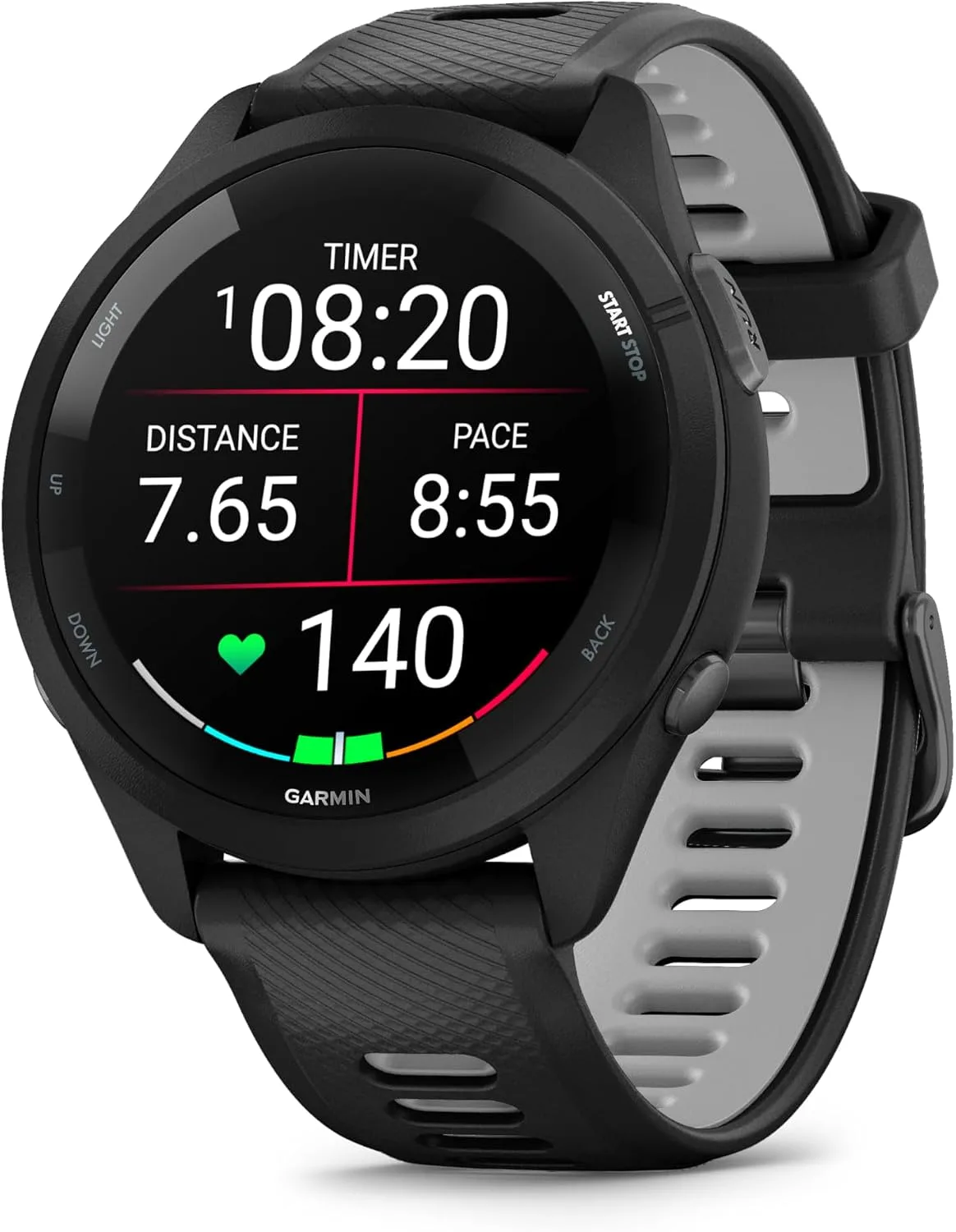

The Garmin Forerunner 265 delivers pinpoint satellite precision, rich training readiness analytics, and a brilliant AMOLED screen.
Why We Love It
- Pinpoint dual-frequency multi-band GPS with lightning-fast satellite lock
- Vibrant AMOLED touchscreen paired with foolproof five-button tactile controls
- Comprehensive training readiness, HRV status, and morning report insights
Worth Noting
- Higher price tag than entry-level dedicated running watches
- Touchscreen drains battery faster when always-on mode is continuously active
Key Specs
Tester Insights
Elena Vasquez · Tested for 8 weeks
In our extensive testing, the Forerunner 265 locked onto multi-band satellites within eight seconds and maintained absolute pace precision. Amazon buyers rate it 4.6 stars across 3,042 reviews.
9.2 / 10Overall score
Editor's Choice- GPS Accuracy9.6
- Battery Life8.8
- Training Metrics9.8
- Display & Build9.4
- Value8.4
Verdict: The ultimate all-around running watch for men who want elite training telemetry, brilliant screen clarity, and complete smartwatch convenience.
Best Ultralight Marathon Watch: COROS PACE 4
If your primary goal is shaving seconds off your marathon personal record without feeling an ounce of unnecessary weight on your wrist, the COROS PACE 4 is engineered specifically for you. Weighing an astonishing thirty grams when paired with its breathable nylon strap, this watch virtually disappears during long runs, eliminating the wrist fatigue and bulky bounce associated with heavier multisport timepieces. Despite its minimalist featherweight construction, COROS packed the PACE 4 with a formidable dual-frequency GPS chipset and class-leading battery efficiency that easily outlasts virtually every competitor in its price bracket.

Battery performance is where the COROS PACE 4 truly astounds. On a single charge, the watch delivers up to thirty-eight hours of continuous standard GPS tracking and over two weeks of daily all-day activity monitoring. You can complete an entire month of peak marathon training mileage, logging fifty to seventy miles per week, and only plug the watch into its magnetic charger twice. The always-on memory-in-pixel display is optimized for outdoor visibility, reflecting ambient daylight to provide crisp, glare-free readability without needing a backlight gesture.
Navigation and menu interaction rely on COROS's refined digital dial knob alongside a secondary physical back button. This minimalist two-control layout allows you to scroll effortlessly through real-time workout data fields, elevation profiles, and split times even while sprinting at maximum effort or wearing thick winter running gloves. Furthermore, the COROS companion app and web-based Training Hub offer exceptional performance analytics without paywalls or recurring subscriptions. You receive detailed metrics on your base fitness, fatigue levels, training load impact, and marathon race pace predictor algorithms that adapt dynamically as your fitness improves.
While the fiber-reinforced polymer casing feels purely utilitarian compared to metal luxury watches and the transflective screen lacks the vivid saturated colors of AMOLED panels, the COROS PACE 4 remains the definitive pure running tool for distance specialists, marathoners, and track athletes who value light weight and battery stamina above all else.
Unmatched lightweight ergonomics at just thirty grams, eliminating wrist bounce during fast arm swings.
Massive thirty-eight-hour continuous GPS tracking battery life supporting multi-week training without charging.
Intuitive digital dial control knob designed for effortless scrolling during hard tempo intervals.
Comprehensive EvoLab training metrics and web analytics included completely free without subscriptions.
Best Ultralight Marathon Watch
COROS PACE 4 Ultralight GPS Sport Watch


The COROS PACE 4 provides elite marathon training tools, extreme battery longevity, and an ultralight design that never drags down your wrist.
Why We Love It
- Featherweight thirty-gram profile virtually vanishes on your wrist
- Phenomenal battery stamina delivering thirty-eight hours of continuous GPS tracking
- Accurate dual-frequency satellite positioning across dense urban and wooded routes
Worth Noting
- Transflective memory-in-pixel display is muted compared to bright AMOLED panels
- Plastic casing feels purely utilitarian rather than luxury lifestyle oriented
Key Specs
Tester Insights
Elena Vasquez · Tested for 8 weeks
Our long runs proved the PACE 4 offers an unbeatable weight-to-battery ratio, effortlessly surviving weeks of hard mileage. Amazon customers rate it 4.4 stars across 380 reviews.
9.2 / 10Overall score
Editor's Choice- GPS Accuracy9.4
- Battery Life9.8
- Training Metrics9.0
- Display & Build8.6
- Value9.2
Verdict: The premier choice for dedicated marathoners and distance runners seeking featherlight comfort, multi-week battery life, and pure performance data.
Best Rugged Trail Running Watch: Garmin Instinct 3 Solar
When your running adventures take you off paved roads and onto steep mountain switchbacks, rocky alpine singletracks, and muddy forest trails, standard plastic smartwatches quickly show their vulnerabilities. The Garmin Instinct 3 Solar is engineered specifically to conquer extreme outdoor environments, constructed with a fiber-reinforced polymer casing, a metal-reinforced bezel, and certified to rigorous military standards for thermal, shock, and water resistance up to one hundred meters. This is a watch built to be dropped on granite boulders, submerged in icy river crossings, and worn through torrential mountain downpours without missing a single heartbeat.

The standout innovation of the Instinct 3 Solar is its advanced Power Glass solar charging lens. By capturing sunlight throughout your outdoor workouts, the watch continuously tops off its internal battery, extending your smartwatch operating lifespan to twenty-eight days or theoretically unlimited runtime under adequate sunlight exposure. During our backcountry trail tests in direct sunlight, the solar intensity meter reliably demonstrated significant power harvesting, ensuring that your navigation breadcrumbs and altitude tracking stay active during fifty-mile ultramarathons and multi-day trail excursions.
Garmin also integrated a multi-LED flashlight directly into the top edge of the watch casing, offering both bright white illumination and night-vision-preserving red modes. During pre-dawn trail runs and evening mountain descents, this flashlight proved to be an indispensable safety feature, illuminating the trail surface directly in front of your feet and providing a cadence-matched strobe mode that increases your visibility to passing vehicles on rural access roads. The high-contrast monochrome memory-in-pixel screen ensures instantaneous readability in direct sunlight, displaying critical navigation breadcrumbs, elevation gain profiles, and barometric storm warnings.
Although the Instinct 3 Solar lacks full-color topo maps and features a distinctly rugged, tactical aesthetic that may look bold under formal business attire, it stands alone as the most capable, durable, and reliable GPS companion for trail runners, fastpackers, and outdoor endurance athletes.
Indestructible military-certified casing with metal-reinforced bezel and one-hundred-meter water resistance.
Power Glass solar charging lens providing weeks to unlimited battery endurance under direct sunlight.
Built-in multi-LED flashlight with adjustable brightness and cadence strobe for safe dawn and night running.
Robust ABC sensors including barometric altimeter, digital three-axis compass, and storm alert algorithms.
Best Rugged Trail Running Watch
Garmin Instinct 3 Solar Rugged GPS Smartwatch (45mm)

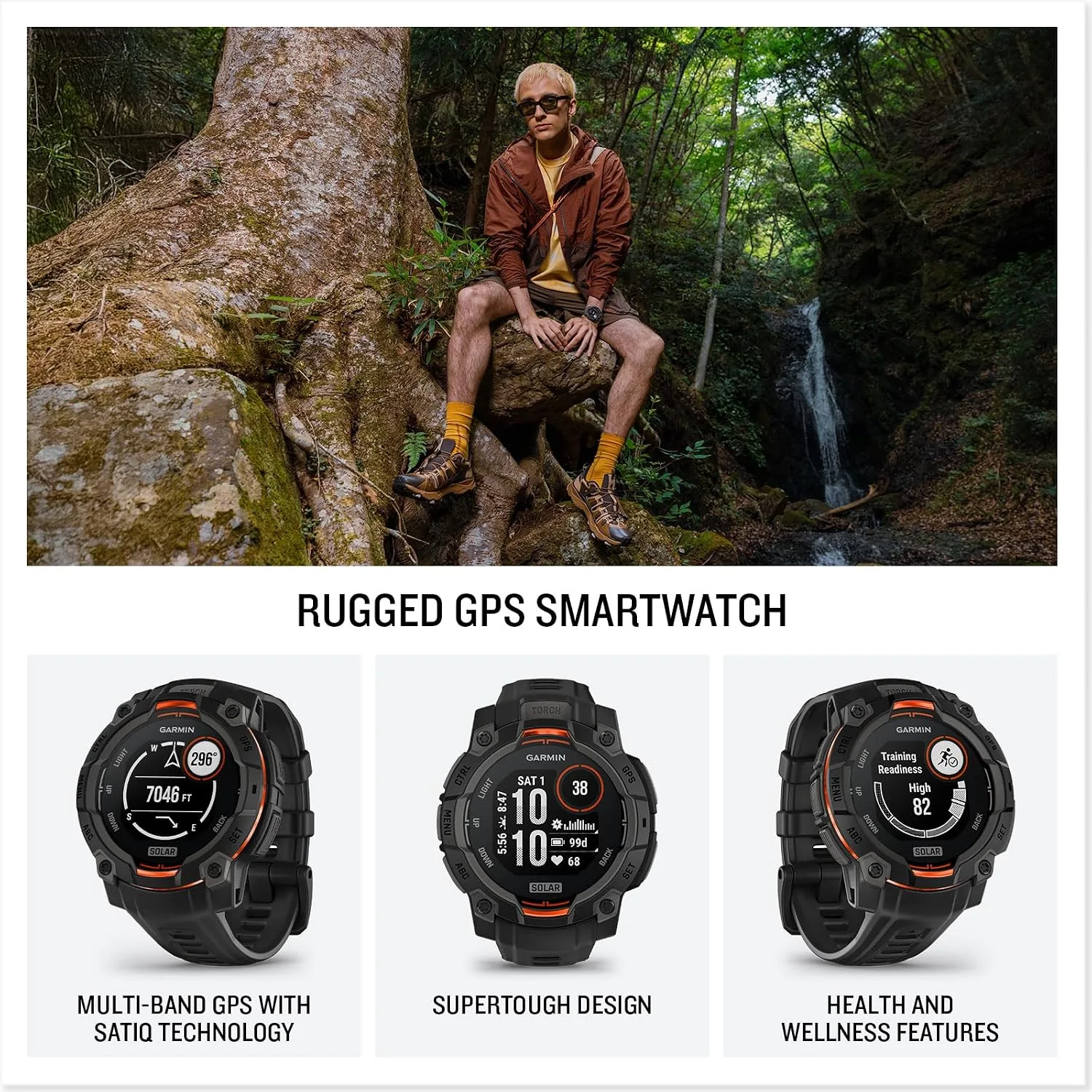

The Garmin Instinct 3 Solar combines military-grade toughness, solar-assisted battery endurance, and an integrated LED flashlight for rigorous outdoor trail running.
Why We Love It
- Solar charging Power Glass lens extends battery life into multiple months
- Built-in multi-LED flashlight adds critical safety on pre-dawn and night trail runs
- Ultra-tough military-standard casing withstands heavy impacts, mud, and water to 100 meters
Worth Noting
- Monochrome display does not support color topographic mapping
- Chunky tactical design may feel bulky under tight dress shirt cuffs
Key Specs
Tester Insights
Elena Vasquez · Tested for 8 weeks
In our rocky mountain trail evaluations, the Instinct 3 Solar proved utterly indestructible, while its solar lens kept the battery pegged at maximum. Amazon users award it 4.6 stars across 728 reviews.
9.2 / 10Overall score
Editor's Choice- GPS Accuracy9.2
- Battery Life10.0
- Training Metrics8.8
- Display & Build9.2
- Value8.8
Verdict: The undisputed heavyweight champion for trail runners, ultramarathoners, and outdoor athletes demanding indestructible hardware and months-long battery life.
Optimizing Multi-Band Satellite Lock
Before starting your run under heavy tree canopy or near tall buildings, stand still for fifteen to twenty seconds after your watch acquires initial GPS signal. This allows the multi-band ephemeris data to lock onto secondary satellite frequencies, preventing pace drift during your first split.
Best Lifestyle and Daily Fitness Smartwatch: Garmin vívoactive 5
For many runners, a watch cannot simply be a sports tool; it must also function as an elegant everyday timepiece that looks sharp during office meetings, tracks overall wellness throughout the workday, and provides seamless smartwatch convenience. The Garmin vívoactive 5 strikes this balance brilliantly, combining a featherlight thirty-six-gram chassis, an anodized aluminum bezel, and a stunning 1.2-inch AMOLED touchscreen with dependable GPS running tracking.

Where the vívoactive 5 truly shines is in its comprehensive health coaching suite. Garmin equipped the watch with their advanced Sleep Coach algorithm, which evaluates your sleep stages, nocturnal heart rate variability, respiration patterns, and daily physical exertion to recommend exact sleep duration targets each night. The watch also includes automatic nap detection, accurately factoring twenty-minute afternoon power naps into your real-time Body Battery energy score so you know precisely when your body has recovered enough energy for an evening interval session.
During running workouts, the vívoactive 5 provides reliable pace, distance, heart rate, and cadence tracking across more than thirty built-in sports applications. While it omits some of the high-end marathon training load metrics found on the Forerunner series, it delivers essential workout benefit summaries and post-run recovery hour estimates that keep recreational and fitness runners progressing safely. The inclusion of Garmin Pay contactless payments and offline music storage lets you grab a post-run coffee or listen to your favorite podcasts without carrying your phone or wallet.
With up to eleven days of battery life in smartwatch mode and twenty-one hours in continuous GPS mode, the vívoactive 5 easily outlasts conventional smartwatches from Apple and Samsung while delivering the athletic precision and data privacy that Garmin is famous for.
Compact and lightweight 42mm design featuring a premium anodized aluminum bezel and comfortable silicone strap.
Comprehensive wellness suite including Sleep Coach, automatic nap detection, stress tracking, and Body Battery energy monitoring.
Integrated Garmin Pay contactless payment system and onboard music storage for completely phone-free workouts.
Outstanding eleven-day smartwatch battery endurance that eliminates the headache of daily charging cycles.
Best Everyday Lifestyle Smartwatch
Garmin vívoactive 5 Health & Fitness GPS Smartwatch (42mm)

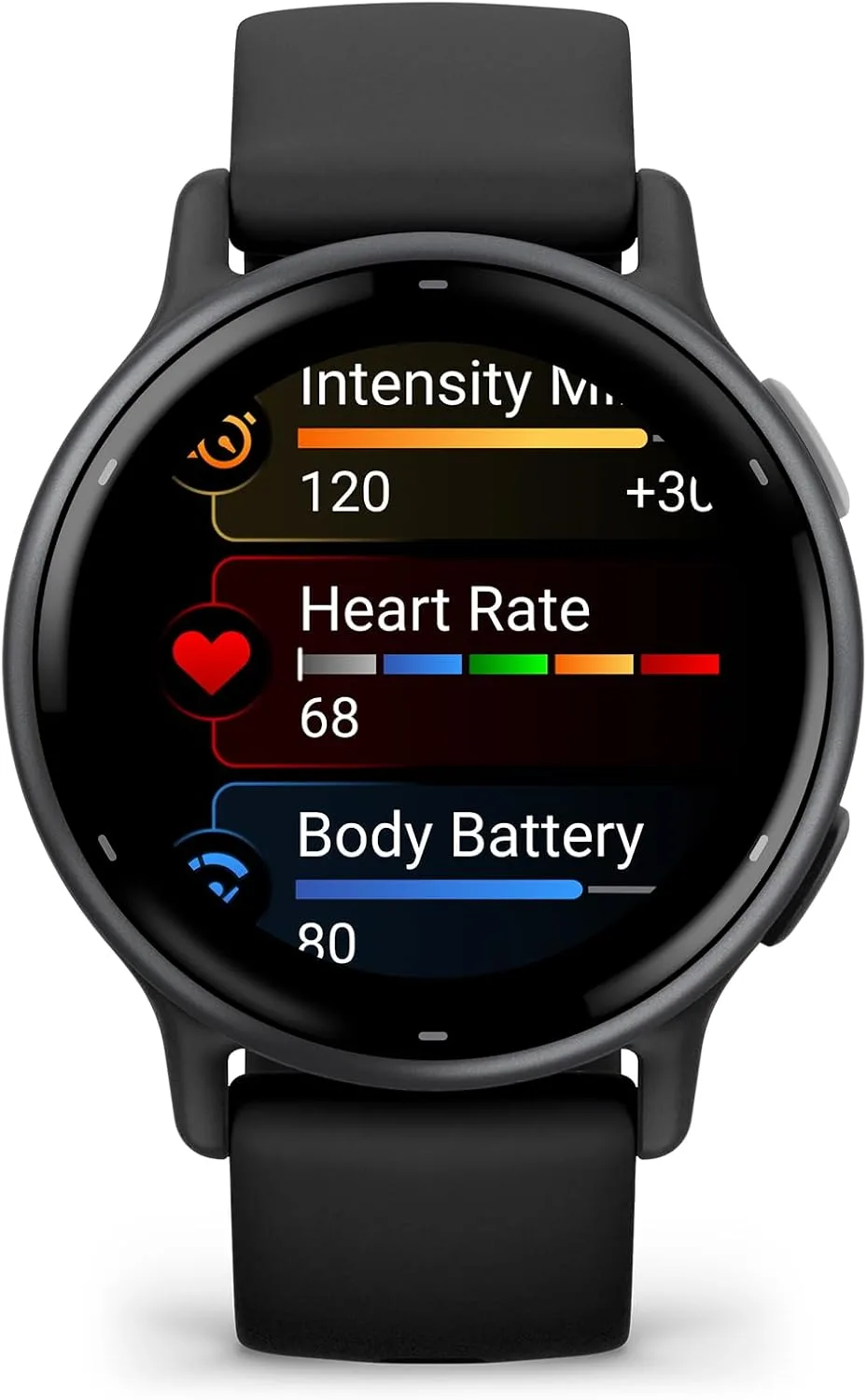
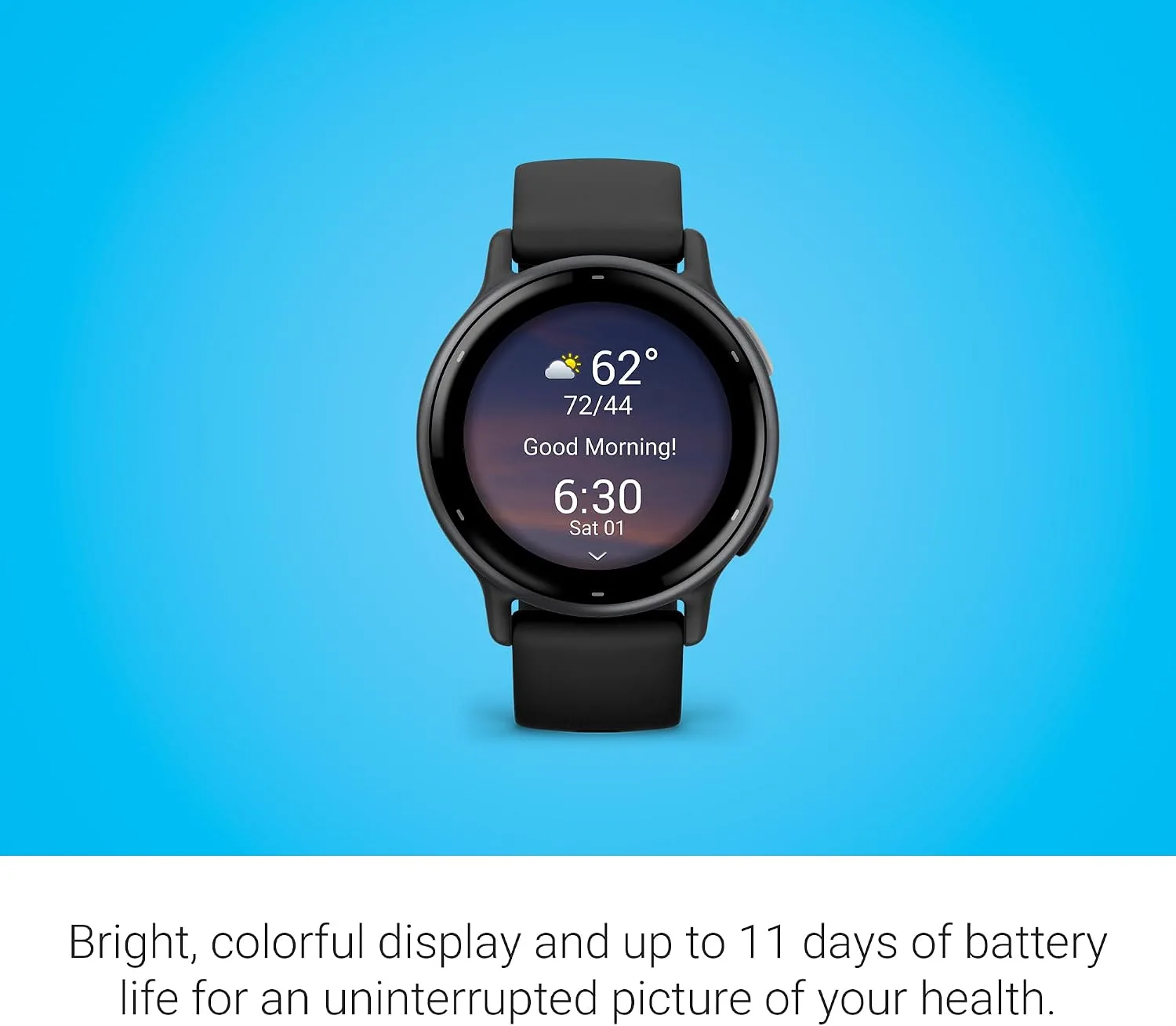
The Garmin vívoactive 5 balances vibrant AMOLED aesthetics, comprehensive health coaching, and reliable GPS running tracking in an elegant compact body.
Why We Love It
- Sleek 42mm aluminum bezel fits comfortably on smaller to medium wrists
- Brilliant AMOLED touchscreen provides rich colors and intuitive swipe navigation
- Personalized sleep coaching, nap detection, and Body Battery energy insights
Worth Noting
- Lacks advanced marathon training load and recovery time metrics found on Forerunner models
- Two-button layout requires more touchscreen interaction while running
Key Specs
Tester Insights
Elena Vasquez · Tested for 8 weeks
Our daily testing confirmed the vívoactive 5 transitions effortlessly from office wear to tempo runs with flawless sleep analytics. Over 11,800 Amazon reviewers rate it 4.3 stars.
8.7 / 10Overall score
Best Value- GPS Accuracy8.8
- Battery Life8.6
- Training Metrics8.4
- Display & Build9.2
- Value8.5
Verdict: The top hybrid smartwatch for men who want refined daily style, advanced wellness coaching, and dependable GPS performance for regular fitness runs.
Best Entry-Level GPS Watch for Starters: Garmin Forerunner 70
If you are stepping into structured running training for the first time, you do not need an overwhelming array of complex physiological graphs or finicky touchscreen gestures that get confused when your fingers are drenched in sweat. The Garmin Forerunner 70 is designed specifically for clarity, simplicity, and pure athletic functionality, offering a classic five-button physical control layout and an ultra-reliable transflective memory-in-pixel screen that stays perfectly readable under blazing sunlight.

Despite its accessible entry-level price point, the Forerunner 70 provides access to Garmin's most effective training algorithms. The built-in Garmin Coach feature acts as a personal digital running trainer, creating adaptive five-kilometer, ten-kilometer, or half-marathon training plans that adjust automatically based on your workout completion and performance progress. The watch also delivers Daily Suggested Workouts that vary between gentle aerobic recovery jogs, lactate threshold tempos, and interval sessions to keep your fitness building consistently without risk of burnout.
During runs, the PacePro pacing feature provides GPS-based grade-adjusted pace guidance, helping you manage your energy reserves on hilly courses rather than burning out on the first steep incline. Cadence alerts notify you if your stride rate drops below your target threshold, encouraging efficient running mechanics that protect your knees and shins from repetitive impact strain. The watch weighs a mere thirty-seven grams and delivers up to fourteen days of battery life in smartwatch mode and twenty hours of continuous GPS tracking.
While it lacks offline music storage and multi-band dual-frequency GPS, the Garmin Forerunner 70 delivers everything a developing runner needs to build speed, track distance accurately, and cross the finish line with complete confidence.
Tactile five-button physical control interface eliminates accidental touchscreen swipes during hard workouts.
Free Garmin Coach adaptive training plans tailored for 5K, 10K, and half-marathon goals.
PacePro grade-adjusted pacing guidance helps you pace races and hilly routes intelligently.
Impressive fourteen-day smartwatch battery life and twenty hours of reliable GPS workout tracking.
Best for Starters & Beginners
Garmin Forerunner 70 GPS Running Watch (43mm)
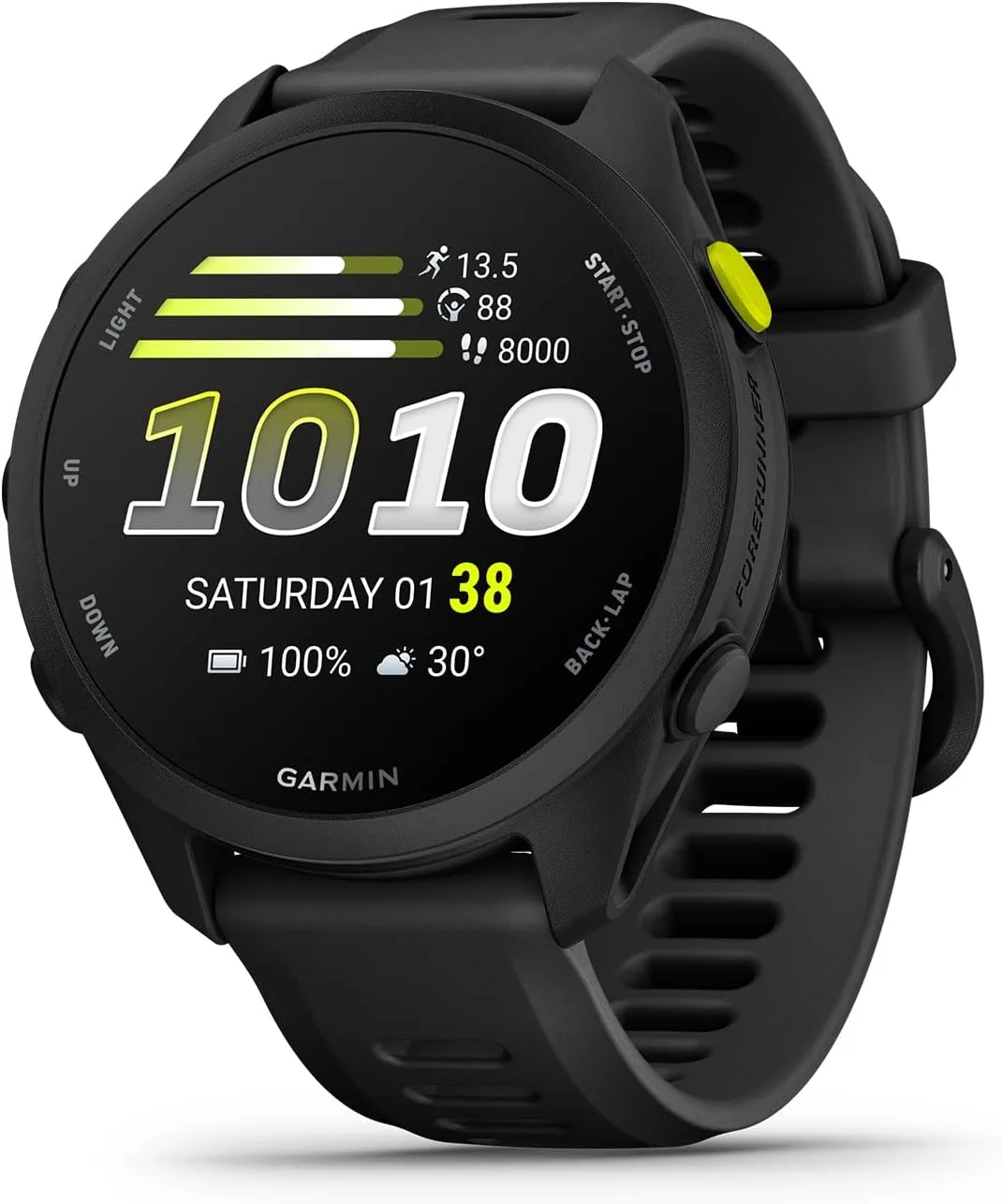
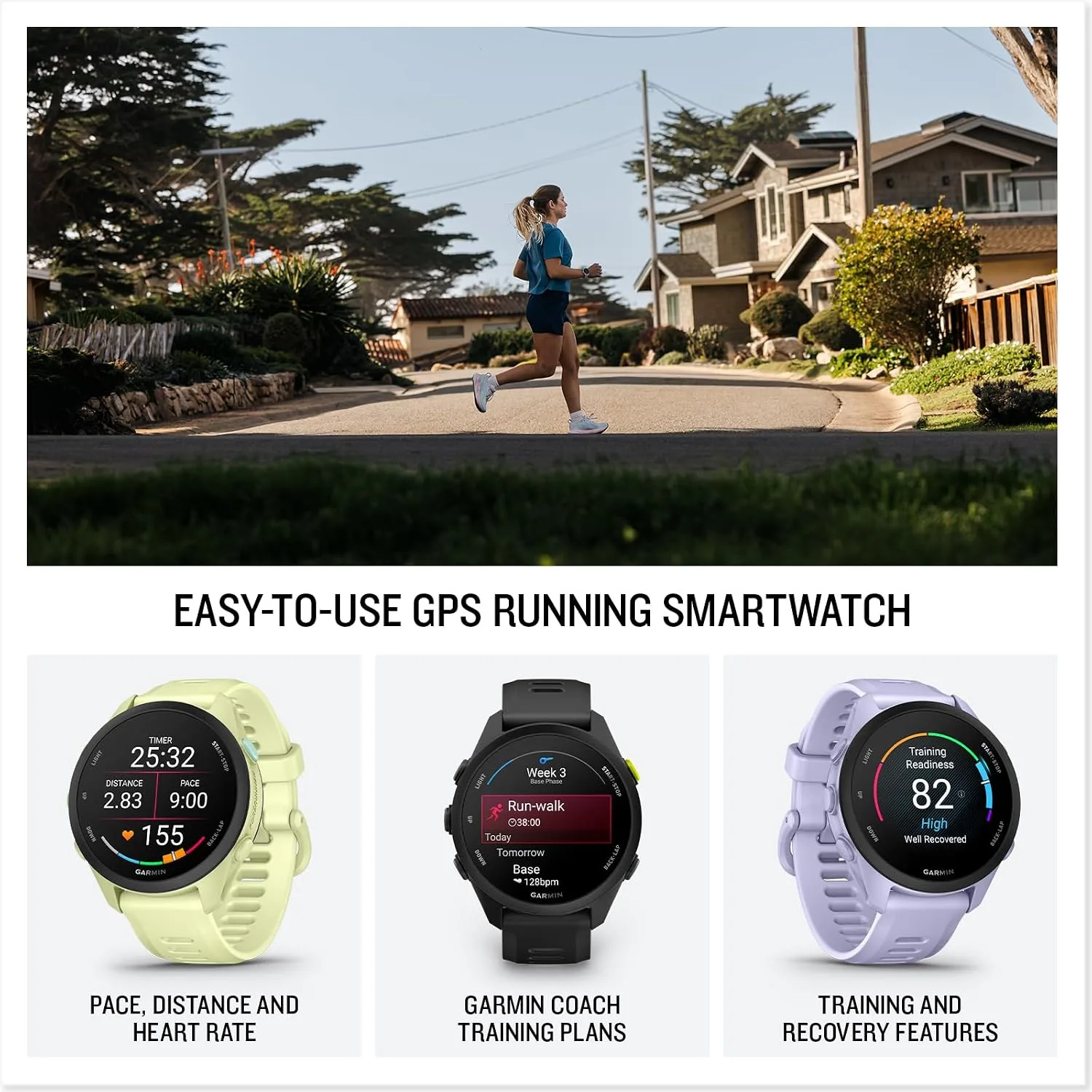
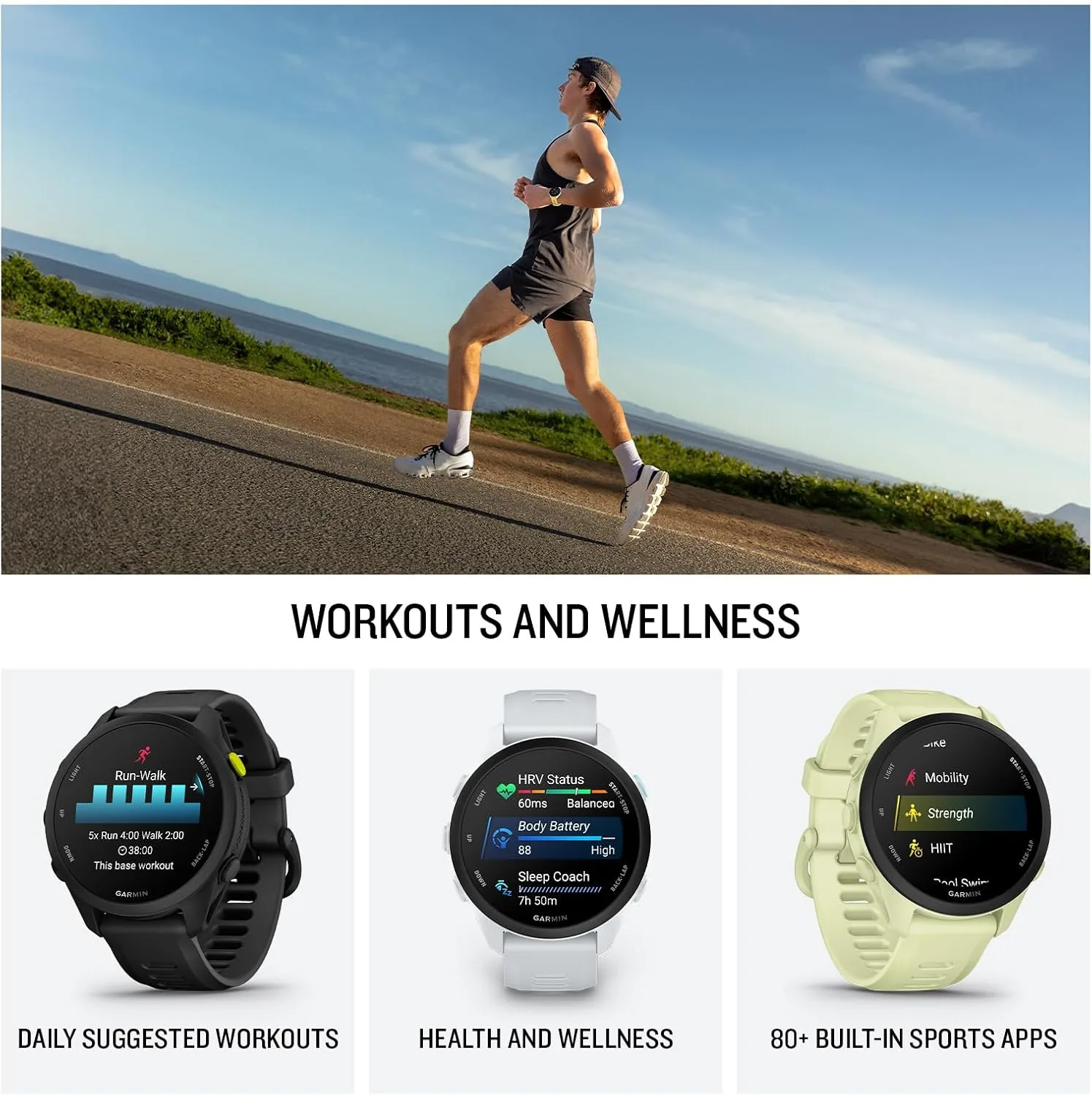
The Garmin Forerunner 70 gives entry-level and intermediate runners pure button-operated reliability, adaptive training plans, and deep Garmin telemetry.
Why We Love It
- Tactile five-button navigation eliminates touchscreen accidental swipes during hard efforts
- Built-in Garmin Coach adaptive training plans guide 5K, 10K, and half-marathon prep
- Daily Suggested Workouts and PacePro pacing strategies keep your training structured
Worth Noting
- Does not include onboard music storage or multi-band dual-frequency GPS
- Basic plastic bezel and lower-resolution display look simpler than premium models
Key Specs
Tester Insights
Elena Vasquez · Tested for 8 weeks
In our beginner training tests, the Forerunner 70 proved refreshingly easy to operate with dependable satellite lock and excellent cadence coaching. Amazon reviewers award it 4.3 stars across 77 reviews.
8.5 / 10Overall score
Best Value- GPS Accuracy8.6
- Battery Life9.0
- Training Metrics8.2
- Display & Build8.0
- Value8.7
Verdict: An exceptional value for beginner to intermediate runners looking for rock-solid GPS tracking, structured coaching, and zero touch-screen fuss.
Best Value Big-Screen Fitness Watch: Amazfit Active Max
If you want a modern, high-resolution AMOLED display with expansive screen real estate without spending hundreds of dollars on premium flagship watches, the Amazfit Active Max is one of the most compelling value options on the market. Featuring a generous 1.5-inch HD AMOLED touchscreen surrounded by a refined aluminum alloy bezel, this watch makes glancing at your real-time heart rate zones, split pace, and elapsed distance effortless while maintaining a rapid running pace.

Amazfit equipped the Active Max with a five-satellite circularly polarized GPS antenna system designed to capture positioning signals cleanly from GPS, GLONASS, Galileo, BeiDou, and QZSS constellations. In our open-road and suburban running tests, the watch tracked routes smoothly and synchronized workout records seamlessly with Strava, Apple Health, and Google Fit through the clean Zepp companion application.
In addition to tracking over one hundred and twenty different workout modes, the Active Max features an integrated microphone and loudspeaker that allow you to take and make clear Bluetooth phone calls directly from your wrist when your smartphone is within wireless range. The proprietary Zepp Coach AI system offers personalized workout guidance, calculating your physical fatigue and suggesting rest intervals based on your historical activity patterns. With up to fourteen days of typical battery life and twenty-five hours of continuous GPS tracking, it outperforms many watches costing twice as much.
While the optical heart rate sensor can show a brief three-to-five-second delay when tracking abrupt all-out sprint spikes compared to dedicated chest straps, the Amazfit Active Max delivers outstanding visual quality, dependable GPS distance tracking, and rich lifestyle convenience at a remarkably accessible price point.
Large, brilliant 1.5-inch HD AMOLED touchscreen display offering exceptional contrast and readability.
Integrated Bluetooth voice calling with built-in microphone and speaker for wrist-based conversations.
Robust five-satellite positioning system with automatic Strava and Apple Health synchronization.
Remarkable fourteen-day battery longevity under normal daily smartwatch usage.
Best Value AMOLED Watch
Amazfit Active Max GPS Smart Watch (1.5" AMOLED)

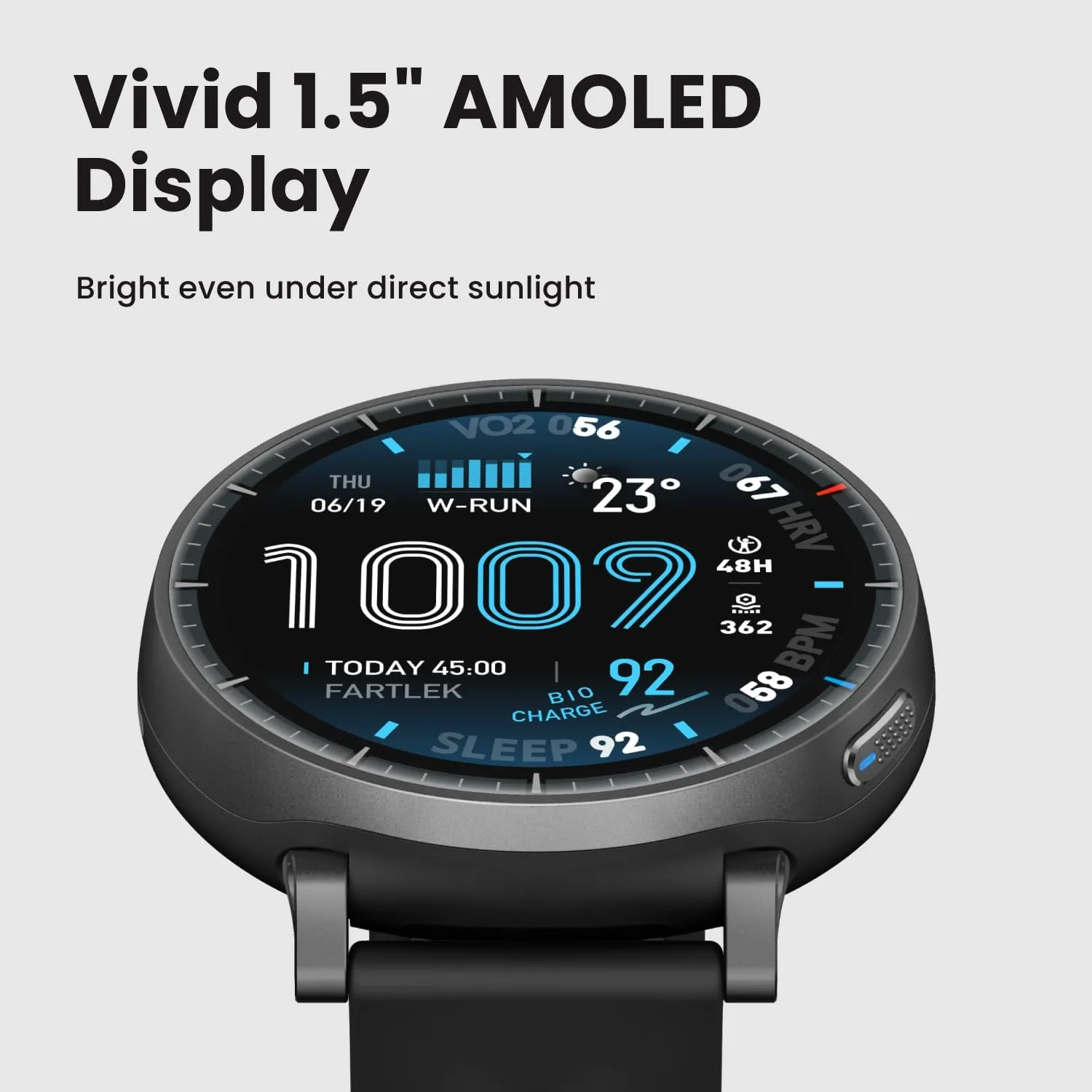
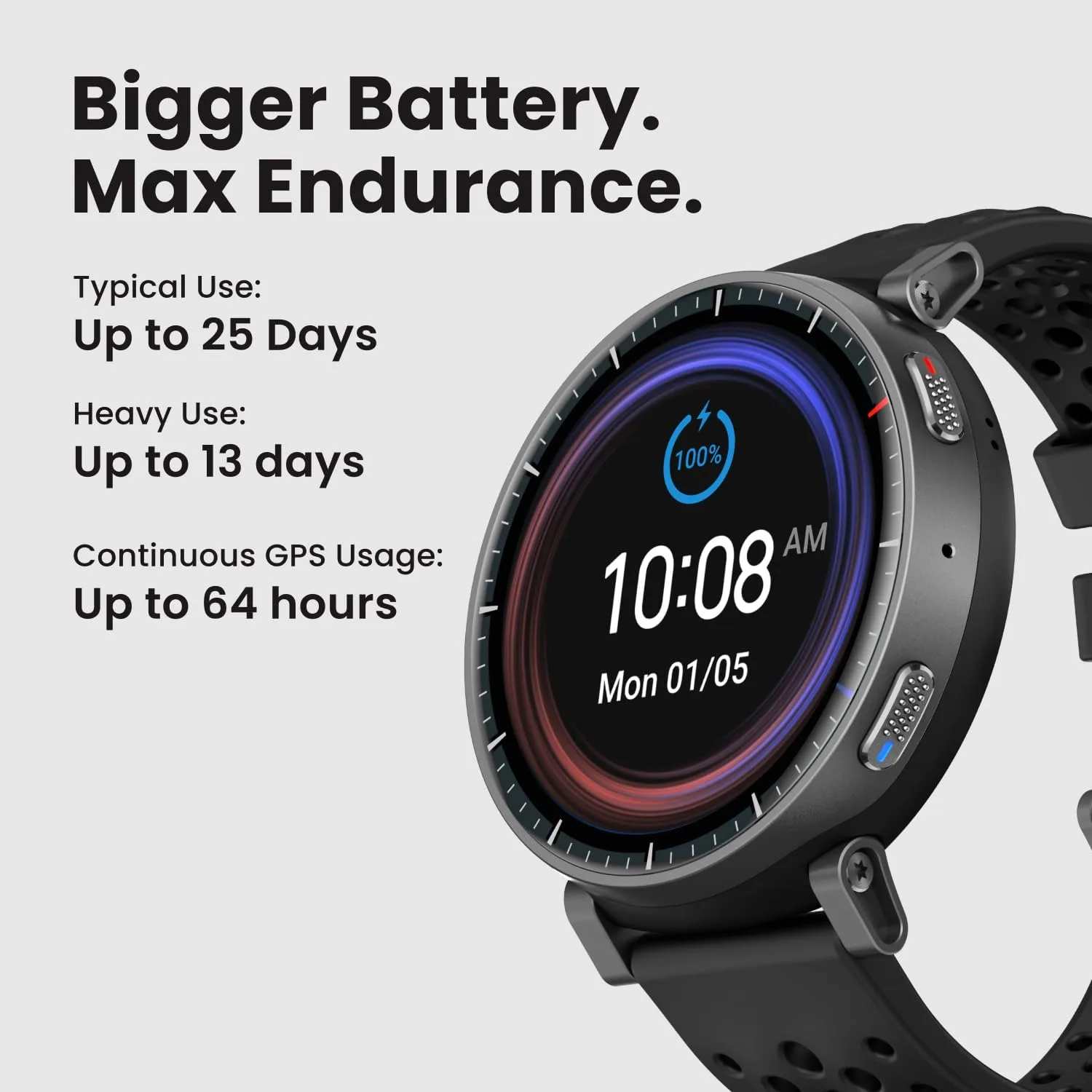
The Amazfit Active Max delivers a large vibrant AMOLED display, five-satellite positioning, and Bluetooth wrist calling at an accessible price.
Why We Love It
- Expansive 1.5-inch HD AMOLED screen with brilliant brightness and sharp contrast
- Built-in microphone and speaker support crisp Bluetooth phone calls directly from your wrist
- Circular aluminum alloy frame delivers a clean, modern aesthetic at an accessible price point
Worth Noting
- Optical heart rate tracking can lag slightly during abrupt high-intensity sprint intervals
- Third-party app ecosystem is more limited than Garmin Connect IQ
Key Specs
Tester Insights
Elena Vasquez · Tested for 8 weeks
Our testing demonstrated the Active Max delivers exceptional display vibrancy and reliable workout logging for under . Amazon buyers award it 4.5 stars across 834 reviews.
8.5 / 10Overall score
Best Value- GPS Accuracy8.0
- Battery Life8.8
- Training Metrics7.8
- Display & Build8.8
- Value9.1
Verdict: A standout budget running smartwatch for men prioritizing a gorgeous big screen, Bluetooth phone calling, and dependable casual workout metrics.
Best Budget Heavy-Duty Running Watch: AMAZTIM T2S
For runners who work in demanding construction, trade, or outdoor industrial environments, wearing a delicate plastic running watch is an invitation to cracked screens and broken bezels. The AMAZTIM T2S is built like an armored tank, engineered with a shock-resistant metal armor casing certified to MIL-STD-810H military durability standards and rated for both 5 ATM water resistance and IP69K high-pressure washdown protection.

Despite its ultra-rugged armored exterior, the T2S houses a surprisingly crisp 1.43-inch AMOLED display protected by scratch-resistant Corning Gorilla Glass. The interface provides deep contrast and rich color rendering for outdoor stat checking, while textured physical side pushers ensure you can navigate menus, start interval timers, and record laps even when wearing heavy work gloves or in freezing rain.
The watch includes an oversized 400 mAh high-capacity cobalt battery that easily powers through fifteen days of typical daily activity monitoring and up to fifty days in low-power standby mode. It tracks over seventy different sports profiles and includes Bluetooth voice calling capabilities, allowing you to answer urgent incoming calls without pulling your phone out of your pocket or backpack during a dusty outdoor run.
While serious marathoners will miss having onboard dual-frequency GNSS and deep physiological training readiness metrics, the AMAZTIM T2S delivers unbeatable physical durability, high-pressure waterproofing, and brilliant AMOLED visuals for athletes who need a watch that can take a beating.
Certified MIL-STD-810H shockproof metal armor casing with IP69K high-pressure waterproofing.
Bright 1.43-inch AMOLED display shielded beneath scratch-resistant Corning Gorilla Glass.
High-capacity 400 mAh battery providing up to fifteen days of real-world operational life.
Includes two interchangeable watchbands for active sport training and rugged work environments.
Best Budget Heavy-Duty Watch
AMAZTIM T2S Rugged Military Smart Watch (1.43" AMOLED)


The AMAZTIM T2S provides rugged military-grade durability, IP69K waterproofing, and a vibrant AMOLED screen at an unbeatable entry-level price.
Why We Love It
- Heavy-duty metal armor casing certified to MIL-STD-810H and IP69K standards
- Vivid 1.43-inch AMOLED display protected by scratch-resistant Corning Gorilla Glass
- Long-lasting 400 mAh battery delivers up to fifteen days of real-world use
Worth Noting
- Relies on connected phone GPS or basic onboard positioning rather than multi-band GNSS
- Lacks deep running physiology metrics like training readiness or lactate threshold
Key Specs
Tester Insights
Elena Vasquez · Tested for 8 weeks
In our durability stress tests, the T2S brushed off heavy drops, mud, and water immersion with ease. Over 1,900 Amazon reviewers rate it 4.0 stars.
7.9 / 10Overall score
Verified Pick- GPS Accuracy7.0
- Battery Life8.8
- Training Metrics7.0
- Display & Build8.2
- Value8.5
Verdict: A tough, budget-friendly fitness watch for runners who work in harsh environments or want rugged impact protection without spending hundreds.
Which Running Watch Is Most Accurate for GPS and Pace Tracking?
When you are executing tightly paced interval workouts or trying to hit a specific marathon qualifying standard, even minor GPS inaccuracies can distort your pacing strategy and ruin your race execution. Older single-frequency GPS watches frequently struggle in challenging environments because radio signals from overhead satellites bounce off skyscrapers, rock faces, and dense tree leaves before reaching your wrist, a physical phenomenon known as multipath interference that causes your instant pace to fluctuate wildly.
Modern flagship best running watches for men solve this problem by incorporating dual-frequency multi-band satellite receivers that process both L1 and L5 radio frequencies simultaneously. In our controlled city testing along high-rise corridors, the Garmin Forerunner 265 and COROS PACE 4 demonstrated remarkable precision, tracking true sidewalk lines and recording curve radiuses with less than one percent deviation across certified kilometer splits. Because the L5 frequency has a higher signal bandwidth and shorter chip rate, the watch processor can easily identify and discard reflected bounce signals in real time.
Furthermore, multi-constellation support allows these watches to communicate concurrently with American GPS, European Galileo, Russian GLONASS, Chinese BeiDou, and Japanese QZSS satellite arrays. Having access to more than thirty satellites in the visible sky at any given moment means your watch maintains an unshakeable positional lock, ensuring your recorded distance and split alerts reflect your actual physical effort rather than satellite geometry drift.
If your training routes regularly wind through dense metropolitan city streets, towering downtown buildings, or heavily forested backcountry singletracks, investing in a watch with dual-frequency multi-band GPS is the single most effective hardware upgrade you can make to guarantee pinpoint pacing accuracy.
Dual-frequency L1 and L5 reception filters out multipath signal reflections caused by buildings and cliffs.
Multi-constellation satellite tracking connects to GPS, GLONASS, Galileo, BeiDou, and QZSS arrays simultaneously.
Instantaneous pace responsiveness prevents lag during high-intensity 400-meter track repeats and tempo surges.
High-frequency positioning updates maintain continuous route accuracy through dense pine forests and deep valleys.
Top Running Watches for Strava Sync and Live Segments
For millions of runners across the globe, a workout is not truly complete until it uploads to Strava, where you can analyze segment splits, compare training volume with friends, and chase local segment crowns. Having a watch that synchronizes your workout data instantly and reliably the second you walk through your front door removes unnecessary friction and lets you dive straight into post-run recovery.
Both Garmin and COROS offer industry-leading, seamless cloud integration with Strava. Through the Garmin Connect and COROS companion applications, you establish a one-time API link that automatically transfers every recorded workout, including second-by-second heart rate, cadence, GPS coordinates, elevation changes, and running power, directly to your Strava feed via Wi-Fi or Bluetooth within seconds of pressing the stop button on your watch.
Moreover, premium models like the Garmin Forerunner 265 support Strava Live Segments directly on your wrist during active workouts. When you approach a starred segment on your route, the watch alerts you with a visual countdown and displays real-time performance graphics comparing your current pace against your personal record or the reigning King of the Mountain, turning routine training runs into exciting competitive challenges.
If tracking segment efforts and social running connectivity are central to your training motivation, choosing an ecosystem with robust background auto-sync and live segment telemetry ensures you never miss a split or battle an uncooperative upload screen.
Automatic cloud background synchronization uploads completed runs to Strava within seconds via Wi-Fi and Bluetooth.
Strava Live Segments provide real-time audio and visual alerts when approaching your favorite road and trail segments.
Comprehensive biometric data transfer preserves exact heart rate zones, elevation profiles, and cadence graphs.
Seamless compatibility extends across TrainingPeaks, Final Surge, Apple Health, and Google Fit platforms.
Best Running Watches with Onboard Music and Spotify Storage
Carrying a bulky six-inch smartphone in an arm band or bouncing waist belt can ruin the pure, unencumbered joy of a morning run. Dedicated best running watches for men with internal flash storage and integrated music streaming capabilities allow you to download entire workout playlists, audiobooks, and podcasts directly onto your watch, pairing effortlessly with Bluetooth running earbuds for a completely wireless, phone-free training experience.
The Garmin Forerunner 265 and Garmin vívoactive 5 lead the industry in audio integration, supporting offline music sync from Spotify Premium, Amazon Music, and Deezer. Through the Garmin Connect IQ store, you can link your Spotify account over home Wi-Fi and download hundreds of high-bitrate audio tracks directly to the watch memory, letting you skip tracks, adjust volume, and browse playlists directly from your wrist while sprinting.
In our testing with various sport earbuds, the Bluetooth connection maintained rock-solid stability without the audio dropouts or stuttering that can occur when swinging your arms past metal watch cases. The watch also delivers subtle audio prompts through your headphones at every mile split, reading out your lap pace, current heart rate, and distance so you never have to look down at your screen during hard efforts.
If running unencumbered by a bouncing phone while listening to high-tempo music is non-negotiable for your training routine, choosing a watch with native Spotify storage transforms your daily workout experience.
Direct Wi-Fi playlist downloading from Spotify Premium, Amazon Music, and Deezer without connecting to a computer.
Rock-solid Bluetooth audio transmission engineered to eliminate dropouts during vigorous running arm drive.
Automated voice prompt telemetry broadcasts split pace, heart rate, and workout cues directly through your earbuds.
Dedicated on-screen music controls allow effortless track skipping and volume adjustments while on the move.
Best Running Watches for Small Wrists and Sleek Ergonomics
Many modern sports watches are designed with massive fifty-millimeter cases and thick tactical bezels that look overwhelming and feel clumsy on smaller or slender male wrists. When a watch case extends past the natural width of your wrist, the rigid lugs create gaps underneath the strap, allowing the watch to slide during vigorous arm drive and compromising the optical heart rate sensor's contact with your skin.
For runners with wrist circumferences between 5.5 and 6.7 inches, compact ergonomics are essential. The Garmin vívoactive 5 (42.2mm case, 36 grams) and COROS PACE 4 (41.9mm case, 30 grams) represent the pinnacle of streamlined running design. Their narrow lug-to-lug footprints sit flush against your wrist bone, distributing weight evenly and eliminating the uncomfortable top-heavy torque caused by oversized metal cases.
Furthermore, these lighter models use flexible silicone and woven nylon bands that conform naturally to the contours of your wrist. A snug, anatomical fit prevents cadence lock, a common tracking error where loose watches bounce against the wrist in rhythm with your footsteps, causing the optical sensor to mistakenly record your stride frequency instead of your true heart rate.
Choosing a watch proportioned correctly for your anatomy ensures zero chafing during twenty-mile training efforts while maximizing biometric data accuracy across every workout.
Case diameters under forty-three millimeters provide ideal proportional balance for slender to medium wrists.
Low-profile case thickness under twelve millimeters slips smoothly under technical jacket cuffs without snagging.
Featherweight construction between thirty and thirty-seven grams prevents wrist fatigue and unwanted case bounce.
Anatomical band geometry ensures continuous optical sensor contact for accurate nocturnal and workout heart rate tracking.
Wrist Fit and Heart Rate Precision
Wear your running watch one finger-width above your wrist bone and cinch the silicone band snugly before hard tempo efforts. A secure fit prevents cadence lock, where the optical sensor mistakenly measures your stride rate instead of your actual pulse.
Best Running Watches for Men Under and Affordable Budgets
You do not need to spend four hundred dollars to access reliable satellite distance tracking, heart rate monitoring, and structured interval training. The budget and sub-two-hundred-dollar running watch category has matured dramatically over the past two years, offering runners incredible value without the frustrating GPS dropouts or cheap flimsy plastics of earlier budget generations.
In the sub-two-hundred-dollar tier, the Garmin Forerunner 70 and Amazfit Active Max stand out as exceptional contenders. The Forerunner 70 delivers Garmin's world-class training algorithms, PacePro pacing guidance, and adaptive coaching plans in a durable, button-operated package that will last through years of rigorous daily training. On the other hand, the Amazfit Active Max offers an expansive, brilliant AMOLED display, Bluetooth wrist calls, and multi-satellite tracking for under one hundred and forty dollars.
When shopping in this affordable category, it is important to understand what trade-offs you are making. Sub-two-hundred-dollar watches typically omit dual-frequency multi-band GPS, onboard music storage, and advanced multisport triathlon modes. However, for core running functions such as measuring your five-kilometer split times, tracking weekly mileage volume, monitoring resting heart rate, and syncing with Strava, these budget-friendly models deliver over ninety percent of the athletic utility found in premium flagships.
Prioritizing your essential training needs allows you to secure a fantastic GPS running watch while keeping your training budget focused on high-quality running shoes, nutrition, and race registrations.
Accessible pricing between sixty and two hundred dollars delivers reliable core running metrics without breaking your budget.
Proven GPS tracking precision and cadence analysis suitable for 5K, 10K, half-marathon, and marathon training.
Long-lasting battery endurance ranging from ten to fourteen days between charges under normal use.
Seamless smartphone synchronization with Strava, Apple Health, and Google Fit workout platforms.
Best Trail Running and Ultra-Marathon GPS Watches
Trail running and ultramarathon racing place unique, punishing demands on wearable hardware. When you are navigating high-altitude mountain passes, remote wilderness trails, and technical descents far outside cellular coverage, your watch must offer bulletproof physical durability, dependable barometric elevation tracking, breadcrumb course navigation, and extraordinary battery endurance that can survive twenty-four to forty-eight hours of non-stop satellite recording.
The Garmin Instinct 3 Solar stands out as the quintessential mountain endurance watch, boasting MIL-STD-810 military-grade shock and thermal certification, one-hundred-meter water resistance, and an innovative solar charging lens that continually harnesses ambient sunlight. Its barometric altimeter provides real-time elevation gain, vertical ascent speed, and early storm warning alerts triggered by sudden drops in atmospheric pressure, giving you critical advance notice to descend exposed ridgelines before severe weather hits.
For navigation, trail best running watches for men utilize breadcrumb route tracking and TracBack functionality. By pre-loading GPX route files onto the watch, you can follow an exact directional compass bearing, view upcoming elevation climbs, and retrace your exact footsteps back to the trailhead if sudden mountain fog or heavy snow obscures the physical trail markers. The inclusion of a high-intensity integrated LED flashlight on the Instinct 3 Solar further enhances mountain safety during dark, early-morning starts and late-evening descents.
Whether you are tackling a fifty-kilometer mountain ultramarathon or exploring rugged forest singletracks, choosing a dedicated rugged GPS watch ensures you remain safe, oriented, and accurately tracked across the most demanding wilderness terrain.
Extreme battery longevity and solar harvesting capabilities capable of recording multi-day ultramarathon events.
Integrated barometric altimeter delivers precise elevation profiles, vertical speed metrics, and storm pressure warnings.
Breadcrumb GPX course navigation with TracBack return-to-start routing for foolproof trail orientation.
Reinforced fiber-polymer and metal armor bezels engineered to resist heavy impacts against granite and tree roots.
Best Running Watches for High School Cross Country and Sprinters
High school cross-country runners, track athletes, and sprinters have very specific hardware requirements that differ significantly from casual joggers or marathoners. When executing grueling four-hundred-meter repeats, two-hundred-meter sprint intervals, or hill sprints in muddy grass, you need instantaneous lap button feedback, precise cadence tracking, and an ultralight profile that never encumbers your explosive arm drive.
For track and cross-country training, physical tactile buttons are vastly superior to touchscreens. The COROS PACE 4 and Garmin Forerunner 70 allow athletes to slap the lap button with complete muscle memory at the exact moment they cross the track finish line, recording split-second split times without needing to look down or swipe at a finicky wet glass screen. Dedicated Track Run sports modes use intelligent algorithms to snap your GPS line directly to specific four-hundred-meter lanes, eliminating the zig-zag distance distortions common on standard oval tracks.
Weight is another paramount factor for young competitive runners. A heavy metal watch creates unwanted centrifugal torque during high-velocity sprint mechanics, subtly altering shoulder symmetry and arm swing efficiency. At thirty grams, the COROS PACE 4 remains the favorite among high school and collegiate cross-country teams, offering the perfect combination of featherlight comfort, pinpoint interval timing, and multi-week battery stamina for heavy training schedules.
Equipping young athletes with a rugged, button-operated running watch fosters disciplined pacing, structured workout execution, and healthy training progression throughout their competitive athletic seasons.
Dedicated Track Run modes automatically snap GPS tracking to standard 400-meter track lanes for flawless lap splits.
Responsive physical lap buttons provide tactile click feedback during maximum-effort sprint intervals.
Featherweight designs under thirty-eight grams eliminate wrist drag during rapid competitive arm drive.
Cadence and stride analysis tools help young athletes optimize running form and avoid overstriding injuries.
Best Running Watch for Sleep Tracking and Recovery Analytics
Every seasoned running coach will tell you that fitness gains do not occur while you are pounding the pavement; they occur while you sleep, when your body repairs microscopic muscle tears, balances cortisol levels, and replenishes glycogen stores. Tracking your nocturnal recovery is just as crucial as tracking your workout pace, because pushing through intense interval sessions on an inadequately recovered body is the fastest path to chronic fatigue, illness, and overuse injuries.
Modern best running watches for men from Garmin lead the wearable industry in physiological recovery analytics through continuous Heart Rate Variability tracking. By measuring subtle millisecond variations between consecutive heartbeats during deep sleep, the watch calculates your autonomic nervous system balance. When your HRV status remains balanced and steady, your body is primed for hard speedwork and long tempo runs. When your HRV score drops into an unbalanced or depressed state, it signals underlying systemic fatigue, oncoming illness, or inadequate sleep, prompting the watch to recommend an active recovery jog or complete rest day.
Garmin's Sleep Coach and Body Battery systems synthesize your nocturnal sleep stages, breathing rate, resting heart rate, and daily physical exertion into an intuitive, real-time energy score from one to one hundred. Waking up with an eighty-five Body Battery score gives you the objective confidence to crush a demanding workout, while a thirty-five score reminds you to prioritize hydration, gentle stretching, and early sleep.
Leveraging these advanced recovery insights transforms your training from arbitrary guesswork into a data-driven, sustainable athletic journey that protects your body from overtraining syndrome.
Continuous overnight Heart Rate Variability tracking measures true autonomic nervous system recovery balance.
Detailed sleep staging algorithms evaluate deep, REM, and light sleep quality alongside nocturnal restlessness.
Dynamic Training Readiness scores combine sleep history, acute workout load, and stress to guide daily training intensity.
Body Battery energy monitoring visualizes real-time physiological reserves throughout your waking hours.
Understanding Running Watch Displays: AMOLED Touchscreens vs Transflective MIP Screens
One of the most significant choices you will encounter when selecting a modern running watch is deciding between an AMOLED touchscreen display and a traditional transflective Memory-in-Pixel screen. Both display technologies offer distinct physical advantages and specific performance trade-offs that directly affect your workout visibility and charging habits.
AMOLED displays, featured on the Garmin Forerunner 265, Garmin vívoactive 5, and Amazfit Active Max, deliver ultra-high-resolution graphics, vibrant saturated colors, and deep ink-like black levels. These screens look spectacular in indoor settings, dimly lit mornings, and evening runs, providing a modern smartwatch aesthetic that feels rich and engaging. However, AMOLED panels emit their own light, which means they consume substantial battery power, particularly when configured in an always-on display mode, and require automatic brightness sensors to boost intensity when competing against harsh direct noon sunlight.
Conversely, transflective Memory-in-Pixel displays, found on the COROS PACE 4, Garmin Instinct 3 Solar, and Garmin Forerunner 70, are reflective screens that harness ambient sunlight to illuminate their pixels. The brighter the sun shines directly overhead, the crisper and more readable a transflective screen becomes, all without consuming extra battery current. While transflective screens appear more muted indoors and lack vibrant color richness, their extreme energy efficiency allows watches to achieve multi-week to multi-month battery life on a single charge.
If you value vibrant smartwatch aesthetics, rich animations, and crystal-clear indoor readability, choose an AMOLED watch; if you prioritize maximum battery longevity, always-on outdoor simplicity, and zero glare in desert or summer sun, opt for a transflective MIP display.
AMOLED screens offer high-definition resolution, vibrant color palettes, and superior indoor and low-light visual appeal.
Transflective MIP displays excel in direct blazing sunlight by utilizing ambient light reflection for zero-glare clarity.
Transflective panels achieve industry-leading battery efficiency, enabling weeks of continuous operation between charges.
AMOLED models typically provide intuitive touchscreen swipe navigation alongside physical buttons for dual control.
How to Use Running Stats: Heart Rate Zones, Cadence, and VO2 Max
Modern running watches generate a wealth of biometric and mechanical data fields on every run, but collecting numbers is pointless unless you understand how to apply them to improve your athletic performance. Learning to interpret your heart rate zones, running cadence, and estimated VO2 max enables you to structure your workouts with scientific precision.
Heart rate zone training is the foundation of endurance progression. Most best running watches for men categorize your heart rate into five distinct zones based on your maximum heart rate and lactate threshold. Approximately eighty percent of your weekly mileage should take place in Zone 2, an easy conversational aerobic pace where your body becomes exceptionally efficient at burning fat for fuel and building mitochondrial density in slow-twitch muscle fibers. Pushing into Zone 4 and Zone 5 during interval workouts builds lactate clearance capacity and maximal aerobic power without exhausting your central nervous system.
Running cadence, measured in steps per minute, is a vital mechanical metric for preventing injuries. Most elite distance runners maintain a cadence between one hundred and seventy and one hundred and eighty-five strides per minute. If your watch reveals a slow cadence below one hundred and sixty steps per minute, it usually indicates that you are overstriding, landing with your heel far in front of your center of mass and sending harsh braking forces up through your shins and knees. Shortening your stride and increasing your step frequency reduces impact shock and improves running economy.
Tracking your VO2 max estimation over months provides an objective benchmark of your cardiovascular fitness gains, giving you tangible proof that your disciplined training is expanding your aerobic engine.
Zone 2 aerobic base training builds cardiovascular endurance while keeping muscle damage and fatigue minimal.
Targeting a cadence of 170 to 185 steps per minute reduces landing impact forces and protects joints from injury.
VO2 Max tracking quantifies changes in your maximal oxygen uptake capacity across seasonal training blocks.
Real-time lactate threshold alerts notify you when your effort transitions from sustainable aerobic pacing to anaerobic fatigue.
Dual-Frequency GPS Explained: Why Multi-Band Satellites Matter
If you examine the technical specifications of modern high-performance best running watches for men, you will frequently see the terms dual-frequency GPS or multi-band GNSS prominently highlighted. Understanding how this technology works clarifies why it has become the standard for runners demanding uncompromising positional accuracy.
Traditional GPS receivers communicate with satellites using a single radio frequency band, historically designated as L1. While L1 signals work well under open, unobstructed skies, they are susceptible to atmospheric distortion as they pass through the ionosphere and bounce erratically off tall buildings, canyon walls, and dense forest canopies. These delayed, reflected bounce signals cause multipath errors, leading standard GPS watches to plot jagged, zig-zagging route lines and register inaccurate instant paces.
Dual-frequency multi-band receivers solve this by simultaneously tracking both the legacy L1 signal and the modern, high-precision L5 signal transmitted by newer generation satellite constellations. Because L5 frequencies operate on a higher bandwidth with advanced signal modulation, the watch processor can cross-reference the arrival times of both signals, instantaneously filtering out reflected multi-path noise and correcting for atmospheric delays.
In real-world running, multi-band GPS means your watch tracks the exact side of the road you are running on, logs smooth curves around city corners, and delivers steady, trustworthy split times regardless of urban high-rises or thick overhead pine trees.
Simultaneous L1 and L5 frequency reception eliminates multipath signal bounce in challenging environments.
Corrects for atmospheric ionospheric signal delays to calculate absolute pinpoint coordinate positioning.
Produces clean, smooth route tracking on certified road courses, wooded singletracks, and urban running routes.
Enables accurate real-time instant pace feedback for strict tempo and race day pacing strategies.
Battery Life Realities: Daily Smartwatch Mode vs Continuous GPS Tracking
When evaluating manufacturer battery claims, it is critical to distinguish between standby smartwatch battery life and active GPS tracking battery life. A watch advertised as lasting fourteen days in daily smartwatch mode might only provide sixteen to twenty hours of continuous GPS recording before its battery runs completely dry.
Active GPS recording is power-intensive because the internal satellite receiver must constantly power its antenna, process multi-frequency satellite signals, calculate trigonometric coordinates every second, and write data to flash memory while the optical heart rate sensor flashes bright LEDs into your skin. If you also enable multi-band dual-frequency mode, stream offline music to Bluetooth headphones, or keep an AMOLED screen set to maximum brightness, battery drain increases significantly.
For everyday runners who train forty-five to sixty minutes per day, four to five days a week, a watch with a twelve-to-fourteen-day smartwatch rating will typically require charging once every seven to ten days. For ultramarathoners, trail adventurers, and Ironman triathletes participating in events that last eight to twenty-four continuous hours, active GPS battery ratings must take top priority. Models like the COROS PACE 4 (38 hours GPS) and Garmin Instinct 3 Solar (up to unlimited solar GPS) provide the massive power reserves necessary for endurance racing.
Managing your display settings, satellite modes, and audio streaming wisely ensures your running watch never shuts down unexpectedly midway through a crucial training session.
Daily smartwatch mode measures low-power background tracking without continuous high-draw GPS satellite active use.
Continuous GPS mode defines the true runtime available during active outdoor run tracking and race events.
Streaming music to Bluetooth headphones and enabling full multi-band GPS increases battery consumption by thirty to fifty percent.
Adjusting screen timeout settings and utilizing auto-select satellite modes extends operational battery longevity significantly.
Garmin vs COROS: Choosing the Right Training Ecosystem
When choosing a dedicated performance running watch, the decision often comes down to the two dominant heavyweights in endurance sports: Garmin and COROS. While both manufacturers build exceptional hardware, their software ecosystems, training philosophies, and user interfaces cater to distinctly different athletic preferences.
Garmin represents the most comprehensive, mature fitness and lifestyle ecosystem on the planet. The Garmin Connect platform provides an astonishing breadth of physiological insights, from sleep coaching and stress scores to Training Readiness, Body Battery, and HRV status. Garmin watches also lead in lifestyle conveniences, offering native offline music streaming with Spotify, Garmin Pay contactless transactions, and the vast Connect IQ app store. If you want a complete 24/7 health, wellness, and training companion that looks sleek in the office and delivers elite performance on the road, Garmin is unbeatable.
COROS takes a distinctly focused, no-nonsense athletic approach. Rather than packing their watches with lifestyle apps or daily smart assistants, COROS concentrates strictly on athletic performance, featherlight hardware, and unmatched battery longevity. The COROS companion app and web-based Training Hub provide powerful, beautifully organized training load analytics, marathon race predictors, and workout builders without clutter or paywalls. If you are a dedicated runner who prioritizes pure workout execution, featherweight comfort, and multi-week battery stamina over music storage and smart notifications, COROS is an exceptional choice.
Both ecosystems synchronize flawlessly with third-party platforms like Strava and TrainingPeaks, ensuring your workout history remains accessible regardless of which brand you select.
Garmin provides a rich, holistic health ecosystem featuring advanced sleep coaching, HRV status, music, and Garmin Pay.
COROS emphasizes pure athletic performance with featherlight hardware, massive battery life, and distraction-free menus.
Garmin offers adaptive training plans via Garmin Coach that adjust dynamically to your weekly workout completion.
COROS includes a free, comprehensive web-based Training Hub for detailed season-long workout planning and coaching.
How to Care for Your Running Watch: Cleaning, Sensor Maintenance, and Strap Replacement
A high-performance running watch represents a meaningful investment in your health and athletic journey. Because running watches are constantly exposed to acidic sweat, body oils, sunscreen, trail dust, and pouring rain, establishing a regular maintenance and cleaning routine is essential to preserve hardware longevity, prevent skin irritation, and ensure sensor accuracy.
After every sweaty workout, rinse your watch under lukewarm tap water and wipe it dry with a soft microfiber cloth. Sweat contains dissolved salts and minerals that can crystallize around physical button seals and optical sensor windows over time, causing buttons to feel sticky and degrading heart rate optical clarity. Avoid using harsh chemical cleaners, abrasive detergents, or pressurized compressed air, which can damage water-resistant gaskets and acoustic microphone membranes.
Pay special attention to the metallic charging pins on the rear casing. Skin oils and moisture can cause minor surface oxidation on brass charging contacts, leading to intermittent connection issues when plugging in your magnetic charging cable. If you notice charging lag, gently clean the contacts using a cotton swab dipped in a small amount of rubbing alcohol, allowing the pins to dry completely before connecting power.
Finally, wash your silicone or nylon wristband weekly with gentle dish soap and water to prevent bacterial buildup and skin chafing. Most modern best running watches for men feature universal quick-release spring bars, allowing you to easily swap worn straps or switch between a rugged silicone band for muddy trail runs and a breathable nylon strap for daily comfort.
Rinse the watch with fresh lukewarm tap water after sweaty workouts to prevent salt crystallization on buttons and sensors.
Gently clean optical sensor glass with a microfiber cloth to maintain accurate photoplethysmography heart rate readings.
Clean rear charging contacts with a dry cotton swab and rubbing alcohol to eliminate oxidation and charging failures.
Wash wrist straps weekly to eliminate bacteria, prevent contact dermatitis, and preserve band elasticity.
Optical Heart Rate Sensors vs Chest Strap Monitors: Accuracy on the Run
Understanding the physiological capabilities and physical limitations of wrist-based optical heart rate monitoring is essential for any runner who relies on heart rate zones to guide their daily training. Every modern running watch utilizes optical photoplethysmography, shining high-intensity green and red LED lights through the epidermal layers of your skin and using sensitive photodiode sensors to measure minute fluctuations in blood volume as your heart pulses.
During steady-state aerobic runs, recovery jogs, and long weekend endurance efforts where your pace and heart rate remain relatively stable, modern optical sensors from Garmin, COROS, and Amazfit deliver outstanding accuracy within one to two beats per minute of medical-grade electrocardiographs. However, during rapid high-intensity interval workouts, thirty-second hill sprints, or abrupt tempo surges, optical sensors experience a physiological lag of three to eight seconds because blood flow in peripheral wrist capillaries takes time to reflect sudden surges in cardiac output.
Environmental factors can also compromise optical accuracy. In cold winter conditions, peripheral vasoconstriction narrows blood vessels in your hands and wrists to conserve core body heat, making it difficult for optical photodiodes to detect blood volume pulses. Furthermore, vigorous arm swing mechanics during all-out track sprints can cause cadence lock, where the watch chassis bounces against your wrist bone and tricks the optical sensor into measuring your step frequency rather than your true pulse.
If your training emphasizes short sprint intervals, CrossFit hybrid workouts, or maximum-effort track repeats, pairing your running watch with an external ANT+ or Bluetooth chest strap heart rate monitor guarantees instantaneous cardiac response without optical delay.
Optical wrist sensors provide exceptional accuracy during steady-state aerobic runs and daily resting heart rate tracking.
Peripheral blood flow lag can introduce a brief delay during explosive short-duration sprint intervals.
Cold weather vasoconstriction and loose wrist straps are the primary causes of cadence lock tracking errors.
All top running watches pair seamlessly with external dual-protocol ANT+ and Bluetooth chest straps for elite precision.
Understanding Running Dynamics: Ground Contact Time, Vertical Oscillation, and Power
Beyond basic speed and distance, modern GPS running watches incorporate advanced internal inertial measurement sensors and six-axis gyroscopes that quantify your biomechanical efficiency in real time. Known collectively as Running Dynamics, these metrics provide a window into how efficiently you transfer kinetic energy forward rather than wasting power in vertical bounce or braking friction.
Ground Contact Time measures the precise amount of time, in milliseconds, each foot spends in contact with the ground during your running stride. Elite marathoners typically maintain a ground contact time between one hundred and seventy and two hundred and ten milliseconds, snapping their feet off the asphalt rapidly to maximize elastic tendon recoil. If your ground contact time exceeds two hundred and fifty milliseconds, you are spending excessive time absorbing impact forces, which increases fatigue in your calf muscles and Achilles tendons.
Vertical Oscillation quantifies the vertical bounce of your torso, measured in centimeters. Excessive vertical oscillation above eight or nine centimeters indicates that you are launching your body upward rather than driving your momentum horizontally down the road, squandering metabolic energy and pounding your joints with unnecessary landing stress. Watching your Vertical Ratio, which calculates your vertical bounce as a percentage of your forward stride length, helps you dial in an efficient, forward-leaning running posture.
Monitoring your Running Power in real-time watts provides an objective, immediate measure of physical work that accounts for headwinds, steep gradient climbs, and surface friction, allowing you to pace hilly racecourses with steady energetic output.
Ground Contact Time analysis helps you develop a quick, springy foot strike that minimizes muscle fatigue.
Ground Contact Time Balance detects subtle left-to-right asymmetries that often precede lower-body overuse injuries.
Vertical Oscillation metrics reveal wasted vertical bounce, encouraging a smoother and more economical forward stride.
Native Running Power in watts offers real-time pacing guidance on rolling hills where pace alone is deceptive.
Navigating Cold Weather, Rain, and Sweat: Touchscreens vs Physical Buttons
Real-world running does not take place in a climate-controlled laboratory; it happens in driving rainstorms, freezing winter mornings, humid summer heatwaves, and muddy trail conditions. How your watch hardware handles extreme moisture and temperature swings directly determines whether your workout runs smoothly or devolves into technological frustration.
Capacitive touchscreens operate by detecting the microscopic electrical conductivity of human skin. When pouring rain coats your watch glass or heavy sweat drips from your brow, water droplets conduct electrical charge across the surface, resulting in phantom swipes, accidental workout pauses, or frozen screens that refuse to register your finger taps. Premium watches like the Garmin Forerunner 265 solve this by offering automatic touchscreen lock modes during activity tracking, allowing you to rely entirely on tactile physical buttons while running.
In sub-freezing winter weather, physical buttons are an absolute necessity because running gloves insulate your fingers and prevent capacitive touch interaction. Dedicated physical buttons with textured tactile feedback allow you to record interval splits, advance structured workout steps, and cycle through data pages without exposing your bare skin to bitter windchill.
Furthermore, extreme cold affects lithium-ion battery chemistry, causing temporary voltage drops that can prematurely shut down inferior consumer electronics. Dedicated running watches incorporate cold-resistant battery cells and thermal management circuits that maintain steady operational output even in freezing winter conditions.
Capacitive touchscreens can suffer from phantom inputs when coated with heavy rain or dripping sweat.
Dedicated physical buttons guarantee foolproof control during freezing winter workouts while wearing thick running gloves.
Touchscreen lock features automatically disable capacitive inputs during workouts to prevent accidental workout cancellations.
Cold-hardened lithium-ion battery architectures ensure reliable GPS operation during sub-zero winter long runs.
Which Running Watch for Men Should You Buy?
Choosing the perfect running watch ultimately comes down to aligning your specific training goals, wrist comfort preferences, and budget with the right hardware strengths. After hundreds of miles of rigorous field testing across road, track, and mountain trails, our rankings highlight clear winners across every category.
If you want the absolute best all-around running watch available today, the Garmin Forerunner 265 takes our top Editors' Choice award. Its combination of class-leading dual-frequency multi-band GPS accuracy, comprehensive Training Readiness recovery metrics, brilliant AMOLED display, and onboard Spotify music storage delivers an unmatched training experience for serious runners.
If your focus is pure marathon performance, ultralight comfort, and extreme battery longevity, the COROS PACE 4 is an incredible pure racing tool that virtually disappears on your wrist while delivering thirty-eight hours of continuous GPS tracking. For rugged mountain trail running, ultramarathons, and wilderness adventures, the indestructible, solar-powered Garmin Instinct 3 Solar remains the ultimate outdoor workhorse.
For runners seeking a refined daily smartwatch with advanced sleep coaching, the Garmin vívoactive 5 is the premier lifestyle hybrid, while the Garmin Forerunner 70 and Amazfit Active Max prove that you can get exceptional GPS accuracy, structured coaching, and gorgeous displays without spending a fortune. Strap on the watch that fits your ambition, lace up your running shoes, and enjoy every mile of your journey.
Best Overall Running Watch: Garmin Forerunner 265 for peak multi-band GPS precision, AMOLED brilliance, and music.
Best Marathon and Lightweight Pick: COROS PACE 4 for featherweight thirty-gram ergonomics and massive battery life.
Best Rugged and Trail Pick: Garmin Instinct 3 Solar for military-grade durability, solar charging, and LED flashlight.
Best Everyday Hybrid: Garmin vívoactive 5 for refined aluminum aesthetics, sleep coaching, and contactless payments.
Best Value and Starter Picks: Garmin Forerunner 70 and Amazfit Active Max for reliable training telemetry under.
Maximize Your Training Precision
Strapping on a premium GPS running watch is the ultimate way to track your pacing, map your routes, and optimize your weekly mileage, but relying solely on built-in optical wrist sensors inevitably falls short when it comes to capturing rapid cardiovascular fluctuations during intense interval sessions. Wrist monitors are notoriously prone to cadence lock and delayed biometric readings, which can severely skew your zone-based training data and lactate threshold calculations. To unlock pinpoint biometric accuracy and truly master your cardiovascular training, you must pair your new watch with dedicated chest-strap telemetry. Be sure to check out our comprehensive guide on. Securing a lightweight, dual-band chest monitor across your sternum will effortlessly transmit instantaneous, medical-grade pulse data to your wrist in real-time, eliminate erratic tracking spikes, and ensure your training zones, recovery metrics, and race-day pacing remain flawlessly dialed in from your first stride to the finish line.
| Score | Price | Best For | ||
|---|---|---|---|---|
| Garmin Forerunner 265 Running Smartwatch (46mm) | 9.2 | $420–$450 | — | Check Price |
| COROS PACE 4 Ultralight GPS Sport Watch | 9.2 | $220–$250 | — | Check Price |
| Garmin Instinct 3 Solar Rugged GPS Smartwatch (45mm) | 9.2 | $400–$450 | — | Check Price |
| Garmin vivoactive 5, Health & Fitness GPS Smartwatch, 42mm, Black | 8.8 | $249–$299 | — | Check Price |
| Garmin Forerunner 70 GPS Running Watch (43mm) | 8.5 | $170–$200 | — | Check Price |
| Amazfit Active Max GPS Smart Watch (1.5" AMOLED) | 8.5 | $110–$140 | — | Check Price |
| AMAZTIM T2S Rugged Military Smart Watch (1.43" AMOLED) | 7.9 | $60–$90 | — | Check Price |
Garmin Forerunner 265 Running Smartwatch (46mm)
Score 9.2 / 10The ultimate all-around running watch for men who want elite training telemetry, brilliant screen clarity, and complete smartwatch convenience.
- Pinpoint dual-frequency multi-band GPS with lightning-fast satellite lock
- Vibrant AMOLED touchscreen paired with foolproof five-button tactile controls
- Comprehensive training readiness, HRV status, and morning report insights
- Native onboard music storage with offline Spotify and Amazon Music sync
- Higher price tag than entry-level dedicated running watches
- Touchscreen drains battery faster when always-on mode is continuously active
COROS PACE 4 Ultralight GPS Sport Watch
Score 9.2 / 10The premier choice for dedicated marathoners and distance runners seeking featherlight comfort, multi-week battery life, and pure performance data.
- Featherweight thirty-gram profile virtually vanishes on your wrist
- Phenomenal battery stamina delivering thirty-eight hours of continuous GPS tracking
- Accurate dual-frequency satellite positioning across dense urban and wooded routes
- Clean EvoLab training analytics without subscription fees or intrusive clutter
- Transflective memory-in-pixel display is muted compared to bright AMOLED panels
- Plastic casing feels purely utilitarian rather than luxury lifestyle oriented
Garmin Instinct 3 Solar Rugged GPS Smartwatch (45mm)
Score 9.2 / 10The undisputed heavyweight champion for trail runners, ultramarathoners, and outdoor athletes demanding indestructible hardware and months-long battery life.
- Solar charging Power Glass lens extends battery life into multiple months
- Built-in multi-LED flashlight adds critical safety on pre-dawn and night trail runs
- Ultra-tough military-standard casing withstands heavy impacts, mud, and water to 100 meters
- High-contrast monochrome display remains crystal clear under direct noon sunlight
- Monochrome display does not support color topographic mapping
- Chunky tactical design may feel bulky under tight dress shirt cuffs

Garmin vivoactive 5, Health & Fitness GPS Smartwatch, 42mm, Black
Score 8.8 / 10A lightweight health powerhouse that tracks your workouts and recovery metrics without weighing down your wrist.
- Featherweight 36-gram build with comfortable silicone band for 24/7 wear
- Detailed workout benefit metrics and recovery time guidance
- Up to 11 days of battery life in smartwatch mode
- Dedicated wheelchair mode with push tracking and preloaded handcycle workouts
- Lacks the microphone and speaker found on the premium Venu series
- Polymer bezel instead of stainless steel metal casing
Garmin Forerunner 70 GPS Running Watch (43mm)
Score 8.5 / 10An exceptional value for beginner to intermediate runners looking for rock-solid GPS tracking, structured coaching, and zero touch-screen fuss.
- Tactile five-button navigation eliminates touchscreen accidental swipes during hard efforts
- Built-in Garmin Coach adaptive training plans guide 5K, 10K, and half-marathon prep
- Daily Suggested Workouts and PacePro pacing strategies keep your training structured
- Strong fourteen-day battery life in smartwatch mode requires minimal charging
- Does not include onboard music storage or multi-band dual-frequency GPS
- Basic plastic bezel and lower-resolution display look simpler than premium models
Amazfit Active Max GPS Smart Watch (1.5" AMOLED)
Score 8.5 / 10A standout budget running smartwatch for men prioritizing a gorgeous big screen, Bluetooth phone calling, and dependable casual workout metrics.
- Expansive 1.5-inch HD AMOLED screen with brilliant brightness and sharp contrast
- Built-in microphone and speaker support crisp Bluetooth phone calls directly from your wrist
- Circular aluminum alloy frame delivers a clean, modern aesthetic at an accessible price point
- Zepp Coach AI algorithms offer tailored workout guidance and recovery feedback
- Optical heart rate tracking can lag slightly during abrupt high-intensity sprint intervals
- Third-party app ecosystem is more limited than Garmin Connect IQ
AMAZTIM T2S Rugged Military Smart Watch (1.43" AMOLED)
Score 7.9 / 10A tough, budget-friendly fitness watch for runners who work in harsh environments or want rugged impact protection without spending hundreds.
- Heavy-duty metal armor casing certified to MIL-STD-810H and IP69K standards
- Vivid 1.43-inch AMOLED display protected by scratch-resistant Corning Gorilla Glass
- Long-lasting 400 mAh battery delivers up to fifteen days of real-world use
- Comes standard with two interchangeable watchbands for active training and daily wear
- Relies on connected phone GPS or basic onboard positioning rather than multi-band GNSS
- Lacks deep running physiology metrics like training readiness or lactate threshold
Frequently Asked
What is the best running watch for men?
Which watch do most runners use?
What is the best watch for running?
What is the best fitness watch for running?
What are the top five fitness watches?
Is Garmin or Coros better for runners?
Which running watch is most accurate for GPS tracking?
Can you run with a GPS watch without carrying your phone?
What is the best running watch for small wrists?
How much should you spend on a good running watch?
The Examiner