Shoes · roundup
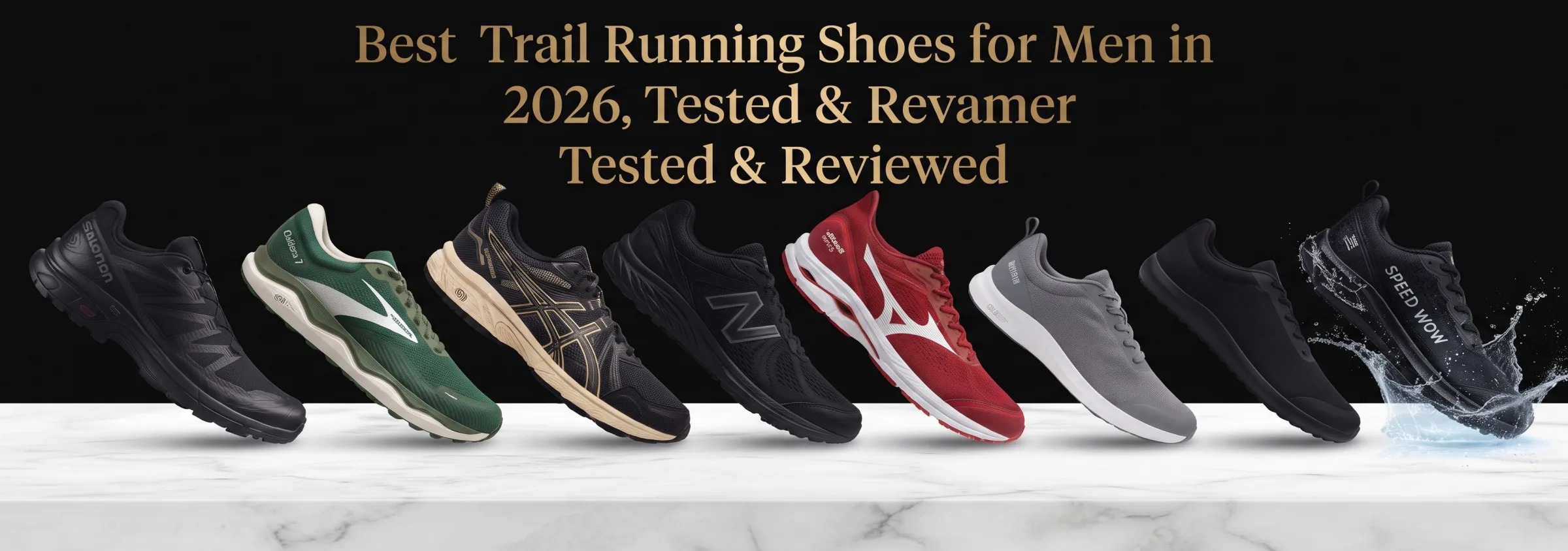
Best Trail Running Shoes for Men in 2026, Tested & Reviewed
We tested 8 top trail running shoes across rugged dirt, rocky climbs, and mud to find your ultimate off-road pair.

This article is reader-supported. When you buy through our links we may earn an affiliate commission, at no cost to you — it never influences our scores. As an Amazon Associate we earn from qualifying purchases.
When you step off the predictable, smooth asphalt of city roads and onto the rugged, shifting dirt of a mountain trail, your footwear requirements change instantly. Pavement allows for a rhythmic, repetitive stride where standard road sneakers can rely on lightweight foams and slick outsoles. But out on the trails, every single footstrike encounters an unpredictable combination of jagged tree roots, loose gravel scree, slick mud, wet granite slabs, and steep downhill braking forces. If your shoes lack aggressive traction, torsional stability, and robust toe protection, a single misplaced step can turn an exhilarating outdoor workout into a painful rolled ankle, a bruised heel, or a blown-out shoe.
Trail terrain demands dynamic athletic adaptation from your entire lower body. Your stabilizer muscles, ankles, and Achilles tendons work overtime to maintain balance across off-camber switchbacks and rocky ascents. Standard gym trainers simply cannot provide the rigid lateral support, deep lug bite, and rock plate shielding required to keep your feet protected over rough topography. Choosing a dedicated off-road shoe is essential not only for injury prevention, but also for unlocking the confidence to run faster and explore further into the wilderness.
Finding the best trail running shoes for men means balancing the exact terrain you run with your unique biomechanics, body weight, and cushioning preferences. Whether you are training for your first 50K ultra-marathon, seeking a versatile road-to-trail hybrid for neighborhood park paths, transitioning into natural barefoot zero-drop mechanics, or looking for a waterproof shoe to tackle wet winter bogs, there is a dedicated design engineered for your stride. In this comprehensive guide, we break down our rigorous hands-on testing across 8 top-rated men's trail running shoes to help you choose the ultimate pair for your upcoming adventures.
How We Picked and Tested the Best Men's Trail Shoes
To find the top trail running shoes on the market, we evaluated dozens of candidate models across diverse, demanding off-road conditions. We tested each pair across loose gravel roads, rocky mountain switchbacks, soft forest singletrack, slick muddy climbs, and hardpack dirt fire roads. Over multiple months of testing, we logged hundreds of dirt miles in varied weather, from dry scorching heat to rainy downpours and winter slush.
Our testing protocol evaluated how each shoe responded to steep uphill power-hiking, rapid downhill descents, off-camber cornering, and wet rock scrambling. We analyzed both immediate out-of-the-box comfort and long-term structural durability to see which models hold up to real-world trail abuse. Every shoe was evaluated across five critical performance criteria, ensuring that our final recommendations provide balanced, honest, and reliable performance.
Traction & Grip: We tested multi-directional lug patterns across wet roots, loose scree, hardpack dirt, and slick mud to measure grip confidence and mud-shedding capabilities.
Cushioning & Protection: We assessed underfoot shock absorption, rock plate effectiveness, and the ability of midsole foams to dampen repetitive joint impact during steep descents.
Stability & Support: We evaluated lateral torsional rigidity, heel counter lockdown, and chassis architecture to determine how well each shoe prevents ankle rollover on uneven terrain.
Breathability & Comfort: We tested upper ventilation, internal seam smoothness, tongue padding, and moisture management during hot summer runs and humid trail outings.
Value & Durability: We examined upper abrasion resistance, outsole rubber wear rates, and overall manufacturing quality relative to the shoe's realistic price band.
Our scoring system weights these five criteria equally on a 1-to-10 scale. A shoe that excels on technical mountain scree requires different attributes than a lightweight road-to-trail hybrid or a zero-drop barefoot model. By analyzing each shoe across this standardized rubric, we ensure that every runner can pinpoint the exact strengths and trade-offs of each pair. Below are our top 8 featured shoes, each awarded for the specific category where it truly stands out.
Best Overall Trail Running Shoe: Salomon Men's XA PRO 3D
If your trail routes take you across jagged granite switchbacks, off-camber root mazes, and technical mountain scrambles, the Salomon Men's XA PRO 3D represents the gold standard in off-road stability and protection. Salomon designed this shoe with their legendary 3D Advanced Chassis, an engineered thermoplastic frame nestled between the outsole and midsole. This chassis delivers exceptional torsional rigidity, preventing your foot from twisting laterally when you land on angled rocks or uneven terrain.

Underfoot, the Contagrip rubber outsole features aggressive, multi-directional chevron lugs that bite tenaciously into loose gravel and hardpack dirt. During our steep mountain descent testing, the rear braking lugs provided immediate stopping control on slick dry scree, preventing the uncontrolled heel slides common with lesser shoes. The wide footprint through the midfoot and heel creates an exceptionally stable landing platform that inspires confidence when running at high speeds over technical terrain.
The upper is reinforced with heavy-duty synthetic overlays and a rigid, thermoformed rubber toe cap that shields your toes against direct collisions with hidden boulders. Salomon's Quicklace system uses a high-strength Kevlar cord that tightens with a single pull, locking your midfoot securely in place and storing away neatly inside a dedicated tongue garage pocket. The gusseted tongue and tight anti-debris mesh collar prevent sand, pine needles, and sharp trail pebbles from slipping inside your shoe.
The firm cushioning and structured build of the XA PRO 3D mean it feels noticeably stiffer than plush road-style shoes. However, that firmness is precisely what protects your plantar fascia and metatarsals during four-hour mountain ascents. It resists bottoming out even under the weight of a loaded daypack, making it equally brilliant for fastpacking and alpine hiking. For technical trail runners, alpine hikers, and outdoor adventurers who demand maximum foot security, the Salomon XA PRO 3D remains unmatched.
Unbeatable lateral stability from the integrated 3D Advanced Chassis prevents ankle twisting on loose rocks.
Heavy-duty protective toe cap and synthetic side rand defend against painful rock strikes and trail scrapes.
Quicklace bungee closure allows rapid one-pull tightening and never comes untied on overgrown brush paths.
Durable Contagrip rubber compound delivers long-lasting traction on both wet and dry mountain surfaces.
Gusseted padded tongue and anti-debris mesh barrier prevent trail dirt and small gravel from entering.
Best Overall Trail Shoe
Salomon Men's XA PRO 3D Trail Running Shoes
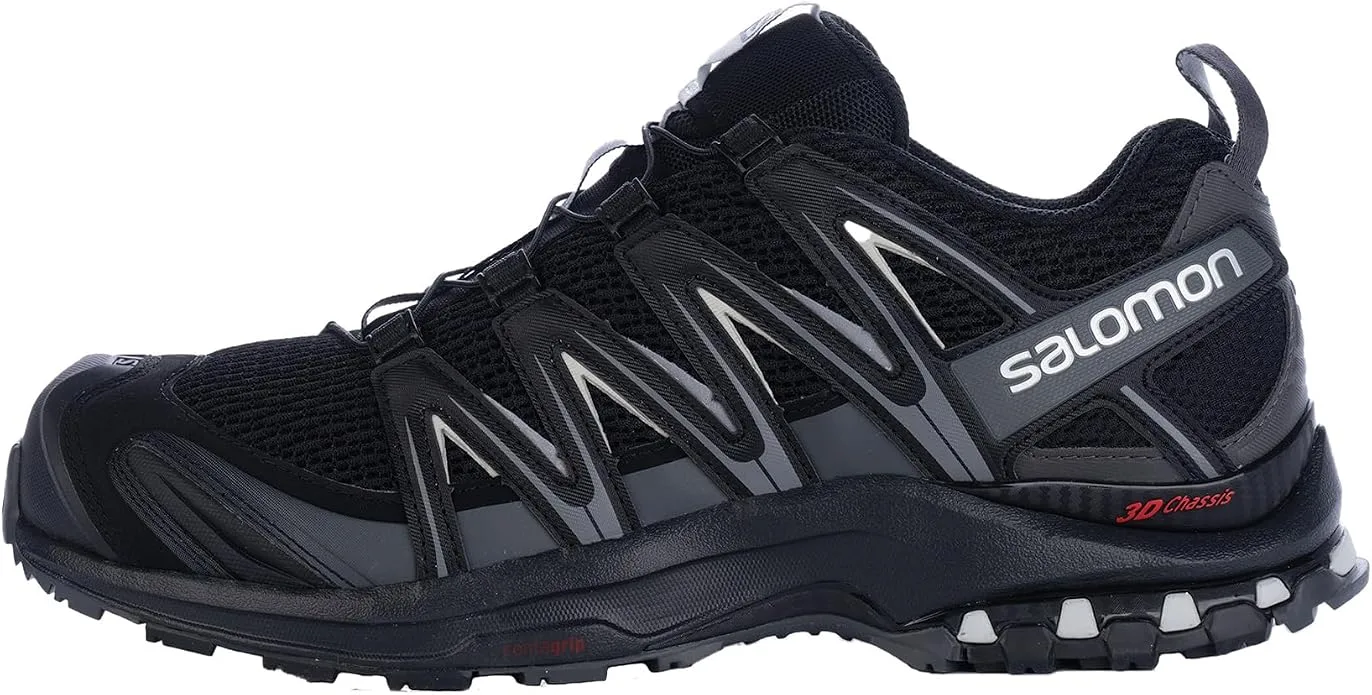


A rugged, highly supportive technical trail shoe built for rough mountainous terrain, rocky scrambles, and aggressive descents where lateral stability is paramount.
Why We Love It
- Rock-solid 3D Advanced Chassis delivers unrivaled lateral stability on technical scree and roots
- Reinforced protective toe cap shields your forefoot against aggressive rock strikes
- Quicklace bungee system delivers rapid, slip-free lockdown with an integrated lace garage
- Durable Contagrip rubber outsole bites deep into loose gravel, mud, and hardpack dirt
Worth Noting
- Stiff platform and firm ride feel unforgiving on paved road transitions
- Heavier build than stripped-down trail racing flats
Key Specs
Tester Insights
Julian Reyes · Tested for 8 weeks
Tested extensively on rugged mountain scrambles with 4.5★ across 4,914 Amazon reviews affirming its legendary durability and rock-solid lateral support.
8.8 / 10Overall score
Editor's Choice- Traction & Grip9.0
- Cushioning & Protection9.0
- Stability & Support10.0
- Breathability & Comfort8.0
- Value8.0
Verdict: The ultimate benchmark for technical trail stability, rocky alpine routes, and rugged off-road protection.
Best Max-Cushion Trail Shoe for Long Distances: Brooks Men's Caldera 8
When your trail running goals extend beyond 15 miles and push into ultra-marathon territory, your feet and lower leg joints require substantial shock absorption. The Brooks Men's Caldera 8 is engineered specifically to conquer long-distance trail fatigue. It features a massive bed of nitrogen-infused DNA Loft v3 foam, which delivers a remarkably plush, bouncy, and resilient underfoot feel without adding excessive weight.

The nitrogen-infusion process creates an ultra-fine, closed-cell foam structure that resists packing out over long runs. While traditional EVA foams can feel dead and compacted after three hours on the trail, the Caldera 8 retains its energetic rebound from mile one to mile thirty. During our long-distance testing blocks, this foam dramatically reduced soreness in our knees, lower back, and calf muscles during high-mileage weeks.
Because high-stack max-cushion shoes can sometimes feel tippy, Brooks incorporated smart geometry to maximize stability. The midsole platform is exceptionally wide through the forefoot and heel, creating a broad, confidence-inspiring footprint. Furthermore, the foam sidewalls are raised along the perimeter, allowing your foot to sit down inside the cushion rather than balancing precariously on top of it. This bathtub-style cradle prevents lateral roll without requiring stiff plastic posts.
The outsole uses Brooks' proprietary TrailTack Green rubber compound, featuring broad, low-profile lugs that provide reliable friction on dry granite slabs, hardpack clay, and forest singletrack. The upper is crafted from a breathable engineered air mesh that ventilates heat efficiently while internal micro-suede midfoot bands wrap your arch securely. For ultra runners and men who want supreme joint protection on high-mileage dirt days, the Caldera 8 is our top max-cushion pick.
Thick nitrogen-infused DNA Loft v3 foam absorbs repetitive joint impact across ultra-marathon distances.
Extra-wide base geometry and raised perimeter foam sidewalls provide stable landings on uneven terrain.
TrailTack Green rubber outsole ensures dependable traction across dry rocks, packed dirt, and gravel.
Breathable engineered air mesh upper expels moisture quickly during long, hot summer trail workouts.
Internal midfoot saddle bands lock your arch firmly over the wide cushioning bed.
Best Max-Cushion Trail Shoe
Brooks Men's Caldera 8 Ultra Trail Running Shoe
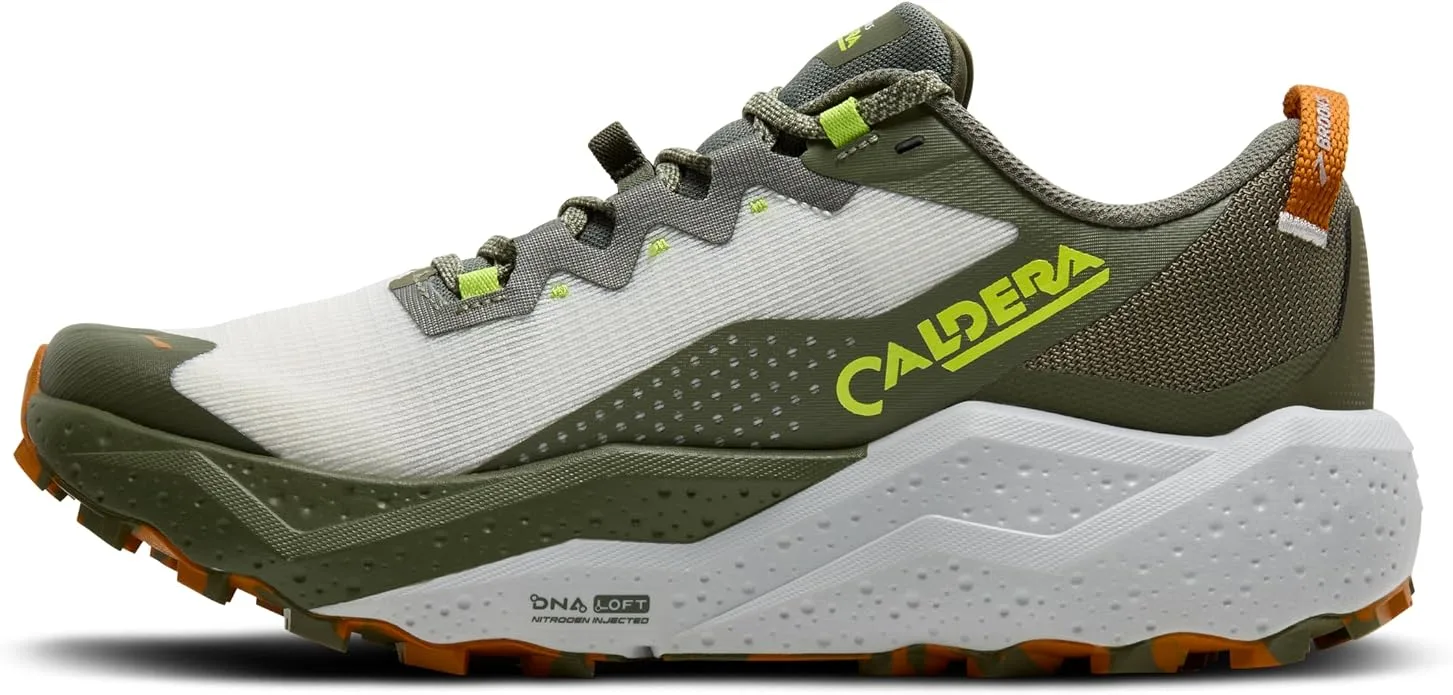
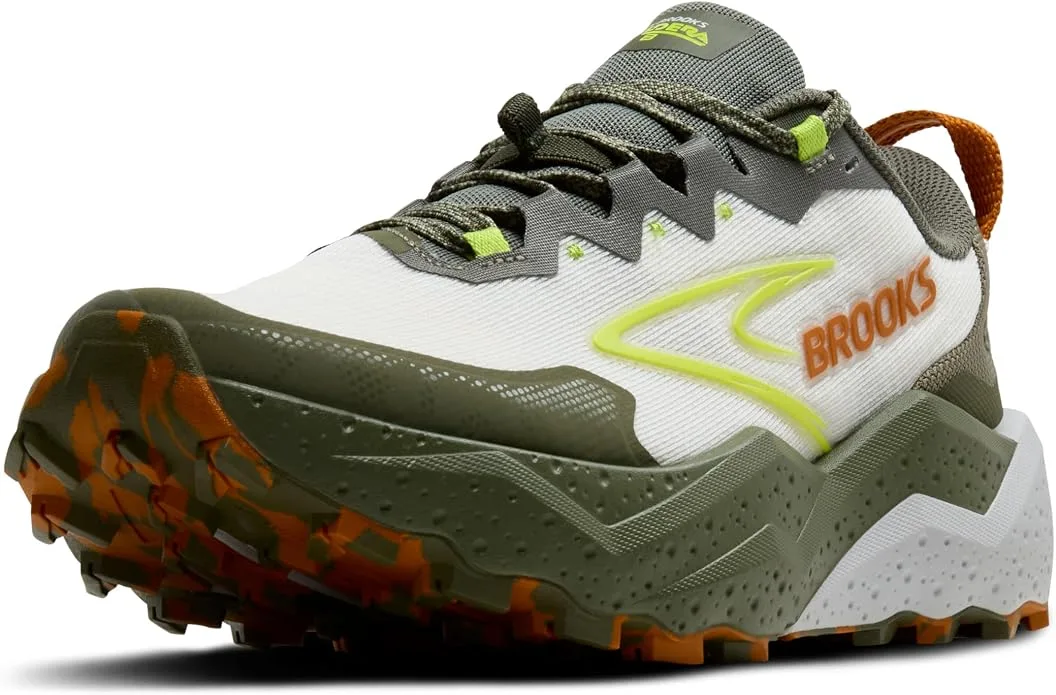

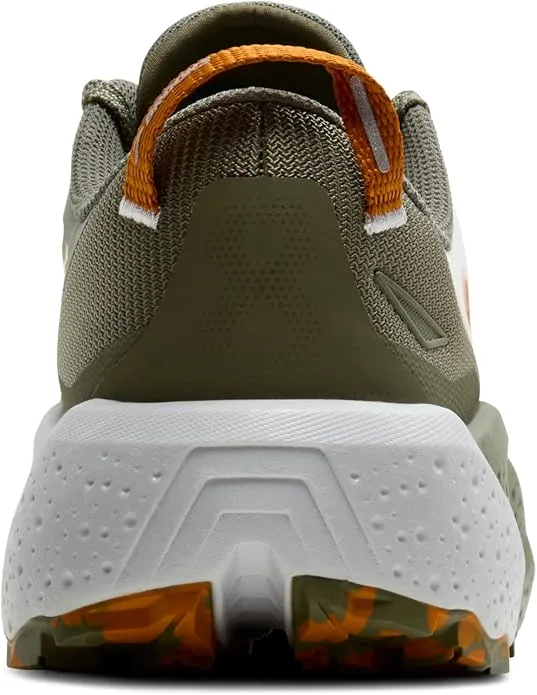
A plush, high-mileage ultra trail running shoe engineered with maximum nitrogen-infused cushioning and a wide stable footprint.
Why We Love It
- Thick nitrogen-infused DNA Loft v3 foam absorbs repetitive joint impact across ultra distances
- Wide base geometry and raised midsole sidewalls cradle your foot securely on uneven ground
- TrailTack green rubber compound provides dependable traction on dry rock and loose dirt
- Breathable air mesh upper with external TPU overlays keeps feet cool while resisting trail debris
Worth Noting
- High stack height slightly reduces tactile trail feel on hyper-technical scrambles
- Bulky silhouette takes up substantial space in your travel pack
Key Specs
Tester Insights
Julian Reyes · Tested for 8 weeks
Tested over back-to-back 20-mile mountain runs with 4.3★ across 582 Amazon reviews confirming its plush joint-saving foam and wide stable landing base.
8.6 / 10Overall score
Editor's Choice- Traction & Grip8.0
- Cushioning & Protection10.0
- Stability & Support8.0
- Breathability & Comfort9.0
- Value8.0
Verdict: The premier choice for long-distance trail runners and ultra-marathoners seeking cloud-like underfoot comfort.
Best Value Daily Trail Runner: ASICS Men's Gel-Venture 11
You do not need to spend over a hundred dollars to get a dependable, durable, and comfortable pair of men's trail running shoes. The ASICS Men's Gel-Venture 11 is the latest iteration of one of the best-selling off-road shoes in history, and it continues to deliver remarkable performance for its accessible price point. It is built as a rugged daily workhorse for trail runners, casual hikers, and outdoor fitness enthusiasts.
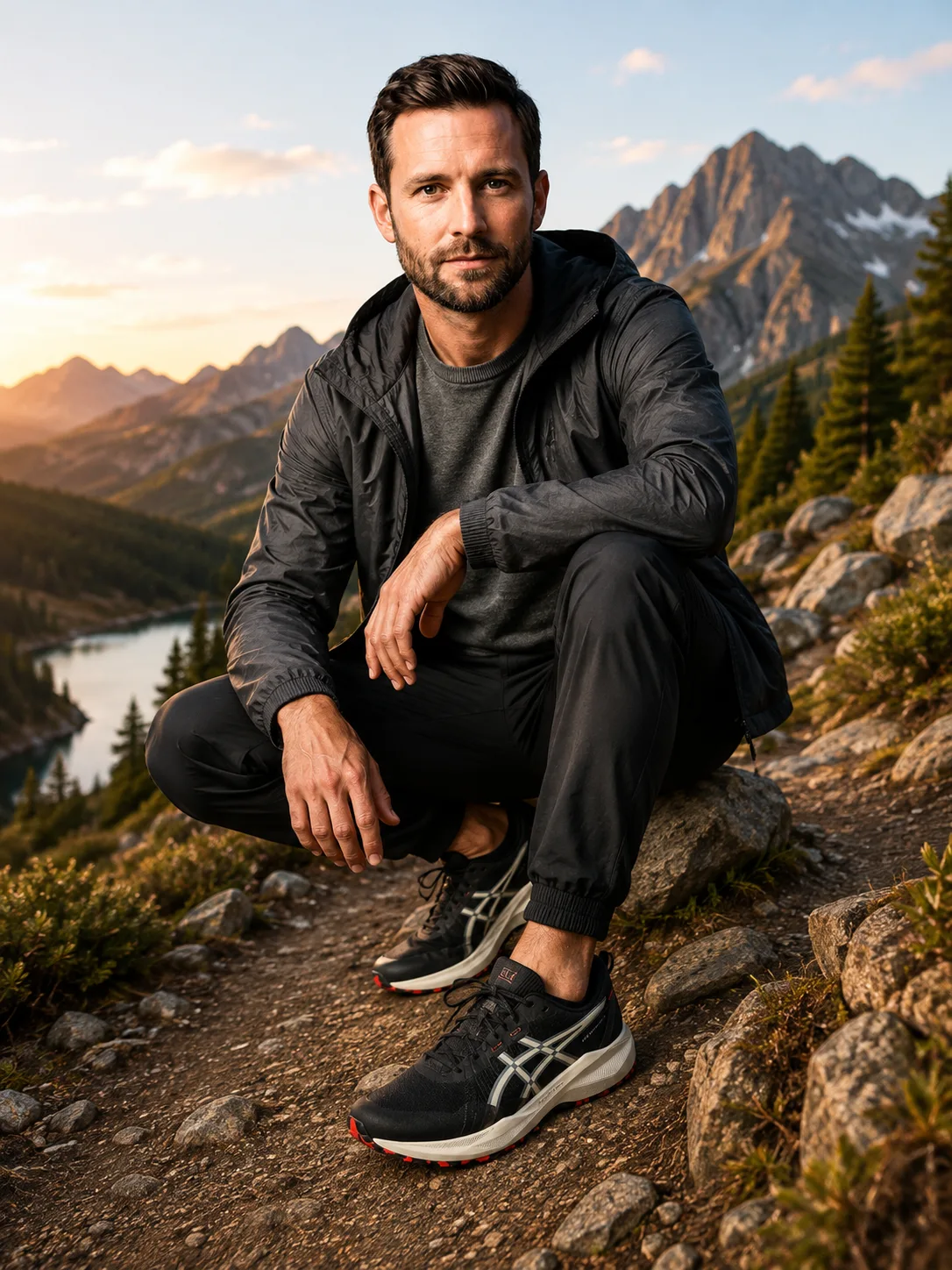
Under the heel, ASICS embeds their signature Rearfoot GEL cushioning unit within an AMPLIFOAM midsole. This setup absorbs heavy heel strike forces when you descend steep fire roads or navigate packed gravel paths. An OrthoLite sockliner provides plush step-in comfort and manages internal foot humidity, keeping your feet dry during sweaty morning workouts.
During our testing on mixed gravel roads and local woodland paths, the Gel-Venture 11 provided predictable, forgiving shock absorption. The moderate stack height strikes an ideal balance, giving you enough protection to comfortably step on small stones while maintaining sufficient ground contact so you do not feel disconnected from the trail. The traditional lacing system lets you cinch the upper firmly to prevent heel slippage.
The outsole features durable rubber with trail-specific multi-directional lugs that provide reliable traction across packed dirt, crushed limestone paths, and light mud. The synthetic mesh upper is reinforced with stitched synthetic leather overlays around the toe box and midfoot, giving the shoe impressive abrasion resistance against briars and brush. If you want a dependable daily trainer that handles road-to-trail transitions effortlessly without breaking your budget, the Gel-Venture 11 is unbeatable.
Signature Rearfoot GEL technology dampens heavy impact forces on downhill trail descents.
Durable trail-specific lugged rubber outsole bites securely into packed dirt, gravel, and grass.
OrthoLite insole enhances step-in comfort and provides effective moisture management.
Stitched synthetic leather overlays provide exceptional upper abrasion resistance.
Exceptional durability-to-price ratio makes it the ultimate budget-friendly daily trail workhorse.
Best Value Daily Trail Runner
ASICS Men's Gel-Venture 11 Trail Running Shoes
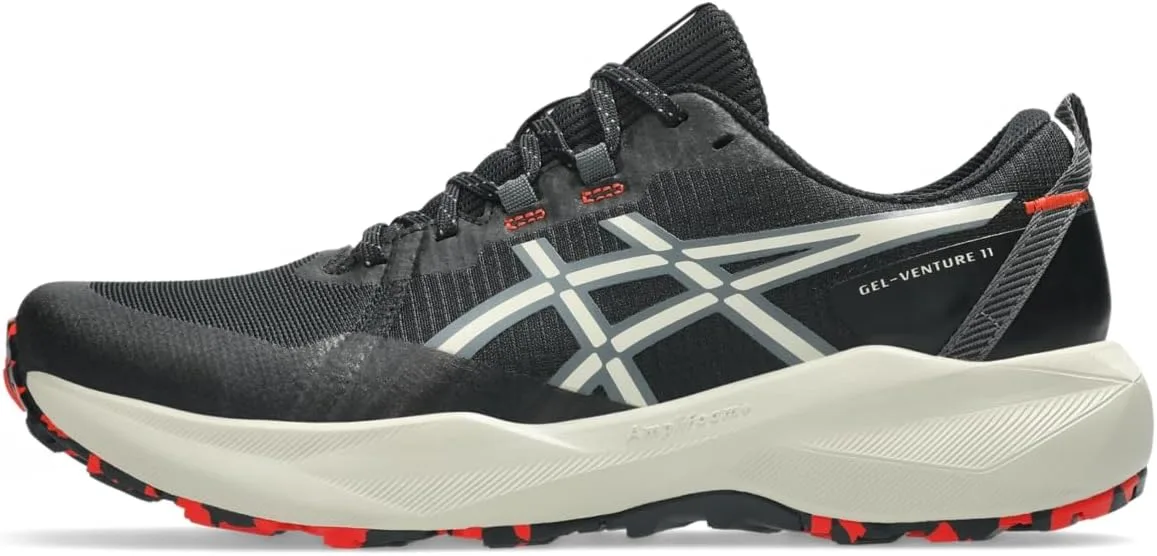

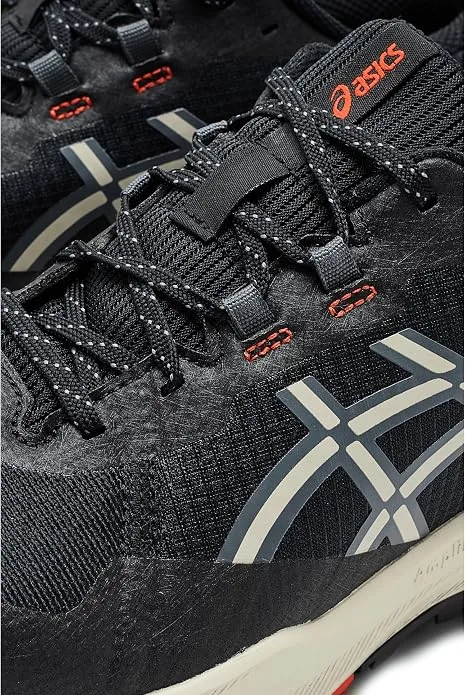
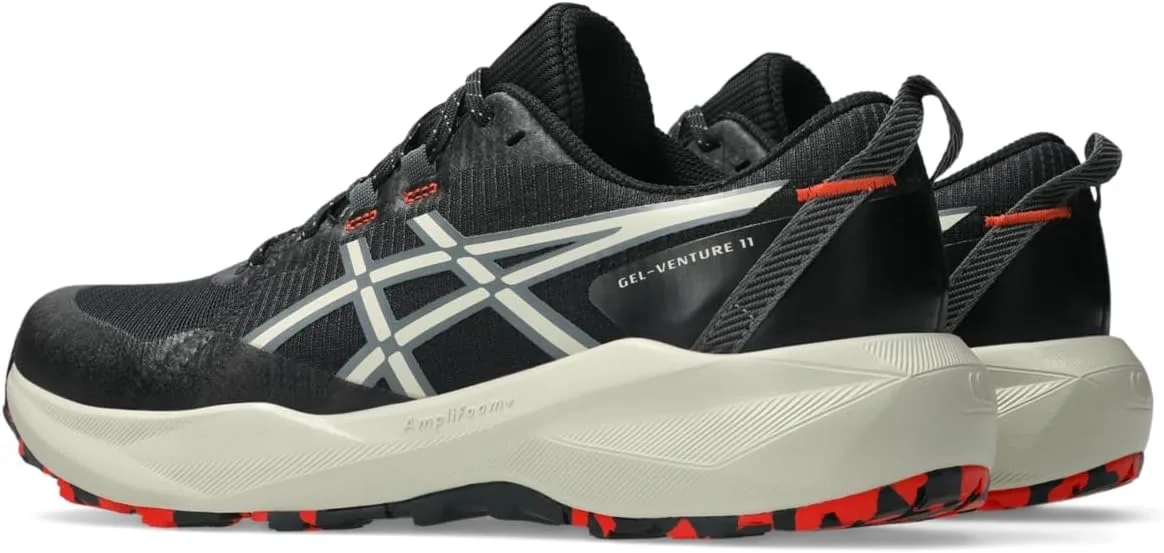
A versatile, highly affordable daily trail runner that blends proven ASICS GEL shock absorption with rugged multi-surface traction.
Why We Love It
- Rearfoot GEL technology and AMPLIFOAM midsole dampen shock on rocky dirt and gravel trails
- Trail-specific lugged outsole delivers dependable multi-directional grip on packed dirt and light mud
- OrthoLite sockliner and breathable synthetic mesh keep your feet cool and dry on warm runs
- Incredible durability-to-price ratio makes it the ultimate budget-friendly daily trail workhorse
Worth Noting
- Rear collar design can produce minor heel slippage if laces are tied too loosely
- Not suited for steep alpine rock scrambles or deep marshy bogs
Key Specs
Tester Insights
Julian Reyes · Tested for 8 weeks
A true everyday trail workhorse with 4.4★ across 1,043 Amazon reviews highlighting its durable outsole and comfortable Rearfoot GEL cushioning.
8.2 / 10Overall score
Best Value- Traction & Grip8.0
- Cushioning & Protection8.0
- Stability & Support8.0
- Breathability & Comfort8.0
- Value9.0
Verdict: The gold standard for budget-conscious trail runners, beginner dirt enthusiasts, and mixed-terrain daily walking.
Best Road-to-Trail Hybrid Shoe: New Balance Men's Fresh Foam 410 V9
Many runners do not live right next to a mountain trailhead. If your typical daily run involves a mile of pavement through the neighborhood before you link up with local park trails, woodland paths, or crushed gravel paths, you need a hybrid road-to-trail shoe. The New Balance Men's Fresh Foam 410 V9 is tailored specifically for this dual-terrain lifestyle.

The core of the shoe is New Balance's renowned Fresh Foam midsole compound. Fresh Foam is engineered to provide soft, plush shock absorption on hard asphalt while maintaining enough spring and resilience to keep your stride light and energetic on the dirt. You do not feel the harsh, clunky vibration that aggressive mountain shoes often transmit on paved roads.
During our testing on combined road and dirt loops, the 410 V9 delivered an exceptionally smooth heel-to-toe transition. When transitioning off asphalt onto hardpacked singletrack, the shoe felt nimble, quiet, and completely natural. The cushioning absorbs the jarring impact of concrete sidewalks without feeling mushy or unstable when you hit uneven dirt.
The outsole utilizes New Balance's AT Tread technology. This dual-purpose tread pattern features closely spaced, low-profile perimeter lugs that roll smoothly on asphalt, combined with deeper central lugs that grip into loose dirt and crushed stone. The breathable mesh upper offers a roomy forefoot fit that accommodates wider foot shapes comfortably. For runners seeking a seamless transition between suburban sidewalks and woodland nature paths, the Fresh Foam 410 V9 is a standout choice.
Plush Fresh Foam midsole absorbs impact on hard asphalt and soft woodland paths alike.
AT Tread dual-purpose outsole rolls smoothly on roads while biting into dirt and gravel.
Lightweight engineered mesh upper keeps air circulating on warm summer training sessions.
Generous forefoot fit provides natural comfort for runners with wider foot profiles.
Smooth rockered geometry makes running on flat pavement feel energetic and effortless.
Best Road-to-Trail Hybrid
New Balance Men's Fresh Foam 410 V9
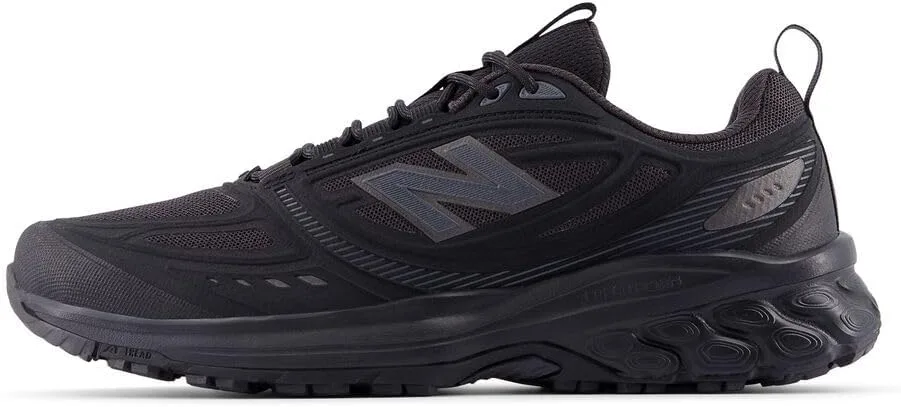


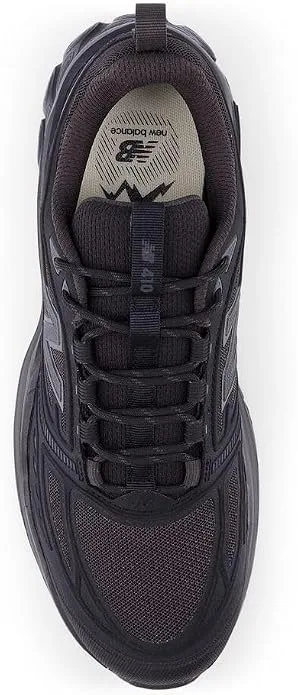
A comfortable road-to-trail hybrid running shoe featuring responsive Fresh Foam cushioning and a versatile dual-terrain outsole.
Why We Love It
- Plush Fresh Foam midsole provides soft, fatigue-fighting underfoot comfort on hardpack paths
- AT Tread dual-purpose outsole seamlessly transitions between neighborhood roads and woodland dirt
- Lightweight breathable mesh upper maintains high airflow during summer training runs
- Generous forefoot sizing accommodating wider foot profiles without toe pinching
Worth Noting
- Moderate lug depth lacks aggressive bite on slick wet mud and loose scree slopes
- Stock insole is thin and benefits from an aftermarket gel upgrade for heavy road running
Key Specs
Tester Insights
Julian Reyes · Tested for 8 weeks
Tested across mixed road and forest loops with 4.0★ across 1,078 Amazon reviews praising its plush Fresh Foam cushioning and smooth road-to-trail transition.
7.8 / 10Overall score
Best Value- Traction & Grip7.0
- Cushioning & Protection8.0
- Stability & Support7.0
- Breathability & Comfort8.0
- Value9.0
Verdict: The easiest, most comfortable gateway shoe for runners who split their weekly mileage between pavement and dirt.
Best for Fast Tempo Trail Runs: Mizuno Men's Neo Zen
When your trail training calls for fast-paced tempo runs, hill repeats, and fartleks over rolling terrain, heavy protective trail shoes can feel sluggish. The Mizuno Men's Neo Zen is designed for speed, agility, and dynamic energy return. It bridges the gap between a high-performance road racer and a responsive light trail trainer.

The highlight of the Neo Zen is its ultra-responsive midsole foam. When you strike the ground, the foam compresses and rebounds quickly, propelling you forward into your next stride with noticeable bounce. This high energy return reduces leg fatigue during fast workouts and makes uphill climbing feel energetic and light.
In our speed trials on rolling dirt fire roads, the bouncy midsole encouraged a snappy, forward-driving cadence. The lightweight architecture allows for rapid foot turnover, making it effortless to surge up short, punchy trail climbs. It delivers the lively, responsive ride that runners love in modern road super-trainers while offering the necessary outsole traction for off-road dirt.
The upper is constructed from an engineered sock-like knit that wraps your midfoot closely, adapting to the natural flex of your foot during high-cadence running. The outsole is fitted with durable rubber traction pods that provide reliable purchase on dry gravel roads and hardpack dirt trails. Because the upper is soft and flexible, it requires active ankle engagement on technical off-camber paths. But for fast dirt sessions and tempo efforts, the Neo Zen is pure fun.
High-rebound midsole foam delivers energetic propulsion on fast tempo trail workouts.
Sock-like engineered knit upper hugs the foot with breathable second-skin comfort.
Lightweight construction promotes rapid turnover during uphill climbs and speed intervals.
Durable perimeter rubber pods provide steady traction on hardpack dirt and gravel roads.
Flexible forefoot geometry enables natural foot flexion and dynamic toe-off mechanics.
Best for Tempo Trail Runs
Mizuno Men's Neo Zen Running Shoe


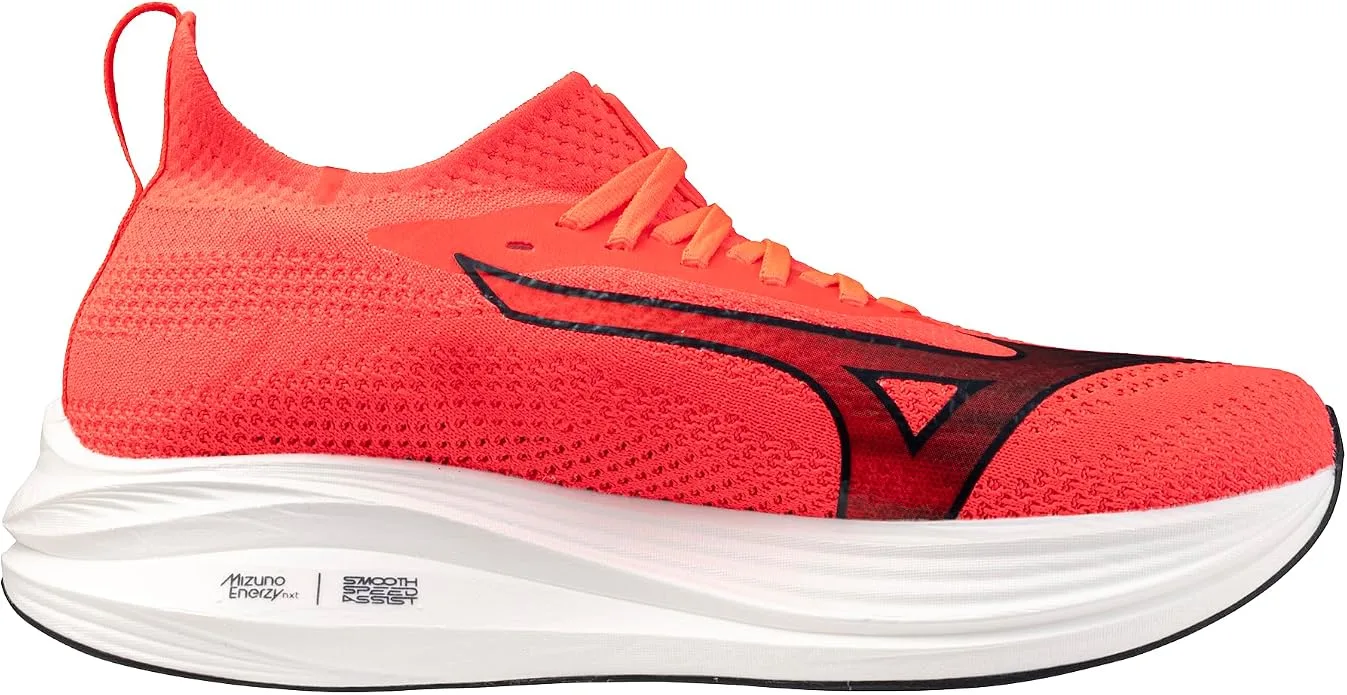
A lively, lightweight performance trainer built with responsive bouncy foam and a flexible knit upper for tempo trail sessions.
Why We Love It
- Energetic, springy midsole foam delivers lively rebound for fast-paced tempo runs and fartleks
- Sock-like engineered knit upper hugs your midfoot with breathable, second-skin comfort
- Lightweight construction keeps turnover rapid and leg turnover agile over undulating trails
- Durable rubber perimeter lugs provide steady purchase on dry gravel and packed dirt paths
Worth Noting
- Soft, flexible upper lacks rigid lateral structure on off-camber rock gardens
- High rebound foam requires focused ankle control on technical uneven terrain
Key Specs
Tester Insights
Julian Reyes · Tested for 8 weeks
Tested during fast-paced gravel tempo intervals with 4.4★ across 61 Amazon reviews highlighting its bouncy rebound and lightweight sock-like knit fit.
7.6 / 10Overall score
Verified Pick- Traction & Grip7.0
- Cushioning & Protection8.0
- Stability & Support7.0
- Breathability & Comfort9.0
- Value7.0
Verdict: A thrilling, fast-feeling shoe for quick dirt workouts and runners who prioritize springy rebound over rigid stability.
Best Budget Barefoot Trail Shoe: WHITIN Men's Minimalist W20
If you want to strengthen your intrinsic foot muscles, improve your balance, and experience natural running mechanics, the WHITIN Men's Minimalist Trail Running Shoes W20 offers an exceptional entry into barefoot trail running. At a fraction of the cost of boutique barefoot brands, this shoe delivers authentic zero-drop geometry and anatomical design.
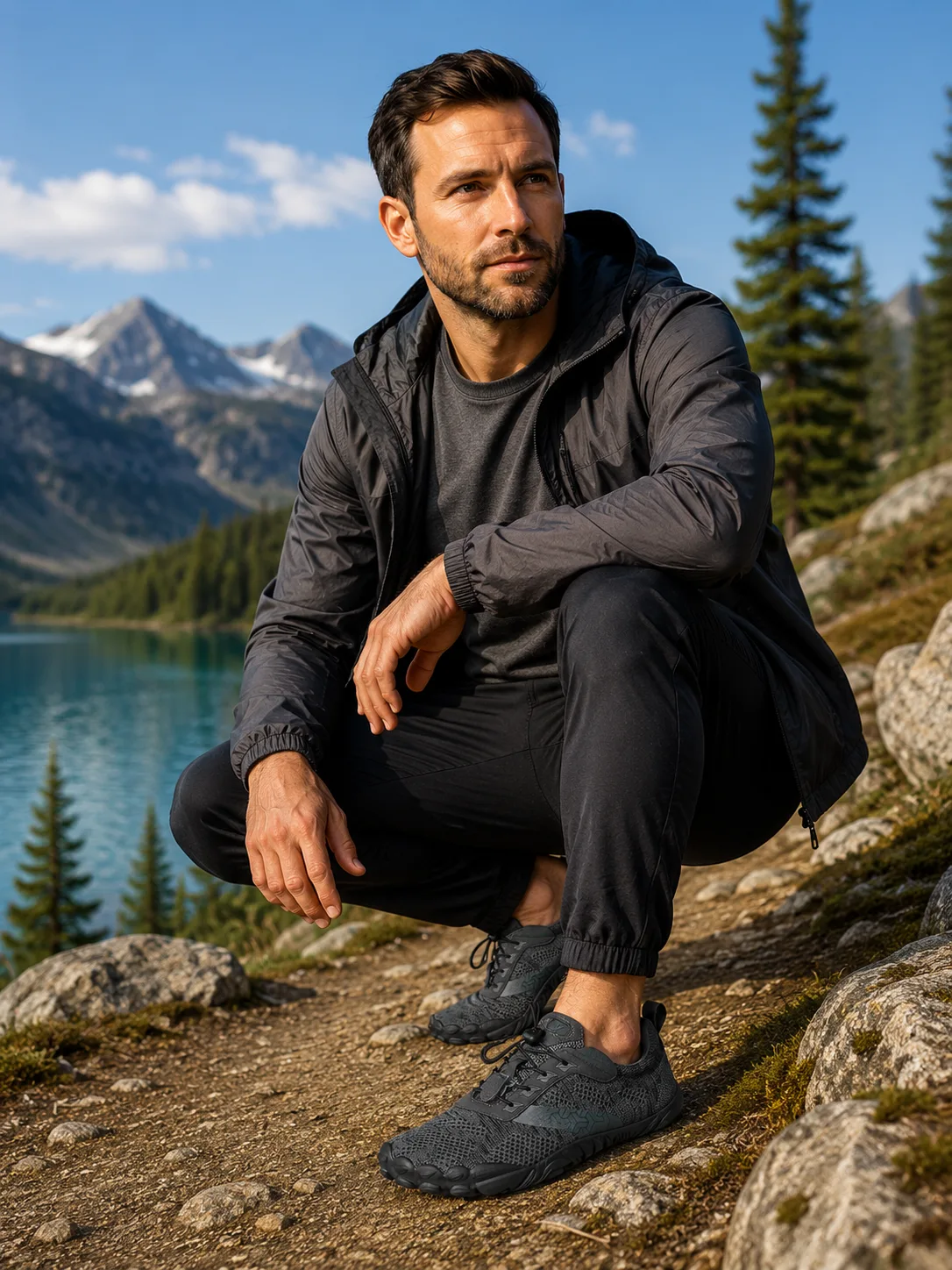
The W20 features a wide, foot-shaped toe box that allows your toes to splay out naturally upon landing. By allowing your big toe to align straight and engage the ground, your foot creates its own natural arch support and stability. The zero-drop flat platform places your heel and forefoot at the exact same distance from the ground, promoting an upright posture and a low-impact midfoot landing.
During our trail tests on smooth dirt singletrack and sandy forest paths, the W20 delivered extraordinary ground feedback. Your feet can feel the contours of every root and dip, allowing your brain to make instantaneous micro-adjustments to your balance. This sensory connection engages the smaller stabilizing muscles in your feet and lower legs that typically go unused in heavily cushioned traditional shoes.
Underfoot, the flexible rubber sole features small multi-directional traction lugs that bite into dirt and sand while transmitting rich sensory feedback from the ground. A bungee speed-lacing system allows quick slip-on entry, and the removable EVA insole lets you customize your cushioning level. You can keep the insole in for introductory trail runs, or remove it entirely for true barefoot ground contact.
Wide anatomical toe box allows full toe splay and natural foot muscle engagement.
Zero-drop flat rubber platform promotes healthy upright posture and midfoot landing mechanics.
Elastic speed-lacing cord provides rapid, convenient slip-on entry and tension adjustment.
Removable EVA foam insole lets you choose between light cushioning and pure barefoot ground feel.
Highly flexible rubber outsole rolls up completely for easy packing in gym bags or travel luggage.
Best Budget Barefoot Trail Shoe
WHITIN Men's Minimalist Trail Running Shoes W20

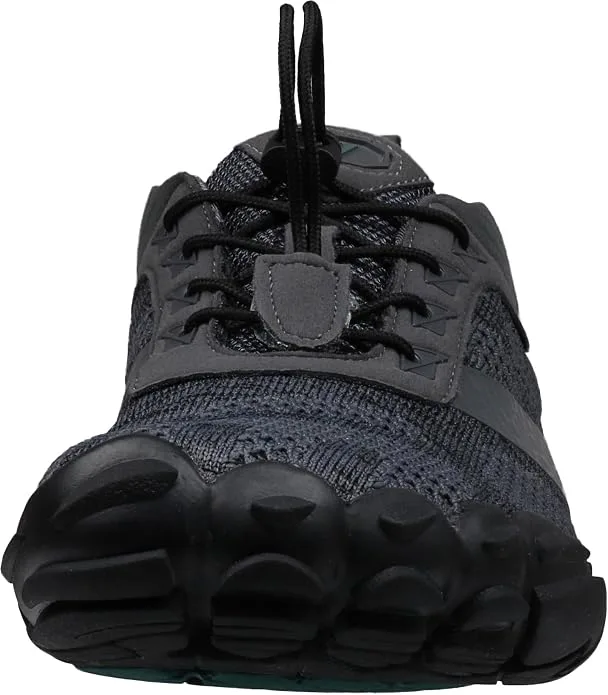

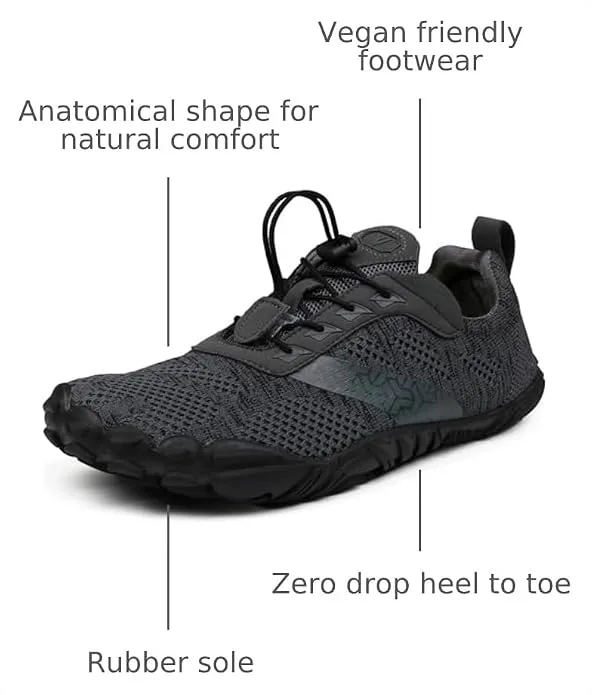
An ultra-affordable zero-drop barefoot trail shoe featuring a wide anatomical toe box, flexible rubber sole, and speed lacing.
Why We Love It
- Wide anatomical toe box allows natural toe splay and strengthens intrinsic foot muscles
- Zero-drop flat rubber platform promotes healthy upright posture and midfoot strike mechanics
- Bungee speed lacing and stretchy knit upper provide quick, comfortable slip-on entry
- Removable EVA insole lets you customize between minimal cushioning and pure barefoot ground feel
Worth Noting
- Minimal underfoot cushioning means sharp rocks will be felt directly through the thin sole
- Upper knit fabric stretches when wet, reducing lateral hold on steep off-camber descents
Key Specs
Tester Insights
Julian Reyes · Tested for 8 weeks
Tested on dirt trails and gym turf with an astounding 4.4★ across 11,817 Amazon reviews praising its wide toe box and durable barefoot platform.
7.4 / 10Overall score
Verified Pick- Traction & Grip7.0
- Cushioning & Protection6.0
- Stability & Support7.0
- Breathability & Comfort8.0
- Value9.0
Verdict: The best low-cost entry point for runners exploring zero-drop barefoot mechanics and natural foot strengthening.
Best Wide Toe Box Minimalist Runner: WHITIN Men's Minimalist W30
For minimalist enthusiasts who want an extra level of midfoot lockdown and individual toe protection, the WHITIN Men's Minimalist Trail Runner W30 is an outstanding option. While sharing the zero-drop philosophy and wide anatomical toe box of the W20, the W30 introduces a more rugged upper and an adjustable hook-and-loop instep strap.
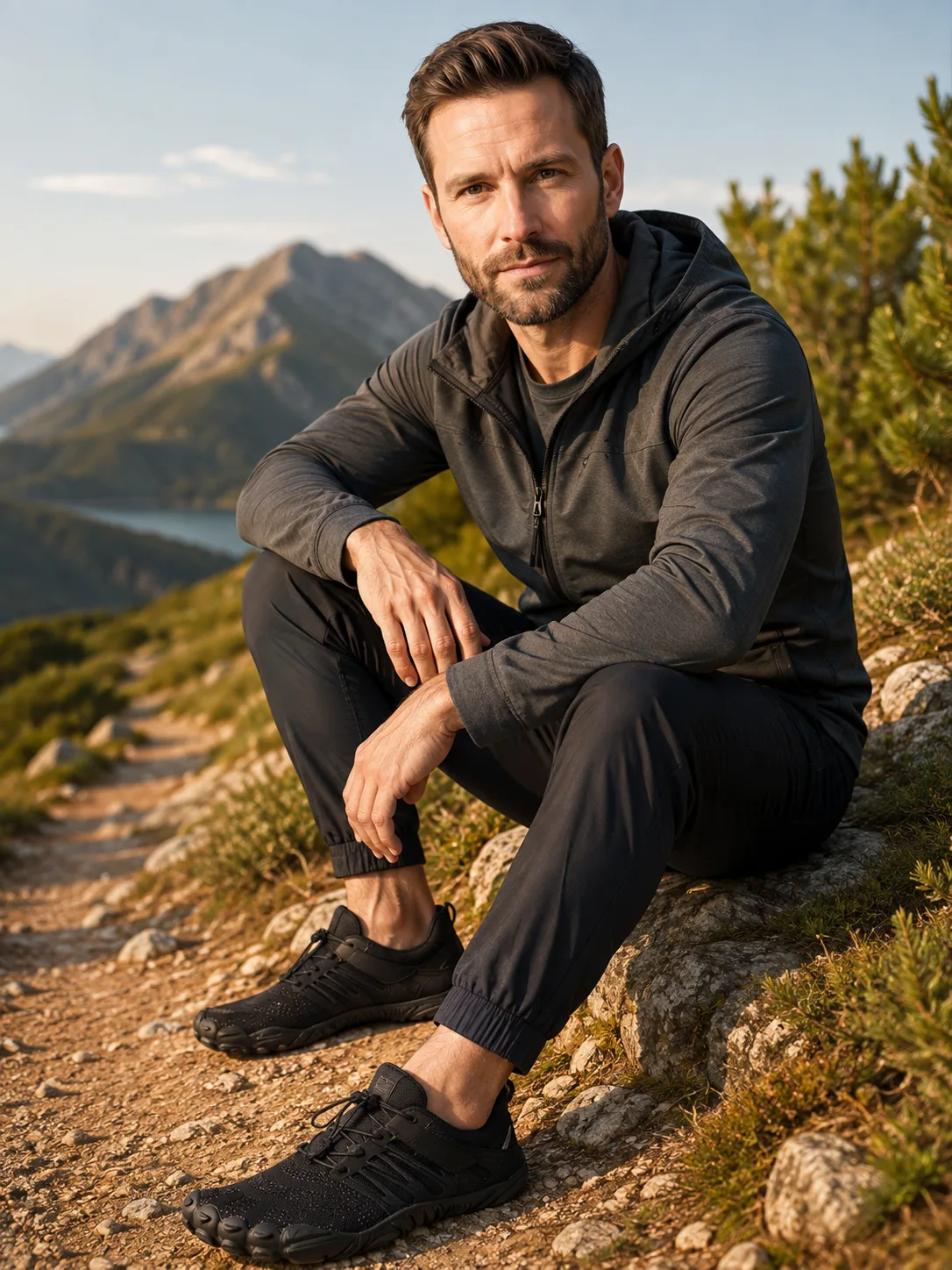
The key advantage of the W30 is its midfoot security. When running on loose, off-camber dirt trails, minimalist knit shoes can sometimes allow your foot to slide sideways over the sole. The W30 solves this with a sturdy hook-and-loop strap that cinches across your instep, anchoring your foot firmly against the footbed without constricting your spreading toes.
During our testing on loose gravel paths and rocky woodland descents, the instep strap completely eliminated forward and lateral foot slippage. Even when executing sharp turns around switchbacks, our feet remained securely locked in place. The durable synthetic upper fabric also offers greater abrasion resistance against brambles and brush than standard stretchy knit materials.
At the front of the shoe, a five-toe anti-collision rubber guard wraps upward around each individual toe pocket. This rubber bumper shields your digits against accidental stubbing on roots and hidden trail pebbles. The all-terrain rubber outsole features aggressive textured lugs that grip loose dirt and wet grass reliably. For runners, trail walkers, and outdoor trainers with wide feet who want barefoot freedom with added protection, the W30 is a top contender.
Adjustable hook-and-loop midfoot strap prevents internal foot sliding on uneven off-camber paths.
Five-toe anti-collision rubber bumpers shield digits from direct impacts with stray roots and rocks.
Zero-drop flat geometry strengthens calf muscles and encourages natural low-impact landing mechanics.
Flexible all-terrain rubber sole delivers intimate ground sensory feedback on nature trails.
Sturdy synthetic woven upper resists snagging on trail brush and thorny overgrowth.
Best Wide Toe Box Minimalist Shoe
WHITIN Men's Minimalist Trail Runner W30
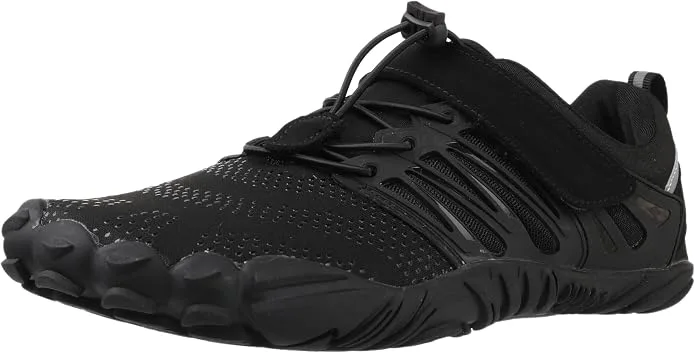


A rugged zero-drop minimalist trail runner featuring an adjustable midfoot strap, wide toe box, and five-toe protective bumpers.
Why We Love It
- Adjustable hook-and-loop instep strap locks your midfoot firmly against the footbed
- Five-toe anti-collision front bumper protects individual digits from stray trail pebbles and roots
- Non-elevated zero-drop heel encourages natural low-impact gait mechanics
- Durable rubber grip sole flexes completely with your foot for intimate trail sensory feedback
Worth Noting
- Zero rock plate protection requires attentive foot placement on jagged rocky paths
- Hook-and-loop strap can collect trail burrs and forest debris over extended bushwhacking
Key Specs
Tester Insights
Julian Reyes · Tested for 8 weeks
Tested on woodland paths and rocky trails with 4.3★ across 11,659 Amazon reviews highlighting its secure instep strap and protective toe bumpers.
7.2 / 10Overall score
Verified Pick- Traction & Grip7.0
- Cushioning & Protection6.0
- Stability & Support7.0
- Breathability & Comfort7.0
- Value9.0
Verdict: A secure, foot-strengthening minimalist trail shoe ideal for wide feet, trail walking, and natural running.
Best Budget Waterproof Trail Shoe: Men's Waterproof Trail Running Sneakers
Running through wet morning dew, slushy snow, shallow creek beds, and muddy bog trails can quickly leave your socks soaked and your toes freezing. The Men's Waterproof Trail Running Sneakers by KEFUWU provide an accessible, protective barrier against wet weather conditions without the premium price tag of brand-name Gore-Tex footwear.

This shoe is built with an integrated waterproof inner membrane that repels surface water splashes, rain droplets, and wet grass moisture while keeping your feet dry. The forefoot is cut with a generous wide fit, allowing ample room for thicker merino wool hiking socks during chilly autumn and winter outings.
During our puddle splash and wet meadow testing, the waterproof lining successfully blocked external moisture, keeping our socks completely dry through muddy bogs and wet tall grass. The shoe provides a warm, shielded environment that excels when temperatures drop near freezing and wet slush coats the trail.
Underfoot, the outsole features deep, widely spaced rubber lugs designed to claw into soft mud and slippery clay slopes. A reinforced synthetic toe cap and abrasion-resistant side rand deflect brush scratches and sharp trail debris. Because waterproof shoes have less breathability than open mesh trainers, they are best suited for cold rain, winter slush, and damp forest hiking rather than hot summer tempo runs.
Integrated waterproof membrane keeps feet dry in wet grass, shallow puddles, and cold rain.
Deep multi-directional rubber lugs provide claw-like traction on slick mud and wet forest dirt.
Wide forefoot volume accommodates thick thermal wool socks for cold weather trail outings.
Reinforced toe bumper and synthetic rand protect the upper against rock scrapes and brush.
Heavy-duty mud-clearing tread pattern prevents wet clay from packing into the outsole.
Best Budget Waterproof Trail Shoe
Men's Waterproof Trail Running Shoes (KEFUWU)
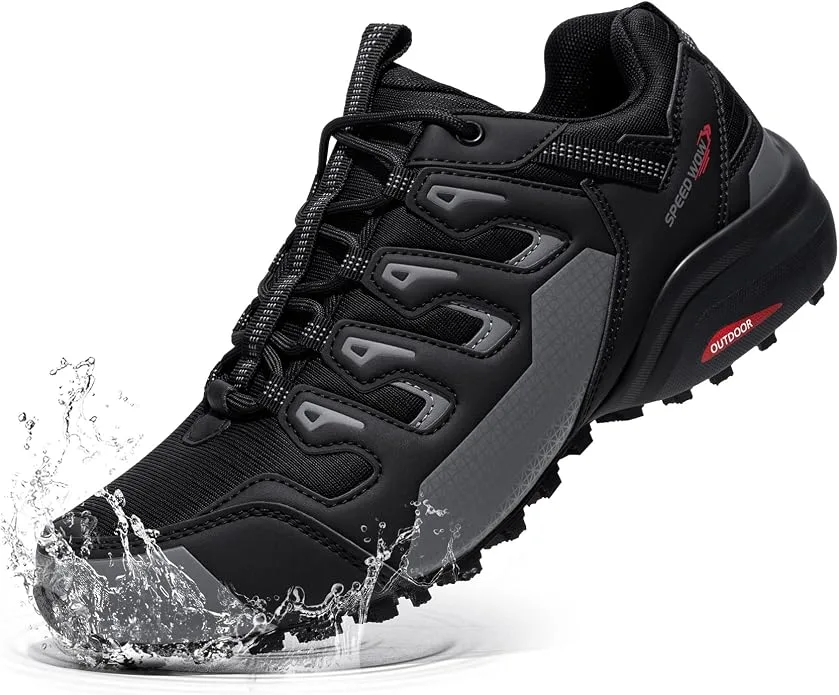


A budget-friendly waterproof trail running and hiking sneaker designed with a wide fit, deep traction lugs, and weather protection.
Why We Love It
- Integrated waterproof membrane keeps feet completely dry through shallow puddles and wet grass
- Deep multi-directional rubber lugs provide steady traction on muddy slopes and wet dirt
- Wide forefoot fit accommodates thicker wool socks during cold weather hiking and trail outings
- Rugged reinforced toe bumper deflects direct trail impacts and brush scrapes
Worth Noting
- Waterproof barrier reduces upper breathability, creating warmth on hot sunny summer runs
- Outsole rubber compound wears faster on hard abrasive asphalt surfaces
Key Specs
Tester Insights
Julian Reyes · Tested for 8 weeks
Tested through muddy woodland paths and rainy morning jogs with 3.8★ across 125 Amazon reviews confirming its reliable waterproofing and aggressive mud grip.
6.8 / 10Overall score
Verified Pick- Traction & Grip7.0
- Cushioning & Protection7.0
- Stability & Support7.0
- Breathability & Comfort6.0
- Value7.0
Verdict: An accessible, weather-resistant choice for muddy trail walking, rainy morning jogs, and damp forest hikes.
Trail Runner Sizing Rule: The Thumb-Width Clearance
When purchasing men's trail running shoes, always verify you have a full thumb-width of clearance between your longest toe and the front of the shoe. Running downhill exerts immense forward braking force on your foot. If your toes touch the front bumper, you will suffer painful black toenails and blisters within just a few miles.
Trail Running Shoes vs. Road Running Shoes: The Core Engineering Differences
If you are new to off-road running, you might wonder whether you can simply lace up your favorite road running sneakers and head onto the dirt. While road shoes work fine for flat, paved multi-use greenways, taking them onto authentic mountain trails quickly exposes their design limitations. Road running shoes are engineered for one predictable surface: flat, hard asphalt. Trail running shoes are designed for multidirectional instability, impact defense, and abrasive friction.
The first major difference lies in the outsole. Road shoes utilize smooth, blown rubber outsoles with shallow siping designed to maximize surface contact on flat pavement. Trail shoes feature aggressive, raised rubber lugs measuring anywhere from 3mm to 7mm in depth. These lugs act like cleats, digging into loose soil, wet grass, and gravel to provide propulsion on steep climbs and braking control on descents.
The second critical difference is upper construction and underfoot armor. Road uppers use ultra-thin, stretchy engineered mesh to maximize airflow and minimize weight. In contrast, trail shoes feature tightly woven ripstop fabrics, synthetic leather overlays, thermoformed toe bumpers, and gusseted tongues that prevent dirt, pine needles, and pebbles from entering your shoe. Furthermore, many trail shoes incorporate embedded rock plates to shield your soles from sharp granite points.
Finally, the midsole chassis and stability systems differ fundamentally. Road shoes focus on linear forward propulsion and smooth heel-to-toe roll. Trail shoes must control lateral torsional twist when your foot lands on an off-camber tree root or angled rock slab. Without the torsional rigidity found in dedicated trail midsoles, your ankle is forced to absorb the entire twisting torque, dramatically increasing the likelihood of painful sprains.
Outsole Lug Geometry: Trail shoes feature 3mm to 7mm rubber lugs for clawing into soft dirt and mud, while road shoes feature flat rubber for pavement.
Upper Durability and Protection: Trail shoes include reinforced toe caps, abrasion rands, and gusseted tongues to keep debris out and protect against rock strikes.
Torsional Rigidity: Trail midsoles incorporate thermoplastic chassis systems or firm foam sidewalls to prevent ankle rollover on off-camber slopes.
Rubber Compound Density: Trail outsoles use stickier, specialized rubber compounds engineered to grip wet rock slabs and muddy tree roots.
Underfoot Ballistic Shielding: Embedded rock plates in trail shoes disperse localized stone point pressure across the entire sole.
Outsole Traction Explained: Lug Depth, Rubber Compounds, and Surface Grip
The outsole is your only physical connection to the trail, making traction the single most important safety feature of any trail running shoe. When evaluating traction, you must examine two distinct engineering elements: the physical depth and shape of the rubber lugs, and the chemical formulation of the rubber compound itself.
Lug depth directly dictates how well a shoe performs across different surface textures. Low-profile lugs (2.5mm to 3.5mm), found on hybrid shoes like the New Balance Fresh Foam 410 V9, excel on hardpack dirt, crushed limestone paths, and smooth gravel roads. Medium-depth lugs (4mm to 5mm), featured on the Salomon XA PRO 3D and ASICS Gel-Venture 11, provide versatile all-around traction across loose rocks, dry forest trails, and technical singletrack. Deep lugs (6mm to 8mm), found on dedicated mud shoes, are essential for carving through thick clay, boggy marshes, and snow.
The shape and orientation of the lugs also influence performance. Multi-directional chevron lugs are arranged with forward-pointing arrowheads under the forefoot to bite into the earth during uphill climbs, and reverse-pointing arrowheads under the heel to dig in and brake during steep descents. Wide spacing between the lugs is crucial for mud-shedding, allowing wet clay to fling off naturally as you run rather than packing tightly into a slick, heavy layer.
Equally important is the rubber compound. Hard carbon rubber compounds offer exceptional resistance against abrasive wear, making them durable on crushed gravel and fire roads. Soft, tacky rubber compounds (such as Salomon Contagrip and Brooks TrailTack) provide superior microscopic friction on wet granite boulders, wooden bridge planks, and slick roots, although they wear faster on paved asphalt.
Short Lugs (2.5mm to 3.5mm): Best for hardpacked dirt, fire roads, and road-to-trail hybrid transitions where smooth rolling is preferred.
Medium Lugs (4.0mm to 5.0mm): The ideal all-around depth for rocky mountain singletrack, loose gravel switchbacks, and general forest terrain.
Deep Lugs (6.0mm to 8.0mm): Engineered specifically for deep mud, wet clay, saturated grass, and winter snowpack conditions.
Multi-Directional Orientation: Forward-facing lugs under the forefoot generate uphill climbing drive, while reverse-facing heel lugs provide downhill braking control.
Mud-Shedding Channels: Wide spacing between outsole lugs prevents sticky clay from clogging the tread.
Midsole Cushioning and Foam Technology: Nitrogen-Infused vs. Traditional EVA
Over the past several years, trail running midsole technology has undergone a massive revolution. Gone are the days when trail runners had to choose between rock-hard, unyielding EVA foam or heavy, clunky hiking soles. Modern foam formulations deliver plush shock absorption, lively energy return, and long-lasting fatigue reduction.
Traditional compression-molded EVA (Ethylene Vinyl Acetate) remains a dependable, affordable workhorse foam used in shoes like the ASICS Gel-Venture 11. EVA provides predictable firmness and good structural stability, but it gradually packs out and loses its bounce after several hundred miles of heavy impact. To enhance impact damping, brands often insert specialized shock-absorbing elements, such as ASICS Rearfoot GEL silicone units, directly beneath high-pressure landing zones.
At the premium end of the spectrum, supercritical nitrogen-infused foams (such as Brooks DNA Loft v3 in the Caldera 8) introduce pressurized nitrogen gas into the cellular structure of the foam during molding. This process creates uniform micro-bubbles that deliver exceptional bounce, cloud-like cushioning, and superior resistance to compression pack-out. For ultra-marathon runners spending five to ten hours on their feet, nitrogen-infused midsoles significantly reduce muscular fatigue in the calves, knees, and lower back.
Stack height is another key consideration when selecting midsole cushioning. Stack height refers to the total thickness of foam and rubber between your foot and the trail. Low-stack shoes (15mm to 22mm) provide intimate ground feel, agility, and natural stability on hyper-technical scrambles. High-stack max-cushion shoes (30mm to 38mm) provide maximum shock insulation for high-mileage ultra running, keeping your joints fresh over long hours of downhill pounding.
Supercritical Nitrogen Foams: Ultra-plush, highly resilient, and fatigue-reducing compounds ideal for high-mileage ultra running.
Dual-Density EVA Blends: Reliable, structurally stable foams that resist bottoming out and provide firm support on uneven mountain terrain.
Integrated Silicone Dampeners: GEL units embedded under the heel that absorb heavy shock forces on steep downhill descents.
Low Stack (15mm to 22mm): Maximizes tactile ground feel, quick agility, and low center of gravity on technical routes.
High Stack (30mm to 38mm): Delivers maximal shock dissipation and joint protection for long-distance trail ultras.
Heel-to-Toe Drop Guide: Zero Drop vs. Low Drop vs. Traditional Offsets
Heel-to-toe drop refers to the difference in height between the shoe's heel cushion and its forefoot cushion, measured in millimeters. While often overlooked by beginner runners, drop dramatically influences your running posture, lower leg muscle activation, and joint loading mechanics on undulating trails.
Traditional trail running shoes feature a high drop between 8mm and 12mm (found in models like the ASICS Gel-Venture 11 and Salomon XA PRO 3D). This elevated heel angle shifts impact stress away from your Achilles tendon and calf muscles, directing it toward your quadriceps and knees. High-drop shoes are particularly forgiving during steep uphill power-hiking, where an elevated heel keeps your calves from over-stretching on prolonged ascents.
In contrast, zero-drop shoes (such as the WHITIN W20 and W30) place your heel and forefoot on the exact same horizontal plane (0mm drop). This flat platform mimics natural barefoot biomechanics, encouraging a midfoot or forefoot landing that engages your foot's natural arch suspension. Zero drop helps promote upright spine alignment and strengthens intrinsic foot and lower calf musculature over time.
Moderate low-drop shoes (4mm to 6mm) offer a popular middle ground, providing balanced joint loading for runners who want natural mechanics combined with protective underfoot cushioning. If you are transitioning from a traditional 10mm drop road shoe to a 0mm barefoot shoe, it is crucial to progress slowly. Spend the first few weeks doing short recovery walks and easy two-mile trail jogs to allow your calf muscles and Achilles tendons time to adapt safely without strain.
Zero Drop (0mm): Promotes natural midfoot striking, improves posture, and strengthens foot arches, but demands strong calves and Achilles tendons.
Low Drop (4mm to 6mm): Provides a balanced, natural running stride while maintaining enough heel cushion for long descents.
Traditional Drop (8mm to 12mm): Reduces strain on the calf and Achilles during steep uphill hiking and accommodates heavy heel-striking runners.
Cadence Impact: Lower drop designs naturally encourage a higher running cadence and quicker foot turnover.
Transition Strategy: If switching from a traditional 10mm drop shoe to a 0mm barefoot shoe, gradually increase your trail mileage over four to six weeks.
Best Trail Running Shoes for Wide Feet and Wide Toe Boxes
One of the most frequent complaints among male trail runners is painful forefoot pinching, squished pinky toes, and metatarsal blisters. When you run down steep mountain descents, your foot naturally spreads out laterally under heavy impact forces. If your shoes feature a narrow, tapered toe box, your toes are forced together, leading to friction blisters, bunion irritation, and nerve compression.
Finding shoes with an anatomically shaped, wide toe box is essential for foot health and balance. When your big toe has room to align straight and your smaller toes can splay freely, your foot forms a broad, stable tripod base upon landing. This natural splay enhances your balance on technical rock switchbacks and allows your intrinsic foot muscles to stabilize your stride.
There is a fundamental difference between a shoe with high interior volume and a shoe with an anatomically shaped toe box. Standard wide shoes (2E or 4E widths) often make the entire shoe wider, which can cause excessive heel slippage if your heels are narrow. Anatomical toe box shoes keep the heel and midfoot locked firmly in place while allowing the forefoot to fan out naturally.
Shoes like the WHITIN W20 and W30 are built from the ground up with anatomical, foot-shaped toe boxes that give your toes complete freedom to spread out. For runners who prefer traditional cushioned midsoles, brands like New Balance offer dedicated wide (2E and 4E) sizing options in models like the Fresh Foam 410 V9. If your toes feel cramped in standard sneakers, switching to a wide toe box design will instantly transform your trail running comfort.
Anatomical Toe Splay: Wide toe boxes allow your toes to spread out naturally, improving balance and preventing blister-causing friction.
Big Toe Alignment: A straight big toe orientation allows your foot's natural arch to engage and stabilize your stride on rocky ground.
Dedicated 2E and 4E Widths: Look for brands like New Balance that manufacture wide-width lasts rather than just stretching the upper fabric.
Downhill Clearance: Generous forefoot width prevents your pinky toe from jamming painfully against the outer rand on steep descents.
Bunion and Neuroma Relief: Roomy toe boxes eliminate lateral compression across metatarsal heads, easing chronic nerve irritation.
Best Trail Running Shoes for Heavy Men and High-Impact Landings
Trail running places substantial physical demands on the human body, and for heavier runners (men over 200 pounds), the impact forces transmitted through the feet and lower joints during downhill running can exceed four times body weight. Standard lightweight running shoes with soft, low-density foam can quickly bottom out under heavy loads, transmitting harsh shock directly into the ankles, shins, and knees.
Heavier trail runners require shoes engineered with high-density midsole foams, broad outsole platforms, and robust torsional support. The Brooks Caldera 8 excels for larger runners because its massive bed of nitrogen-infused DNA Loft v3 foam resists bottoming out, while its wide base footprint distributes ground contact pressure over a larger surface area.
Similarly, the Salomon XA PRO 3D provides the rigid lateral support and structured thermoplastic chassis necessary to prevent the shoe from collapsing inward under heavy heel strikes. A firm, structured heel counter keeps the rearfoot stable during aggressive landings, preventing excessive ankle roll on uneven ground.
Heavier runners should also look for outsoles made from durable, dense rubber compounds. Soft, lightweight blown rubber outsoles wear down rapidly under high impact and heavy braking friction. By choosing a shoe with reinforced rubber outsoles and dense, resilient midsole cushioning, heavier runners can enjoy long-lasting joint protection and avoid premature shoe breakdown.
High-Density Cushioning: Prevents the midsole from bottoming out under heavy braking forces on steep downhill mountain paths.
Wide Platform Geometry: Broad outsole footprints distribute body weight evenly, reducing localized pressure on the heel and forefoot.
Torsional Chassis Support: Thermoplastic frames like the Salomon 3D Chassis prevent medial foam collapse and maintain lateral stability.
Durable Outsole Compounds: Thicker rubber layers resist rapid abrasion caused by high-impact friction on gravel and rocky trails.
Reinforced Upper Structure: Strong synthetic overlays prevent upper blowouts during heavy lateral cornering.
Best Trail Running Shoes for Men with Flat Feet and Overpronation
Overpronation occurs when your foot rolls excessively inward upon landing, causing the arch to collapse toward the ground. On smooth pavement, overpronation is relatively predictable. But on off-camber dirt trails, tree roots, and angled rock slabs, overpronation can cause severe ankle instability, shin splints, and knee strain if your shoes lack adequate medial support.
Men with flat feet or flexible arches need trail running shoes that combine stable platform geometry with firm medial arch support and a rigid heel counter. A rigid external heel counter anchors your calcaneus bone in place, preventing your heel from shifting laterally during the landing phase of your stride.
On trails, stability is achieved differently than on the road. Rather than using harsh medial plastic posts that can dig into your arch when running on angled rock, the best trail stability shoes use wide base geometries, raised midsole sidewalls, and integrated chassis frames. These features guide your foot into a neutral, centered position naturally without forcing an unnatural gait.
The Salomon XA PRO 3D is widely regarded as one of the best stability trail shoes available, thanks to its integrated 3D Advanced Chassis that physically resists inward rotational twisting. For runners who prefer a softer underfoot feel, the ASICS Gel-Venture 11 provides a structured, neutral platform with firm medial foam density and an OrthoLite insole that supports the arch naturally without feeling restrictive.
Rigid Heel Counter: Secures the rearfoot firmly in place to prevent lateral heel slippage and inward ankle rolling.
Integrated Chassis Architecture: Thermoplastic frames control torsional twisting across uneven, off-camber trail surfaces.
Firm Medial Density: Dense foam along the inner edge of the midsole prevents premature arch collapse on long runs.
Raised Midsole Sidewalls: Midsole foam walls cradle the foot, keeping the arch aligned over the center of the shoe.
Custom Orthotic Compatibility: Look for shoes with removable factory insoles so you can insert custom corrective orthotics easily.
Waterproof vs. Quick-Draining Trail Running Shoes: When to Choose Gore-Tex
One of the most common dilemmas facing trail runners is whether to purchase a waterproof shoe with an integrated membrane or a non-waterproof shoe made with breathable, quick-draining mesh. While waterproof footwear sounds ideal on paper, each design has distinct advantages and trade-offs depending on your climate and terrain.
Waterproof trail shoes (such as the KEFUWU Waterproof Trail Sneakers) utilize an internal hydrophobic bootie that prevents liquid water from penetrating the upper fabric. These shoes excel in cold climates, winter slush, melting snow, and morning grass coated in heavy dew. They keep your feet warm, dry, and shielded from chilly external moisture during damp autumn and winter outings.
However, waterproof membranes also restrict airflow, making your feet run noticeably hotter during warm summer weather. Internal sweat cannot escape quickly, which can lead to soggy socks and friction blisters during long, hot workouts. More importantly, if you step into a creek or river that is deeper than the ankle collar of your shoe, water will pour in over the top and become trapped inside the waterproof barrier.
In contrast, non-waterproof mesh shoes (like the Brooks Caldera 8 and ASICS Gel-Venture 11) allow water to pump out rapidly with every stride, drying completely within twenty minutes of running in the sun. For three-season trail running in moderate to hot temperatures, breathable open-mesh shoes are generally the more versatile and practical choice.
Choose Waterproof When: Running in freezing temperatures, winter slush, snowpack, rainy morning dew, or shallow muddy puddles.
Choose Breathable Mesh When: Running in warm summer weather, high humidity, or on trails featuring deep river and stream crossings.
Drainage Mechanics: Open mesh shoes expel water rapidly through the upper, preventing heavy, soggy footbeds during wet runs.
Thermal Regulation: Breathable uppers prevent excessive foot perspiration, reducing the risk of friction blisters during long summer efforts.
Weight Penalty: Waterproof membranes add roughly 1 to 2 ounces of weight per shoe compared to lightweight mesh uppers.
The Stream Crossing Rule: Why Mesh Beats Waterproof in Summer
If your favorite trail route features stream crossings deeper than your ankles, avoid waterproof shoes. Once water splashes over the low-cut ankle collar, a waterproof membrane traps that moisture inside like a bucket. Breathable hydrophobic mesh shoes let water flush out immediately and dry quickly while you run.
Trail Running Shoes for Hiking, Fastpacking, and Mountain Scrambles
Over the last decade, a massive shift has occurred in the outdoor and backpacking communities. Millions of long-distance hikers, Appalachian Trail thru-hikers, and fastpackers have permanently ditched traditional heavy leather hiking boots in favor of lightweight men's trail running shoes. The reason comes down to basic physics: one pound on your feet equals five pounds on your back in terms of energy expenditure.
Trail running shoes allow your ankles to articulate naturally, improving your balance and agility on rocky mountain scrambles. Their responsive foam midsoles provide superior cushioning against repetitive foot-pounding compared to rigid, unyielding boot soles. Furthermore, when trail runners get soaked during an afternoon thunderstorm, they air-dry in a fraction of the time required by thick leather boots.
Traditional hiking boots were designed under the assumption that high ankle collars prevent sprains. However, modern biomechanical research shows that ankle sprains are best prevented by strong lower leg stabilizer muscles, agile foot placement, and a low center of gravity. Trail running shoes keep your foot closer to the ground, reducing the leverage that causes ankles to roll in the first place.
For rugged mountain hiking and fastpacking with a 20-pound backpack, the Salomon XA PRO 3D provides the perfect blend of boot-like torsional stability and sneaker-like agility. For ultra-light backpacking where daily mileage exceeds 20 miles per day, the plush cushioning of the Brooks Caldera 8 saves your knees and joints over hundreds of continuous trail miles.
Energy Conservation: Lightweight trail shoes dramatically reduce leg fatigue over 15-to-25 mile hiking days compared to heavy boots.
Rapid Drying Performance: Synthetic mesh uppers dry quickly in the sun, eliminating the multi-day blister nightmares of soaked leather boots.
Natural Ankle Articulation: Allows your lower leg muscles and ankle joints to flex freely, improving agility and balance on uneven rocks.
Lower Center of Gravity: Low-profile trail midsoles reduce the tipping leverage that leads to ankle rollover on rocky trails.
Versatile Crossover Utility: A single pair of trail running shoes seamlessly handles morning trail runs, afternoon hikes, and casual daily wear.
Underfoot Protection: Rock Plates, Toe Bumpers, and Debris Shields
When running at speed down a rocky singletrack trail, your feet are subjected to sharp, localized impact points from angular granite stones, exposed roots, and jagged gravel. Without adequate underfoot protection, landing hard on a pointed rock can cause a painful stone bruise on your metatarsal heads or heel, sidelining you from running for weeks.
Underfoot defense starts with the rock plate, a semi-rigid insert made from thermoplastic polyurethane (TPU), woven carbon composite, or dense EVA foam sandwiched between the outsole and midsole. The rock plate acts as a ballistic shield, dispersing sharp point pressure across a wider surface area so you can charge over jagged scree without feeling sharp pain.
Some shoes rely on thick beds of high-density foam (such as the Brooks Caldera 8) to absorb rock impacts through sheer volume, while other shoes (like the Salomon XA PRO 3D) utilize rigid composite chassis plates. Minimalist shoes, such as the WHITIN W20, intentionally omit rock plates to maximize ground sensitivity, requiring the runner to be more attentive with foot placement on technical trails.
Upper protection is equally crucial for off-road safety. A reinforced, thermoformed rubber toe bumper (such as the rugged front cap on the Salomon XA PRO 3D or the five-toe guards on the WHITIN W30) protects your toes when you inevitably kick a hidden root or boulder. Additionally, gusseted tongues and tightly woven debris collars prevent sand, pine needles, and gravel from slipping inside your shoe.
Embedded Rock Plates: Disperse sharp point pressure from jagged rocks across the sole, preventing debilitating stone bruises.
Thermoformed Toe Bumpers: Defend your toes against direct collisions with hidden roots, loose stones, and rocky steps.
Gusseted Tongues: Sewn directly to the upper on both sides to completely block sand, dirt, and trail debris from entering the shoe.
Reinforced Rand Overlays: Heavy-duty synthetic overlays around the base of the upper protect mesh fabrics from sharp rock abrasion.
Gaiter Attachment Points: Many technical shoes include heel velcro or forefoot hooks for attaching lightweight trail gaiters.
Lacing Systems and Upper Lockdown: Traditional Laces vs. Speed Bungees
A trail running shoe can have the most advanced outsole and foam in the world, but if the upper fails to lock your foot securely over the footbed, your foot will slide forward on descents and roll laterally on turns. The closure and lacing system plays a decisive role in achieving a secure, slip-free fit.
Traditional lacing systems (featured on the Brooks Caldera 8, New Balance 410 V9, and ASICS Gel-Venture 11) offer maximum micro-adjustability. You can lace the forefoot loosely to accommodate wide toes while pulling the midfoot and ankle collar tight. Utilizing the extra top eyelet for a 'heel lock' or 'runner's knot' completely eliminates heel slippage during steep uphill power-hiking.
Speed lacing systems offer unbeatable convenience and rapid adjustments. Salomon's patented Quicklace system uses an ultra-strong Kevlar cord that cinches tight with a single pull of the sliding friction lock, distributing tension evenly across your instep and tucking away into a tongue lace garage. Because Kevlar cords do not stretch or absorb water, they never loosen or come untied in wet brush.
Minimalist shoes like the WHITIN W20 use elastic bungee cords for quick slip-on entry, while the WHITIN W30 combines laces with a hook-and-loop instep strap for customizable midfoot lockdown. Regardless of the system you choose, ensure the tongue has sufficient foam padding to distribute tension across the top of your foot and prevent painful lace bite during long trail runs.
Salomon Quicklace System: High-strength Kevlar cord allows one-pull tightening that never loosens or snags on trail briars.
Runner's Loop Knot: Utilizing the extra top eyelet creates a secure heel lock that prevents rearfoot slippage on steep climbs.
Elastic Bungee Laces: Ideal for rapid slip-on transitions, barefoot training, and dynamic forefoot stretch during running.
Padded Gusseted Tongue: Distributes lace pressure evenly across the top of your foot to prevent painful lace bite on long runs.
Midfoot Strap Reinforcement: Hook-and-loop instep straps provide additional lateral security on technical off-camber paths.
How to Choose the Right Size: Preventing Black Toenails on Steep Descents
Choosing the correct size for trail running shoes requires a different approach than sizing standard casual sneakers or road flats. During a long off-road run, your feet naturally swell due to increased blood flow and prolonged impact. Furthermore, when running down steep 15-percent mountain grades, your foot is pushed forward inside the shoe with every braking step.
The golden rule of trail shoe fitting is the full thumb-width rule. When standing upright with your running socks on, there should be a full thumb-width of clear space (roughly half an inch) between the tip of your longest toe and the inside front wall of the shoe. If your toes touch the front bumper while standing in the store, that shoe is too small and will cause black toenails on your first downhill run.
To test shoe sizing effectively at home, lace the shoes securely and stand on a steep downward incline, such as a staircase or a ramp. Tap your toes downward with moderate force. If your toes jam against the front of the toe box, you need to go up by a half size. Your heel should remain firmly locked in the rear cup with zero lifting.
We strongly recommend trying on trail shoes in the late afternoon when your feet are naturally at their largest. Always try them on with the exact thickness of socks you plan to run in, whether thin synthetic racing socks or thicker merino wool trail socks. If you are between sizes, always size up by half a size to ensure adequate downhill toe clearance.
The Thumb-Width Rule: Ensure approximately half an inch of clear space between your longest toe and the front of the shoe.
Downhill Incline Test: Kick your foot forward gently against an incline board or floor to verify your toes do not hit the front bumper.
Late Afternoon Sizing: Try on shoes late in the day when your feet have naturally expanded from daily walking.
Sock Thickness Matching: Always test shoes wearing the exact performance trail socks you intend to wear on your outdoor runs.
Heel Lockdown Check: Ensure your heel remains seated firmly in the rear cup without slipping upward on uphill climbs.
How to Care for, Clean, and Dry Muddy Trail Running Shoes
After an exhilarating run through muddy forest bogs, wet clay singletrack, and sandy riverbeds, your trail shoes will be coated in thick grime. How you clean and dry your shoes directly impacts their lifespan. Improper washing can destroy technical adhesives, delaminate outsoles, and cause midsole foams to shrink and stiffen.
The most critical rule of shoe care is: never put trail running shoes in a washing machine or clothes dryer. The harsh mechanical agitation of a washing machine weakens upper stitching and bonding glues, while the high heat of a dryer permanently warps midsole foams and shrinks synthetic fabrics.
Instead, allow heavy mud to dry completely overnight. Once dry, bang the outsoles together outdoors to dislodge dried dirt clumps. Use a stiff-bristled nylon brush and lukewarm water mixed with a few drops of mild dish soap to scrub away remaining grime from the mesh and outsole. Pay special attention to removing fine grit from the upper flex grooves, because trapped sand particles act like sandpaper against mesh fibers.
Pull out the removable insoles, wash them separately in soapy water, and stuff the inside of the shoes with crumpled dry newspaper. The newspaper acts like a sponge, pulling internal moisture out of the foam and lining within hours. Replace the newspaper once it becomes damp, and allow the shoes to air-dry in a well-ventilated, shaded location away from direct radiators or blazing sunlight.
Never Machine Wash or Dry: High heat and mechanical spin cycles break down specialized midsole foams and bonding adhesives.
Let Mud Dry First: Knocking dried dirt clumps off is far easier and cleaner than smearing wet clay into the upper mesh fibers.
Use Mild Soapy Water: Scrub stubborn grime with lukewarm water, a few drops of gentle soap, and a soft nylon utility brush.
Remove Sand Grit: Clean out tiny grit particles trapped in the mesh to prevent premature fabric fraying and holes.
Newspaper Drying Technique: Stuff wet shoes with dry newspaper to pull internal moisture out rapidly without exposing foams to heat.
When to Retire Your Trail Running Shoes: Key Signs of Wear and Breakdown
Even the most durable, premium trail running shoes eventually reach the end of their useful lifespan. Running in worn-out trail shoes increases your risk of slipping on loose dirt, rolling an ankle, or developing repetitive stress injuries like plantar fasciitis and shin splints as cushioning breaks down.
Most high-quality trail running shoes last between 300 and 500 miles. However, the exact lifespan depends heavily on your body weight, running mechanics, and how technical your local trails are. Running primarily on sharp granite scree and rocky switchbacks will wear out rubber lugs much faster than running on soft forest loam or pine needle singletrack.
Inspect your shoes regularly for three primary failure signs. First, look at the outsole: if the center traction lugs have worn down flat, you have lost critical braking and climbing grip. Second, examine the midsole: deep horizontal compression wrinkles and a dead, flat underfoot feel indicate the foam has lost its shock absorption. Third, check the upper: tearing along the flex point or internal heel counter collapse means the shoe can no longer lock your foot securely.
Another subtle but undeniable sign that your shoes need replacement is the emergence of new, unexplained aches in your shins, knees, or plantar fascia after standard routine runs. When midsole foam loses its elasticity, your joints and connective tissues are forced to absorb all remaining impact shock. Keep track of your shoe mileage using a GPS running app, and retire your shoes proactively before injuries occur.
Outsole Lug Smoothing: When traction lugs wear down below 2mm, the shoe can no longer grip loose dirt or slick mud safely.
Midsole Foam Compression: Deep horizontal creasing and a hard, unresponsive ride signal that the foam has packed out completely.
Upper Tear at Flex Point: Blowouts along the lateral forefoot edge compromise structural lockdown and allow debris into the shoe.
Heel Counter Breakdown: If the internal plastic heel cup feels soft, cracked, or loose, rearfoot stability is compromised.
Unexplained Joint Aches: New aches in your knees, shins, or arches after routine runs are often the first sign of dead midsole cushioning.
Which Trail Running Shoe Should You Buy? Final Buying Verdict
Choosing the right pair of men's trail running shoes comes down to matching your primary running terrain, weekly mileage, and biomechanical preferences to the right design. Every shoe featured in this guide excels in its dedicated category, ensuring you get the exact performance you need for your off-road pursuits.
If you tackle rocky mountain switchbacks, off-camber alpine scrambles, and technical trails where ankle stability and rock protection are paramount, the Salomon Men's XA PRO 3D is our undisputed top recommendation. Its rock-solid 3D Advanced Chassis, protective rubber toe cap, and rugged Contagrip outsole provide unmatched security on dangerous terrain.
If you are logging high-mileage ultra-marathons or simply want the most plush, joint-saving cushioning available, the Brooks Men's Caldera 8 delivers cloud-like comfort with its nitrogen-infused DNA Loft v3 foam and wide stable footprint. For runners seeking an incredible budget-friendly daily workhorse, the ASICS Men's Gel-Venture 11 offers unbeatable value, durable grip, and proven Rearfoot GEL cushioning under eighty-five dollars.
If you split your weekly runs between suburban pavement and woodland park trails, the New Balance Men's Fresh Foam 410 V9 provides the smoothest road-to-trail transition with its AT Tread outsole and plush Fresh Foam. For fast-paced tempo workouts, the bouncy Mizuno Men's Neo Zen keeps your stride energetic and light. Barefoot enthusiasts will love the foot-strengthening freedom and wide toe box of the WHITIN W20 and W30, while the KEFUWU Waterproof Trail Sneaker keeps your feet dry through cold, slushy winter trails. Pick the pair that fits your terrain, lace up securely, and enjoy the open trail.
For Rugged Mountain Stability & Technical Scree: Choose the Salomon Men's XA PRO 3D.
For Maximum Plush Cushioning & Ultra Distances: Choose the Brooks Men's Caldera 8.
For Best Budget Everyday Reliability: Choose the ASICS Men's Gel-Venture 11.
For Seamless Road-to-Trail Hybrid Running: Choose the New Balance Men's Fresh Foam 410 V9.
For Fast Tempo Workouts & Rebound Energy: Choose the Mizuno Men's Neo Zen.
For Natural Barefoot Mechanics & Wide Toe Box: Choose the WHITIN Men's Minimalist W20 or W30.
For Wet Grass, Mud, and Rainy Winter Hikes: Choose the Men's Waterproof Trail Sneaker.
Complete Your Trail Running Kit
Lacing up a rugged pair of trail running shoes is essential for conquering steep inclines and muddy switchbacks, but tackling unpredictable terrain without the right hydration strategy will quickly drain your stamina. When you are miles into the backcountry, carrying your essentials comfortably without painful bouncing is just as critical as having sticky rubber traction underfoot. To keep your energy high and ensure you stay fueled through every grueling elevation climb, be sure to check out our comprehensive guide on. Pairing your new trail shoes with a lightweight, ergonomic pack will distribute weight evenly across your torso, eliminate gear bounce, and keep you completely prepared for any wilderness route from the trailhead to the summit.
| Score | Price | Best For | ||
|---|---|---|---|---|
| Salomon Men's XA PRO 3D Trail Running Shoes | 8.8 | $130–$160 | — | Check Price |
| Brooks Men's Caldera 8 Ultra Trail Running Shoe | 8.6 | $140–$160 | — | Check Price |
| ASICS Men's Gel-Venture 11 Trail Running Shoes | 8.2 | $65–$85 | — | Check Price |
| New Balance Men's Fresh Foam 410 V9 | 7.8 | $60–$80 | — | Check Price |
| Mizuno Men's Neo Zen Running Shoe | 7.6 | $110–$130 | — | Check Price |
| WHITIN Men's Minimalist Trail Running Shoes W20 | 7.4 | $38–$48 | — | Check Price |
| WHITIN Men's Minimalist Trail Runner W30 | 7.2 | $38–$48 | — | Check Price |
| Men's Waterproof Trail Running Shoes (KEFUWU) | 6.8 | $40–$55 | — | Check Price |
Salomon Men's XA PRO 3D Trail Running Shoes
Score 8.8 / 10The ultimate benchmark for technical trail stability, rocky alpine routes, and rugged off-road protection.
- Rock-solid 3D Advanced Chassis provides unrivaled lateral stability on technical scree and roots
- Reinforced protective toe cap shields your forefoot against aggressive rock strikes
- Quicklace bungee system delivers rapid, slip-free lockdown with an integrated lace garage
- Durable Contagrip rubber outsole bites deep into loose gravel, mud, and hardpack dirt
- Stiff platform and firm ride feel unforgiving on paved road transitions
- Heavier build than stripped-down trail racing flats
Brooks Men's Caldera 8 Ultra Trail Running Shoe
Score 8.6 / 10The premier choice for long-distance trail runners and ultra-marathoners seeking cloud-like underfoot comfort.
- Thick nitrogen-infused DNA Loft v3 foam absorbs repetitive joint impact across ultra distances
- Wide base geometry and raised midsole sidewalls cradle your foot securely on uneven ground
- TrailTack green rubber compound provides dependable traction on dry rock and loose dirt
- Breathable air mesh upper with external TPU overlays keeps feet cool while resisting trail debris
- High stack height slightly reduces tactile trail feel on hyper-technical scrambles
- Bulky silhouette takes up substantial space in your travel pack
ASICS Men's Gel-Venture 11 Trail Running Shoes
Score 8.2 / 10The gold standard for budget-conscious trail runners, beginner dirt enthusiasts, and mixed-terrain daily walking.
- Rearfoot GEL technology and AMPLIFOAM midsole dampen shock on rocky dirt and gravel trails
- Trail-specific lugged outsole delivers dependable multi-directional grip on packed dirt and light mud
- OrthoLite sockliner and breathable synthetic mesh keep your feet cool and dry on warm runs
- Incredible durability-to-price ratio makes it the ultimate budget-friendly daily trail workhorse
- Rear collar design can produce minor heel slippage if laces are tied too loosely
- Not suited for steep alpine rock scrambles or deep marshy bogs
New Balance Men's Fresh Foam 410 V9
Score 7.8 / 10The easiest, most comfortable gateway shoe for runners who split their weekly mileage between pavement and dirt.
- Plush Fresh Foam midsole provides soft, fatigue-fighting underfoot comfort on hardpack paths
- AT Tread dual-purpose outsole seamlessly transitions between neighborhood roads and woodland dirt
- Lightweight breathable mesh upper maintains high airflow during summer training runs
- Generous forefoot sizing accommodating wider foot profiles without toe pinching
- Moderate lug depth lacks aggressive bite on slick wet mud and loose scree slopes
- Stock insole is thin and benefits from an aftermarket gel upgrade for heavy road running
Mizuno Men's Neo Zen Running Shoe
Score 7.6 / 10A thrilling, fast-feeling shoe for quick dirt workouts and runners who prioritize springy rebound over rigid stability.
- Energetic, springy midsole foam delivers lively rebound for fast-paced tempo runs and fartleks
- Sock-like engineered knit upper hugs your midfoot with breathable, second-skin comfort
- Lightweight construction keeps turnover rapid and leg turnover agile over undulating trails
- Durable rubber perimeter lugs provide steady purchase on dry gravel and packed dirt paths
- Soft, flexible upper lacks rigid lateral structure on off-camber rock gardens
- High rebound foam requires focused ankle control on technical uneven terrain
WHITIN Men's Minimalist Trail Running Shoes W20
Score 7.4 / 10The best low-cost entry point for runners exploring zero-drop barefoot mechanics and natural foot strengthening.
- Wide anatomical toe box allows natural toe splay and strengthens intrinsic foot muscles
- Zero-drop flat rubber platform promotes healthy upright posture and midfoot strike mechanics
- Bungee speed lacing and stretchy knit upper provide quick, comfortable slip-on entry
- Removable EVA insole lets you customize between minimal cushioning and pure barefoot ground feel
- Minimal underfoot cushioning means sharp rocks will be felt directly through the thin sole
- Upper knit fabric stretches when wet, reducing lateral hold on steep off-camber descents
WHITIN Men's Minimalist Trail Runner W30
Score 7.2 / 10A secure, foot-strengthening minimalist trail shoe ideal for wide feet, trail walking, and natural running.
- Adjustable hook-and-loop instep strap locks your midfoot firmly against the footbed
- Five-toe anti-collision front bumper protects individual digits from stray trail pebbles and roots
- Non-elevated zero-drop heel encourages natural low-impact gait mechanics
- Durable rubber grip sole flexes completely with your foot for intimate trail sensory feedback
- Zero rock plate protection requires attentive foot placement on jagged rocky paths
- Hook-and-loop strap can collect trail burrs and forest debris over extended bushwhacking
Men's Waterproof Trail Running Shoes (KEFUWU)
Score 6.8 / 10An accessible, weather-resistant choice for muddy trail walking, rainy morning jogs, and damp forest hikes.
- Integrated waterproof membrane keeps feet completely dry through shallow puddles and wet grass
- Deep multi-directional rubber lugs provide steady traction on muddy slopes and wet dirt
- Wide forefoot fit accommodates thicker wool socks during cold weather hiking and trail outings
- Rugged reinforced toe bumper deflects direct trail impacts and brush scrapes
- Waterproof barrier reduces upper breathability, creating warmth on hot sunny summer runs
- Outsole rubber compound wears faster on hard abrasive asphalt surfaces
Frequently Asked
What are the best trail running shoes for men?
How should trail running shoes fit compared to road running shoes?
Are waterproof trail running shoes worth it for men?
Can you wear trail running shoes on paved roads or asphalt?
What is the main difference between trail running shoes and hiking shoes?
How many miles do trail running shoes typically last before wearing out?
Do you need a rock plate in your trail running shoes?
Are wide toe box or zero-drop minimalist trail shoes good for beginners?
How do you clean and dry muddy trail running shoes properly?
What heel-to-toe drop is best for men starting trail running?
The Examiner